Is Tejashwi Yadav Playing on NDA Turf?
Synopsis
In a strategic political play, Tejashwi Yadav aims to outmaneuver the NDA in Bihar's upcoming elections. With promises of enhanced support for farmers and women, he seeks to reshape the political landscape. Can his proposals effectively challenge the long-standing governance of Nitish Kumar? Explore how these developments could impact Bihar's electorate.
Key Takeaways
Tejashwi Yadav aims to challenge the NDA with new proposals.
Support for farmers includes free electricity and increased payments.
PACS replaces the APMC system, acting as intermediaries.
Women’s empowerment through the 'Mai Bahin Maan Yojana.' Digital challenges persist for farmers in accessing PACS.
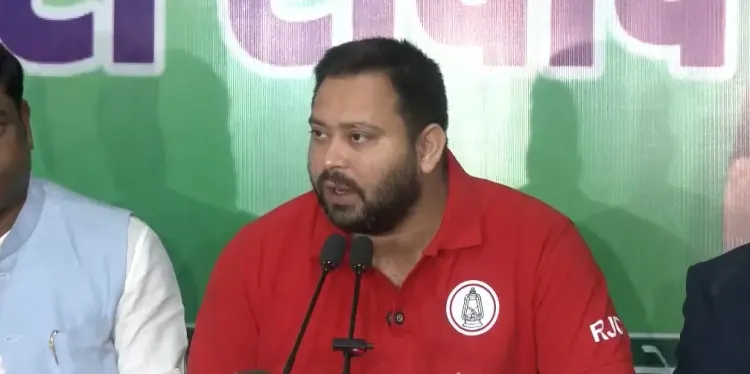
New Delhi, Nov 4 (NationPress) Utilizing his past cricketing expertise, Tejashwi Yadav, the leader of the Rashtriya Janata Dal (RJD), seems to be aiming for political success by maneuvering past two formidable opponents set up by the National Democratic Alliance (NDA) under Nitish Kumar in Bihar.
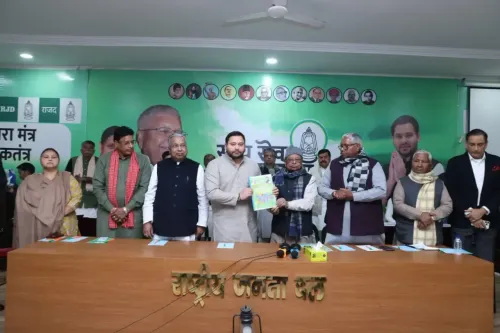
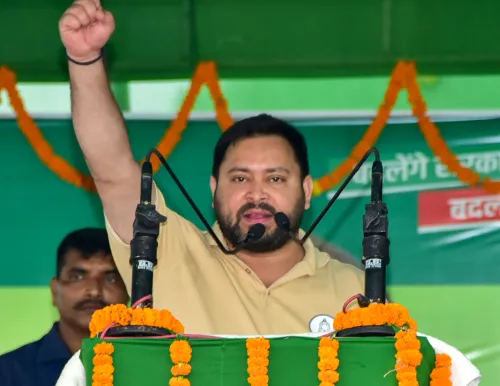
On Tuesday, November 4, the Chief Ministerial candidate for the Opposition Mahagathbandhan announced plans to enhance the benefits of two groups that Nitish Kumar has already initiated during his two decades as the state's leader.
Tejashwi, leveraging his political acumen, might have preferred to navigate through a less fortified defense. However, with the election campaign for the initial phase of the Bihar Assembly elections concluding shortly—set for November 6—the urgency of his proposals is evident. The second phase is slated for November 11, with outcomes to be revealed on November 14.
If victorious, he promises his administration will support Bihar’s farmers with complimentary electricity for irrigation, alongside an additional ₹300 per quintal for paddy and ₹400 per quintal for wheat above the Minimum Support Price (MSP). The MSP is determined annually by the Union government based on recommendations from the Commission for Agricultural Costs and Prices (CACP) for specific crops, typically announced prior to the sowing season to ensure farmers receive fair compensation.
Tejashwi further mentioned that his government would elevate the status of Primary Agricultural Credit Society (PACS) representatives to that of public officials. He also indicated that PACS managers might receive an honorarium. Notably, it was the Nitish Kumar administration that, in 2006, deregulated the agricultural sector, significantly minimizing state oversight of crop procurement.
In many states, crop procurement was conducted through the Agricultural Produce Market Committee (APMC), managed by the state government. Crops would subsequently be sold in mandis (wholesale markets), where farmers sold directly to the Food Corporation of India or the State Farming Corporation at the MSP. Nitish Kumar substituted the APMC system with PACS, which function at the panchayat level. These societies act as intermediaries in procuring food grains and selling them to government entities.
Critics have raised concerns about this system, noting that the digital application process for PACS can be challenging in areas with poor connectivity. Many farmers struggle with computer literacy, leading to various technical hurdles.
Furthermore, there are reports of small and marginal farmers facing challenges accessing PACS, with dishonest individuals buying their produce to resell in mandis in Punjab or Haryana. While Tejashwi did not address these issues directly, he proposed enhancements to the current system.
Utilizing his political experience, he could have deliberated on improving support for farmers lacking digital or physical access to PACS or those cultivating less common crops beyond paddy and wheat, such as oilseeds.
On the women’s empowerment front, Tejashwi has proposed a year-long financial support of ₹30,000 for women under the “Mai Bahin Maan Yojana”. This initiative closely resembles the Mukhyamantri Mahila Rojgar Yojana launched by Prime Minister Narendra Modi on September 26, which provided ₹10,000 to the bank accounts of 75 lakh women who registered by that date.
Commencing with an initial ₹10,000, the scheme can offer up to ₹2 lakh, contingent on the success of the business venture, aiding women in entrepreneurship. Nitish Kumar has historically garnered support from a vast majority of women voters due to his numerous welfare schemes.
Programs like the Mukhyamantri Balika Cycle Yojana, uniform and scholarship initiatives for girls from disadvantaged families, and a 50% reservation for women in local bodies have significantly benefited women and girls.
Nitish Kumar has also initiated women’s helplines and fast-track courts to combat domestic violence and harassment. Additionally, the pension for widows and elderly women has been raised dramatically from ₹400 to ₹1,100 per month.
Another area Tejashwi Yadav may have contemplated, drawing from his tenure as Health Minister, involves the welfare of health workers, particularly nurses, with promises of job placements within 70 km of their home districts.
Point of View
Tejashwi Yadav's latest announcements reflect a significant attempt to re-engage with Bihar's electorate. While his proposals for farmers and women are commendable, they also highlight the ongoing challenges faced by the agricultural sector and digital access for rural populations. As the elections approach, the effectiveness of these pledges will be crucial in determining the political landscape in Bihar.
NationPress
7 Sept 2026
Frequently Asked Questions
What are Tejashwi Yadav's key proposals for farmers?
Tejashwi Yadav has promised free electricity for irrigation and additional payments for paddy and wheat over the Minimum Support Price.
How does the PACS system work?
PACS operate at the panchayat level, serving as intermediaries in the procurement of food grains, replacing the former APMC system.
What support is Tejashwi offering to women?
Tejashwi proposed a year-long financial assistance of ₹30,000 under the 'Mai Bahin Maan Yojana' to empower women.
What challenges do farmers face with PACS?
Farmers often struggle with digital access and computer literacy, which hampers their ability to utilize the PACS system effectively.
What is the significance of the upcoming Bihar elections?
The elections are crucial as they will determine the future governance of Bihar, especially regarding agricultural policies and women’s welfare.