Did the Ministry of Textiles Sign MoUs with 15 States to Enhance Evidence-Based Policymaking?
Synopsis
The Ministry of Textiles has taken a major step by signing MoUs with 15 states during the National Textiles Ministers’ Conference in Guwahati. This initiative aims to enhance evidence-based policymaking in the textile sector and improve data systems across India.
Key Takeaways
MoUs signed with 15 states to enhance evidence-based policymaking.
Annual grant of Rs 12 lakh per state under Tex-RAMPS.
Focus on key sectors like handlooms and technical textiles .
Additional Rs 1 lakh grant for each district based on action plans.
Emphasis on developing the northeastern region .
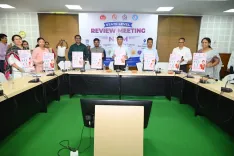
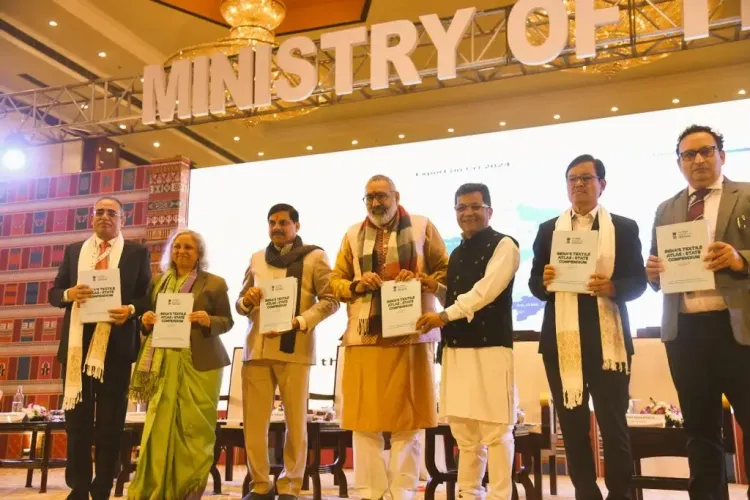
New Delhi, Jan 8 (NationPress) On Thursday, the Ministry of Textiles announced that it has entered into Memorandums of Understanding (MoUs) with 15 states during the opening session of the 'National Textiles Ministers’ Conference' held in Guwahati. This marks a significant advancement towards evidence-based policymaking.
The MoUs are integral to the “Textiles focused Research, Assessment, Monitoring, Planning and Start-Up (Tex-RAMPS)” initiative, aimed at enhancing the coverage, quality, timeliness, and reliability of textile-related statistical products and research.
This agreement establishes a solid operational framework intended to fortify textile data systems across different states and union territories.
As part of the Tex-RAMPS initiative, this program promotes integrated planning for essential sectors—such as handlooms, handicrafts, apparel, and technical textiles—by concentrating efforts at the cluster and district levels.
To facilitate these structural transformations, the Ministry will provide financial support through an annual grant of Rs 12 lakh to each state/UT.
Moreover, acknowledging that the industry's core strength lies within its regional clusters, the initiative reaches out to the grassroots level.
This encompasses an additional grant of Rs 1 lakh per year for each district, distributed based on the formulation and execution of distinct district action plans.
“These MoUs reflect the essence of cooperative federalism. By enhancing the Textiles Statistical System, the government strives to close existing data gaps and ensure that the pathway toward a $350 billion industry is supported by strong, real-time insights,” it stated.
During the inaugural session, Union Minister for Textiles, Giriraj Singh, remarked that the government is diligently working to align production, exports, and sustainability within the textile sector.
He expressed that the conference aims to foster brainstorming, innovation, and the exchange of ideas to formulate a robust roadmap for strengthening India's textile industry.
The minister urged textile ministers from various states and UTs to develop investor-friendly policies while emphasizing the necessity of attracting more investments in the textile sector at the state level.
He expressed optimism that the two-day discussions at the conference would help chart a way forward.
Regarding the northeastern region, Singh highlighted that the Prime Minister has prioritized the growth and development of these areas, and the government is working relentlessly to enhance basic infrastructure and accelerate overall development in the northeast.
Minister of State for Textiles, Pabitra Margherita, expressed pride that the National Textiles Ministers’ Conference is being held in Guwahati, uniting the Centre and the States to collaboratively build a roadmap for the textile sector.
He added that through dialogue and coordination among representatives from the Centre and state governments, the conference will empower the Indian textile industry to broaden its global presence.
Point of View
The signing of MoUs by the Ministry of Textiles with 15 states is a commendable step towards enhancing evidence-based policymaking. This initiative not only strengthens the textile data systems but also promotes the growth of the industry at the grassroots level. It reflects a commitment to cooperative federalism, which is essential for bridging data gaps and driving sustainable economic growth.
NationPress
1 Oct 2026
Frequently Asked Questions
What is the purpose of the MoUs signed by the Ministry of Textiles?
The MoUs aim to enhance evidence-based policymaking and improve textile data systems across various states and union territories.
How much financial assistance is provided to each state under the Tex-RAMPS scheme?
Each state/UT will receive an annual grant of Rs 12 lakh to support the Tex-RAMPS initiative.
What sectors are covered under the Tex-RAMPS scheme?
The scheme focuses on key sectors including handlooms, handicrafts, apparel, and technical textiles.
What does the additional grant for districts depend on?
The additional grant of Rs 1 lakh per year for each district will be based on the development and execution of specific district action plans.
Why is the northeastern region emphasized in this initiative?
The northeastern region is prioritized for its growth and development, with efforts to strengthen infrastructure and enhance overall development.