Anurag Thakur inaugurates Kamdhenu Godham floor on Gopashtami
Synopsis
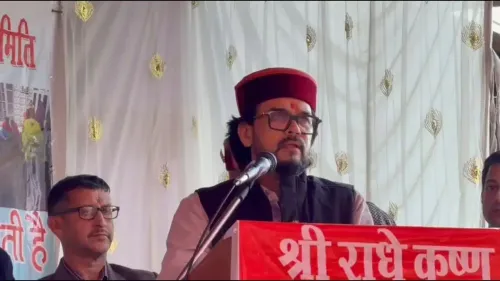
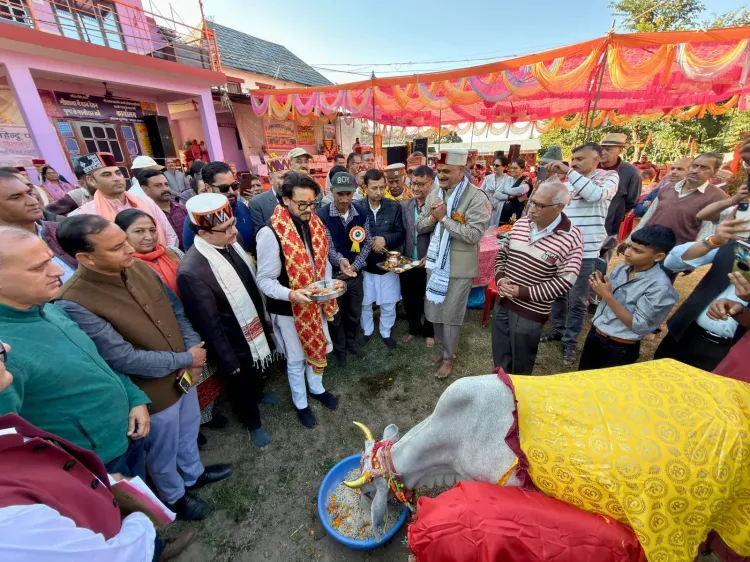
BJP MP Anurag Thakur inaugurated the first floor of Shri Radhe Krishna Kamdhenu Godham in Ghumarwin, Himachal Pradesh, on Gopashtami, praising VHP's goshala work and calling on every citizen to actively participate in cow conservation alongside government efforts.
Key Takeaways
BJP MP Anurag Thakur attended the 9th annual celebration of Shri Radhe Krishna Kamdhenu Godham in Karayalag, Ghumarwin on 17 November 2026 .
He inaugurated the first floor of the goshala, marking a physical expansion of the shelter's capacity.
Thakur praised Vishwa Hindu Parishad's work in gau-seva and urged every member of society to define their role in cow conservation.
Gopashtami , observed in the Kartik month, is the traditional occasion for cattle veneration and goshala events across north India.
Article 48 of the Constitution and the Rashtriya Gokul Mission (2014) provide the constitutional and policy framework for such cow-protection initiatives.
Ghumarwin falls in Bilaspur district, Himachal Pradesh , within Thakur's Hamirpur Lok Sabha constituency .
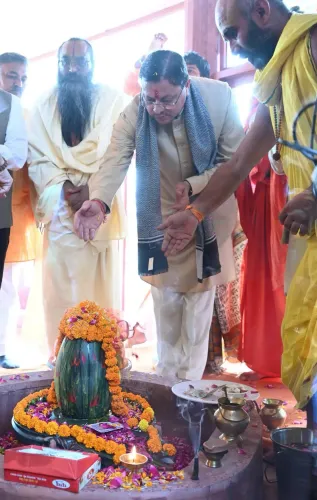
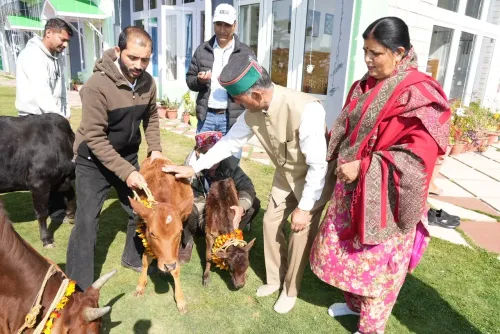
On the auspicious occasion of Gopashtami, BJP MP Anurag Thakur travelled to Ghumarwin in his Hamirpur constituency on Tuesday, 17 November 2026, to inaugurate the first floor of Shri Radhe Krishna Kamdhenu Godham in Karayalag — marking the shelter's 9th annual celebration and issuing a direct call for wider public participation in cow protection.
What Thakur said at Ghumarwin
Posting in Hindi, Thakur declared: 'Gau seva se badhkar koi seva nahin hai aur is se badhkar koi dharm nahin hai' — 'There is no service greater than cow service, and no religion greater than it.' He framed cow protection not merely as a religious duty but as a matter of livelihood and civilisational identity, rooted in what he called the values of Indian culture since ancient times.
Crucially, Thakur moved beyond ritual sentiment. He argued that in present-day conditions, 'every individual in society, alongside the government, must define their own role' in gau-sanrakshan and gau-samvardhan — conservation and promotion of cattle. It was a call to action aimed at community ownership, not state dependence alone.
VHP's goshala network and the Karayalag milestone
At the event, Thakur highlighted the work of Vishwa Hindu Parishad (VHP) in the gau-seva space, calling it sarahniya — praiseworthy. VHP, founded in 1964, has maintained a network of goshalas across India for decades as part of its documented social service activities. The Shri Radhe Krishna Kamdhenu Godham in Karayalag represents a local instance of that wider infrastructure, and the inauguration of its first floor at the 9th annual festival marks a tangible expansion of the shelter's capacity.
Ghumarwin is a town in Bilaspur district, Himachal Pradesh, within Thakur's Lok Sabha constituency — making this both a religious and a constituency-outreach event.
Gopashtami, Article 48, and the Rashtriya Gokul Mission
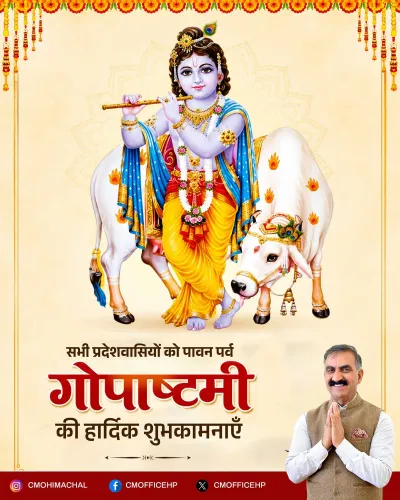
Gopashtami, observed in the Kartik month of the Hindu calendar, is traditionally linked to Krishna and the veneration of cattle. It has long served as the focal occasion for goshala inaugurations and gau-seva pledges across north India.
The constitutional footing for cow protection is Article 48 of the Indian Constitution (1950), which directs the State to prohibit the slaughter of cows, calves, and milch cattle. On the policy side, the central government launched the Rashtriya Gokul Mission in 2014 to conserve and develop indigenous bovine breeds through goshala support and breeding programmes — the precise kind of infrastructure events like today's seek to amplify at the grassroots level.
Himachal Pradesh itself has a history of state-level cattle protection measures and local goshala initiatives, giving Thakur's Ghumarwin appearance a layered resonance — national policy meeting local practice on a symbolically charged day.
The arc from Article 48 to Rashtriya Gokul Mission to a first-floor inauguration in Karayalag is, in a sense, the whole story: a constitutional aspiration, a central scheme, and a community-built shelter — with a sitting MP asking citizens to close the gap between all three.
Point of View
The event bridges organisational Hindu nationalism with constitutional directive, normalising cow protection as a shared civic responsibility rather than a purely state function. For Thakur specifically, participating in a 9th-year celebration in his own constituency signals sustained engagement rather than a one-off gesture. The call for 'every individual in society' to act also subtly deflects from questions about the adequacy of government provisioning for stray and rescued cattle — a persistent challenge in Himachal Pradesh and beyond.
NationPress
17 Nov 2026
Frequently Asked Questions
What is Gopashtami and why is it significant?
Gopashtami is an annual Hindu festival observed in the Kartik month, traditionally associated with Lord Krishna and the veneration of cows. It is widely observed as an occasion for goshala inaugurations, gau-seva pledges, and community cattle-care events across north India.
What is Shri Radhe Krishna Kamdhenu Godham in Karayalag?
It is a goshala — a cattle shelter — located in Karayalag in the Ghumarwin area of Bilaspur district, Himachal Pradesh. BJP MP Anurag Thakur inaugurated its first floor during the shelter's 9th annual celebration on 17 November 2026.
What is the Rashtriya Gokul Mission?
The Rashtriya Gokul Mission was launched by the central government in 2014 to conserve and develop indigenous bovine breeds in India, primarily by supporting goshalas and improving cattle breeding programmes.
What role does VHP play in cow protection in India?
Vishwa Hindu Parishad (VHP), founded in 1964, runs a documented network of goshalas across India as part of its social service activities, making it one of the largest non-governmental actors in the gau-seva space.
What does the Indian Constitution say about cow protection?
Article 48 of the Indian Constitution (1950) directs the State to take steps to prohibit the slaughter of cows, calves, and other milch and draught cattle, providing the constitutional basis for cow protection laws and schemes.