Tharoor reflects on who writes Indian history
Synopsis
Congress MP Dr. Shashi Tharoor has written an essay in Open The Magazine asking who writes Indian history and what stories they tell — extending his long-running public argument for a pluralist, anti-colonial reading of India's past against efforts to impose a singular national narrative.
Key Takeaways
Shashi Tharoor published an essay in Open The Magazine on 22 May 2026 on the politics of historical narration in India.
The essay asks who writes Indian history and which stories they choose to tell — a question with direct implications for school curricula and public memory.
Tharoor's engagement with this debate dates to at least his 2015 Oxford Union speech and his 2016 book An Era of Darkness .
The debate has recurring policy consequences, particularly around NCERT textbook revisions and the framing of history syllabi.
Stakeholders include academic historians, students, and political parties with competing visions of India's national identity.
Further parliamentary or public interventions by Tharoor on curriculum content are anticipated as the next academic review cycle approaches.
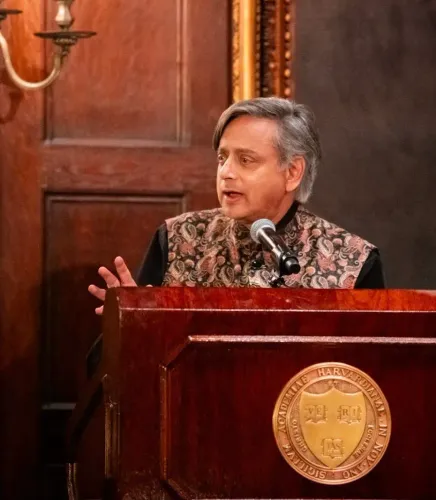
Congress MP Dr. Shashi Tharoor on Friday, 22 May 2026, shared a reflective essay in the Indian weekly Open The Magazine, turning his attention to the politics of historical narration — specifically, who controls the telling of India's past and which stories get elevated or erased.
In the post, Tharoor wrote: 'In Open The Magazine, I reflect on our history: who writes it, what stories they tell.' The brevity of the message belies the depth of the debate it enters — one that has animated Indian intellectual and political life for decades.
Context
The question of who narrates Indian history is neither new nor settled. Dr. Tharoor has long been a prominent voice in this debate, most visibly through his 2015 Oxford Union speech on colonial reparations and his 2016 book An Era of Darkness, which argued that British colonialism systematically impoverished and distorted India's self-understanding. Those interventions established him as a defender of a pluralist, anti-colonial reading of the subcontinent's past.
His latest essay, published in Open The Magazine — an Indian English-language weekly known for long-form writing on politics and culture — continues that project, probing the mechanisms by which historical memory is constructed and contested.
Policy Backdrop
The timing of such a reflection is significant. India's school curriculum, overseen by the National Council of Educational Research and Training (NCERT), has periodically been the site of fierce argument over which historical episodes are foregrounded, which are downplayed, and whose interpretive framework governs the classroom. Successive governments and political movements have sought to shape public memory through textbook revisions and commemorative choices.
Tharoor's interventions have consistently pushed back against efforts to privilege a singular cultural-nationalist account, advocating instead for a reading of Indian history that accommodates its layered, plural inheritances. The essay in Open The Magazine appears to extend that argument into the broader question of historiographical authority — not just what is taught, but who is empowered to teach it.
Stakeholders and Impact
The debate over historical narration directly affects academic historians, whose professional authority is implicitly at stake whenever political actors seek to reframe the past. It also shapes the intellectual formation of school and university students across India, who encounter these contested narratives during their most formative years.
For the Indian National Congress, Tharoor's consistent engagement with questions of history and identity serves a dual purpose: it reinforces the party's claim to a secular, inclusive national vision, and it positions its most internationally visible intellectual voice at the centre of a culture-war debate that shows no sign of abating.
What's Next
Observers of Indian educational policy will watch whether Tharoor follows this essay with parliamentary questions or public statements on proposed changes to NCERT history syllabi ahead of the next academic session. His track record suggests the essay is unlikely to be a standalone intervention; it more often marks the opening of a sustained public argument. The broader contest over India's historical self-image — fought in classrooms, legislatures, and the opinion pages of weekly magazines — will continue to intensify as curriculum review cycles approach.
Point of View
Making his intervention strategically timed as much as intellectually motivated. By framing the issue around authorial power — who writes history, not merely what it says — he shifts the debate from content to control, a more structurally challenging argument for any incumbent government to answer. This is consistent with his broader pattern of using long-form cultural commentary to reinforce the Congress party's secular-pluralist identity at a time when that identity is under sustained pressure. The essay's publication in a respected general-interest weekly rather than an academic forum signals that the intended audience is the educated urban reader, not the specialist — widening the political resonance of the argument.
NationPress
6 Oct 2026
Frequently Asked Questions
What did Shashi Tharoor write in Open The Magazine?
Dr. Shashi Tharoor published an essay in Open The Magazine reflecting on who writes Indian history and what stories they choose to tell, continuing his long-running engagement with questions of historical narration and colonial legacy.
Why does it matter who writes Indian history?
Control over historical narration shapes school curricula, public memory, and national identity. In India, debates over NCERT textbooks and commemorative choices have repeatedly shown that competing political and cultural movements attach enormous importance to whose version of the past is taught and celebrated.
What is Shashi Tharoor's position on Indian history?
Tharoor has consistently advocated for a pluralist, anti-colonial reading of Indian history, arguing — most prominently in his 2016 book An Era of Darkness — that British colonialism distorted India's self-understanding and that a full reckoning with that legacy is essential.
What is Open The Magazine?
Open The Magazine is an Indian English-language weekly publication known for long-form essays on politics, culture, and current affairs, frequently featuring writing by public intellectuals and policymakers.
What are the policy implications of Tharoor's history essay?
The essay feeds into ongoing debates about NCERT history syllabus revisions. Tharoor has a track record of following such essays with parliamentary questions, and further interventions on curriculum content are expected as the next academic review cycle approaches.