Tharoor on India's Colonial Past and the 1947-Brexit Link

Synopsis
Congress MP Dr. Shashi Tharoor on 30 May 2026 announced his contribution to a collaborative exploration of India's colonial past, drawing a comparative thread between 1947 independence and Brexit under the hashtag #1947BrexitIndia, arguing that history actively shapes the present.
Key Takeaways
Shashi Tharoor posted on 30 May 2026 about contributing to a work exploring India's encounter with British rule.
The hashtag #1947BrexitIndia draws a comparative link between India's 1947 independence and the UK's Brexit as parallel moments of sovereign realignment.
Tharoor's post builds on his documented body of work, including his 2016 book 'An Era of Darkness' , on the economic and institutional costs of British colonialism.
The precise publication tied to the hashtag has not been independently confirmed; Tharoor's language suggests a collaborative or anthology-format work.
The post arrives amid ongoing India-UK post-Brexit trade negotiations , lending immediate policy relevance to the historical framing.
Tharoor argues history is 'never merely about the past,' positioning colonial reckoning as directly relevant to contemporary bilateral relations.
Congress MP Dr. Shashi Tharoor on Saturday, 30 May 2026, expressed pride in contributing to what he described as a 'thoughtful exploration of India's long encounter with British rule,' sharing his remarks under the hashtag #1947BrexitIndia. The post underscores his long-standing engagement with colonial history and its relevance to contemporary geopolitics.
Context
Tharoor wrote: 'History is never merely about the past; it continues to shape the present.' The observation is consistent with a body of public work in which he has argued that the economic and institutional consequences of British rule remain embedded in modern India. The hashtag #1947BrexitIndia signals a comparative lens — drawing a thread between India's independence in 1947 and Britain's departure from the European Union between 2016 and 2020, two moments of sovereign realignment separated by seven decades.
While the precise publication or project tied to the hashtag has not been independently confirmed, Tharoor's language — 'delighted to have contributed' — indicates a collaborative or anthology-style work rather than a solo-authored volume. The framing of the post places colonial history not as settled record but as an active force shaping present-day relations.
Policy Backdrop
Tharoor's engagement with colonial reckoning has a documented lineage. His 2016 book 'An Era of Darkness' — published internationally as 'Inglorious Empire' — catalogued the systematic economic extraction and institutional disruption that accompanied nearly two centuries of British administration in India. The book drew on arguments he first advanced in a widely circulated Oxford Union debate, where he made the case for colonial reparations.
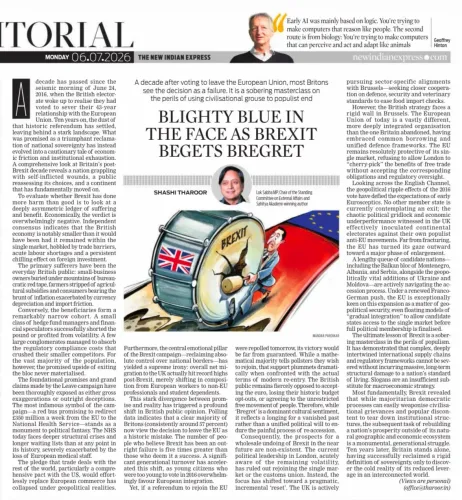
The Brexit analogy has gained traction in academic and policy circles as a framework for examining sovereignty, trade realignment and the unravelling of imperial-era arrangements. Commentators have noted that both 1947 and 2020 represent moments when a polity chose to reclaim decision-making authority from a larger supranational structure — one through anti-colonial struggle, the other through referendum. Tharoor's post suggests this comparative framework is now finding expression in longer-form historical writing.
Stakeholders and Impact
The post is likely to resonate with historians, India-UK relations analysts, and a domestic readership already primed by renewed debates over colonial-era wealth transfers and museum artefacts. India and the United Kingdom have been navigating a post-Brexit bilateral trade agreement, a process that has itself prompted fresh scrutiny of the historical terms on which the two nations interact.
For the Indian National Congress, Tharoor's continued prominence in the decolonisation discourse reinforces a party narrative that links historical injustice to contemporary foreign-policy positioning. His interventions consistently attract cross-partisan attention given his background as a former UN Under-Secretary-General and his reputation as one of Parliament's most internationally recognised voices.
What's Next
Attention will turn to the formal release or announcement of the publication associated with #1947BrexitIndia, which could generate broader public and diplomatic commentary. Any forthcoming India-UK strategic dialogue or high-level bilateral visit is likely to provide an occasion for these historical arguments to re-enter the policy conversation. Tharoor's framing — that history 'continues to shape the present' — positions the work as directly relevant to live questions of trade, sovereignty and historical accountability between the two nations.
Point of View
He extends an argument that has found growing institutional traction beyond parliamentary speeches and solo books. The move also reinforces his positioning within the Congress as the party's most globally legible voice on foreign policy and historical justice. Whether or not the publication generates mainstream debate, the hashtag itself seeds a comparative framework that is likely to recur in academic and policy discourse on India-UK relations.
NationPress
14 Oct 2026
Frequently Asked Questions
What is the #1947BrexitIndia hashtag about?
The hashtag #1947BrexitIndia draws a comparative parallel between India's independence from British rule in 1947 and Britain's exit from the European Union (Brexit), treating both as moments of sovereign realignment. Tharoor used it on 30 May 2026 to reference a new collaborative work on India's colonial history.
What has Shashi Tharoor written about British colonialism before?
Tharoor's most prominent work on the subject is his 2016 book 'An Era of Darkness,' published internationally as 'Inglorious Empire,' which documented the economic extraction and institutional disruption caused by nearly two centuries of British rule in India. He also made a widely circulated case for colonial reparations at an Oxford Union debate.
Is Shashi Tharoor releasing a new book in 2026?
Tharoor's 30 May 2026 post indicates he contributed to a work linked to the #1947BrexitIndia hashtag, using language — 'delighted to have contributed' — that suggests a collaborative or anthology format. The precise title and publisher have not been independently confirmed.
How does Brexit relate to Indian independence?
Commentators and historians have drawn analogies between India's 1947 independence and Brexit as two instances where a polity reclaimed decision-making authority from a larger structure — one through anti-colonial struggle, the other through referendum. The comparison is used to examine themes of sovereignty, trade realignment and the end of imperial-era arrangements.
Why does Shashi Tharoor focus on colonial history?
As a Congress MP from Thiruvananthapuram, former Union Minister and former UN Under-Secretary-General, Tharoor has consistently argued that the economic and institutional legacies of British rule continue to shape modern India's development and its bilateral relationship with the United Kingdom. He views historical accountability as directly relevant to contemporary foreign policy.