Tharoor visits Belfast, reflects on Troubles history
Synopsis
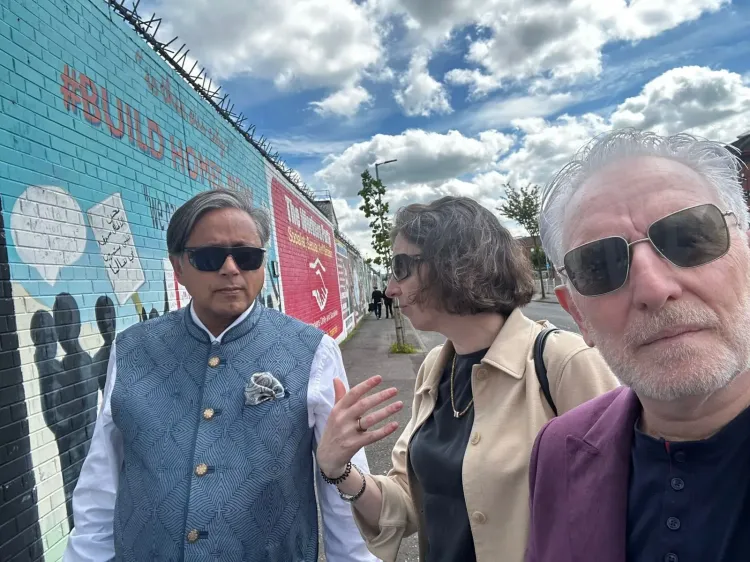
Congress MP Dr. Shashi Tharoor made his first visit to Belfast on 25 May 2026, taking a 'black taxi' tour of Troubles-era sites with the British High Commissioner and calling it 'a profound and sobering education.' A follow-up post was signalled.
Key Takeaways
Shashi Tharoor made his first-ever visit to Belfast , Northern Ireland, on 25 May 2026 .
He undertook a 'black taxi' tour — a community-led guided experience through Troubles-era murals and peace walls — alongside the British High Commissioner .
Tharoor described the visit as 'a profound and sobering education' and noted that history is 'etched into every street corner' of the city.
The post was marked '1/2,' with a second instalment of reflections expected.
The visit fits a broader pattern of Indian parliamentarians engaging with UK sites linked to conflict resolution and comparative governance.
Northern Ireland's post-conflict experience, anchored by the 1998 Good Friday Agreement , is a global reference point for peacebuilding.
Congress MP Dr. Shashi Tharoor visited Belfast, the capital of Northern Ireland, for the first time on Sunday, 25 May 2026, describing the experience as 'a profound and sobering education' through a city where, in his words, 'history is etched into every street corner.' Tharoor undertook a signature 'black taxi' tour of the city alongside the British High Commissioner, sharing his reflections in a post on X.
Context
The 'black taxi' tour is a well-known Belfast tradition in which former residents of communities affected by the Troubles — the decades-long ethno-nationalist conflict that claimed over 3,500 lives between the late 1960s and the 1998 Good Friday Agreement — guide visitors through murals, peace walls, and neighbourhoods that bear the physical imprint of that period. Tharoor described undertaking the tour 'in the distinguished company of the British High Commissioner,' indicating the visit carried a degree of diplomatic formality alongside its personal and educational character.
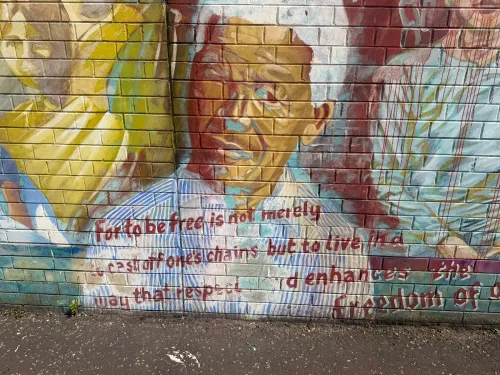
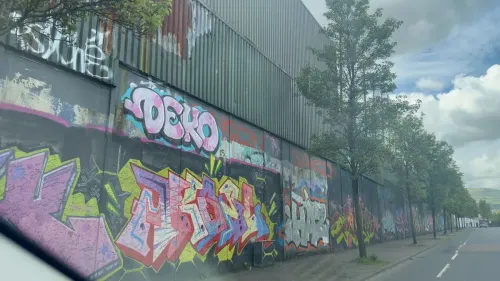
Belfast's urban landscape remains a living archive of the conflict. Towering murals on gable walls commemorate paramilitary figures, hunger strikers, and peace advocates alike, while the so-called 'peace lines' — barriers separating predominantly Nationalist and Unionist communities — still stand in several parts of the city, a visible reminder that reconciliation remains an ongoing process.
Policy Backdrop
Indian parliamentarians periodically undertake study visits to the United Kingdom that touch on themes of conflict resolution, governance, and comparative political history. Such engagements sit within the broader framework of India-UK bilateral dialogue, which has deepened across trade, education, and people-to-people ties in recent years. Tharoor, a former UN Under-Secretary-General with a career spanning international diplomacy, has consistently used overseas visits to draw comparative lessons for Indian policy discourse.
Northern Ireland's post-conflict experience — power-sharing governance under the Stormont Assembly, cross-community policing reform, and state-supported truth and reconciliation mechanisms — is frequently cited in global conversations about managing identity-based conflict. The Good Friday Agreement of 1998, brokered with involvement from the United States, the Republic of Ireland, and the United Kingdom, remains a landmark reference point in international peacebuilding literature.
Stakeholders and Impact
For Indian observers, a senior opposition MP's reflective engagement with a post-conflict society carries symbolic weight. Tharoor's public commentary on Belfast is likely to resonate with academics, civil society actors, and parliamentarians interested in how deeply divided societies navigate memory, identity, and institutional reform. His international profile lends additional visibility to such exchanges within the India-UK relationship.
For the British High Commission in India, the joint tour signals an interest in showcasing Northern Ireland's peace process as part of broader UK public diplomacy. The presence of the High Commissioner alongside a prominent opposition figure from Thiruvananthapuram underscores the non-partisan, people-to-people dimension of such engagements.
What's Next
Tharoor's post was labelled '1/2,' indicating a second instalment with further reflections on the Belfast visit was expected. Any follow-up parliamentary statements or references to lessons from Northern Ireland in Indian legislative debate would represent a concrete translation of the visit into domestic policy discourse. Observers of India-UK relations will watch whether the trip generates formal exchanges on conflict resolution or feeds into Tharoor's ongoing public writing on comparative democracy and history.
Point of View
Conducted alongside the British High Commissioner, is more than a personal travelogue — it is a piece of soft diplomacy that reinforces the cultural and intellectual dimension of the India-UK relationship at a time when both governments are deepening bilateral ties. For a former UN Under-Secretary-General who has long argued that India must learn from comparative political histories, Northern Ireland's post-conflict arc — power-sharing, memory politics, and institutional reform — offers a rich reference point. His choice to share the experience publicly, in a two-part thread, suggests a deliberate effort to bring these lessons into Indian public discourse. Whether this translates into parliamentary debate or policy advocacy remains the key question to watch.
NationPress
7 Oct 2026
Frequently Asked Questions
Why did Shashi Tharoor visit Belfast?
Tharoor visited Belfast for the first time in May 2026 and described it as 'a profound and sobering education,' undertaking a 'black taxi' tour of Troubles-era sites alongside the British High Commissioner as part of what appears to be a study visit to the United Kingdom.
What is the 'black taxi' tour in Belfast?
The black taxi tour is a Belfast tradition in which community guides — often former residents of areas affected by the Troubles — take visitors through murals, peace walls, and key sites that document the decades-long ethno-nationalist conflict and subsequent peace process.
What were the Troubles in Northern Ireland?
The Troubles was a period of ethno-nationalist conflict in Northern Ireland lasting from the late 1960s until the 1998 Good Friday Agreement, in which over 3,500 people were killed in violence between communities broadly identified as Unionist and Nationalist.
What is the Good Friday Agreement?
The Good Friday Agreement, signed in 1998, was a landmark peace accord that ended the main phase of the Troubles in Northern Ireland, establishing power-sharing governance, cross-community institutions, and mechanisms for normalisation, with support from the United States, Ireland, and the United Kingdom.
What is Shashi Tharoor's background in international affairs?
Dr. Shashi Tharoor is a Congress MP from Thiruvananthapuram and a former Union Minister of State for External Affairs. Before entering Indian politics, he served as UN Under-Secretary-General, giving him an extensive background in international diplomacy and conflict resolution.