White House Highlights Crimes by Illegal Aliens, Slams 'Fake News'
Synopsis
The White House on July 9, 2026, posted on X citing two criminal cases — a trooper death in Pennsylvania and a child molestation sentencing — to challenge what it called 'fake news' downplaying crimes by undocumented immigrants, escalating its immigration enforcement messaging.
Key Takeaways
The White House posted on July 9, 2026 , accusing media of downplaying crimes by undocumented immigrants.
An illegal alien is being held on $700,000 bail in connection with the death of a Pennsylvania state trooper .
A separate illegal alien was sentenced to 25 years for child molestation.
The post is framed as 'CORRECTING THE RECORD,' signalling a deliberate counter-narrative communications strategy.
Congressional battles over ICE funding and interior removal operations are expected to intensify in upcoming budget cycles.
The White House, the official communications account of the Executive Office of the President of the United States, on Thursday, July 9, 2026, posted a pointed message on X pushing back against what it called 'fake news' coverage of crimes allegedly committed by undocumented immigrants, citing two specific criminal cases involving illegal aliens.
Context
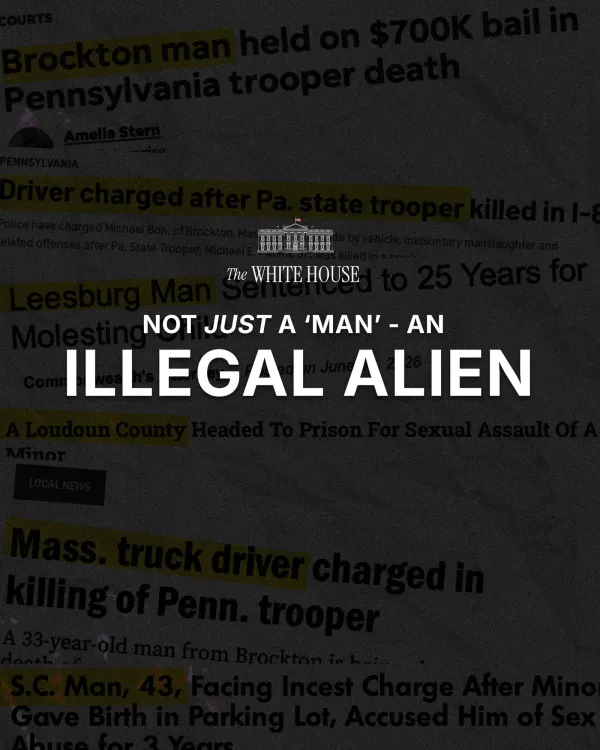
The post, framed as 'CORRECTING THE RECORD,' accused media outlets of spinning or downplaying crimes linked to undocumented immigrants. It cited two cases: an illegal alien held on $700,000 bail in connection with the death of a Pennsylvania state trooper, and a separate case in which an illegal alien was sentenced to 25 years for child molestation.
The White House did not name the individuals involved or specify the jurisdictions beyond the Pennsylvania reference. The post was accompanied by one image and was published in the early hours of the morning Indian Standard Time.
Policy Backdrop
The use of individual criminal cases to reinforce immigration enforcement messaging has been a recurring feature of US immigration politics across administrations. The Illegal Immigration Reform and Immigrant Responsibility Act of 1996 significantly expanded the grounds on which noncitizens could be deported, particularly for aggravated felonies and crimes of moral turpitude.
Critics of this approach argue that isolated incidents do not reflect broader statistical patterns about crime rates among undocumented populations. Supporters contend that any preventable crime committed by someone who should not be in the country represents a systemic failure of border and interior enforcement.
Stakeholders and Impact
Law enforcement agencies, particularly state police and federal immigration authorities, are central to both cases cited. The alleged killing of a Pennsylvania state trooper — a law enforcement officer — gives the post particular political weight, as attacks on police have historically drawn bipartisan condemnation.
Immigrant advocacy groups are likely to push back, arguing that the selective highlighting of crimes by undocumented individuals fuels xenophobia and ignores the broader contributions of immigrant communities to American society. The framing of media coverage as 'fake news' also signals a continuing effort by the administration to discredit reporting it views as unfavourable to its immigration enforcement agenda.
What's Next
Congressional debates over Immigration and Customs Enforcement (ICE) interior removal operations and enforcement funding are expected to intensify in upcoming budget cycles. Posts like this one are likely to be used as political ammunition in those debates, with the administration seeking to build public and legislative support for stricter immigration enforcement.
The administration's sustained use of social media to 'correct the record' on crime and immigration suggests this is part of a coordinated communications strategy ahead of key legislative battles, not a one-off response to individual cases.
Point of View
Not merely responding to individual incidents.
NationPress
7 Oct 2026
Frequently Asked Questions
What did the White House post about illegal aliens on July 9, 2026?
The White House posted on X citing two criminal cases — an illegal alien held on $700,000 bail in a Pennsylvania trooper death and another sentenced to 25 years for child molestation — accusing media of downplaying such crimes.
What is the Pennsylvania trooper death case involving an illegal alien?
The White House referenced an illegal alien held on $700,000 bail in connection with the death of a Pennsylvania state trooper. Specific details about the individual or jurisdiction were not provided in the post.
What does 'fake news' mean in the context of the White House immigration post?
The White House used the term 'fake news' to accuse media outlets of spinning or minimising crimes committed by undocumented immigrants, framing its post as a factual correction to that coverage.
How does the US government use individual crime cases in immigration policy debates?
US administrations have historically highlighted individual criminal cases involving undocumented immigrants to build public and legislative support for stricter enforcement, a practice that remains deeply contested across partisan lines.
What is the US law on deporting immigrants convicted of crimes?
The Illegal Immigration Reform and Immigrant Responsibility Act of 1996 significantly expanded deportation grounds for noncitizens convicted of aggravated felonies or crimes of moral turpitude, forming the legal backbone of enforcement actions.