Rajasthan CM Signs Framework for Action on Clean Energy
Synopsis
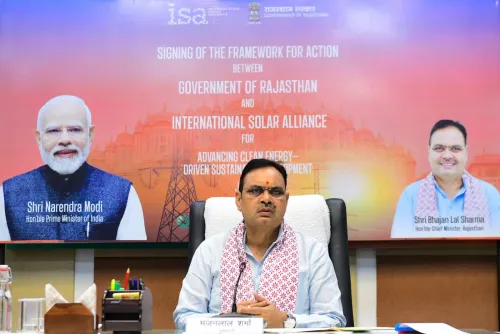
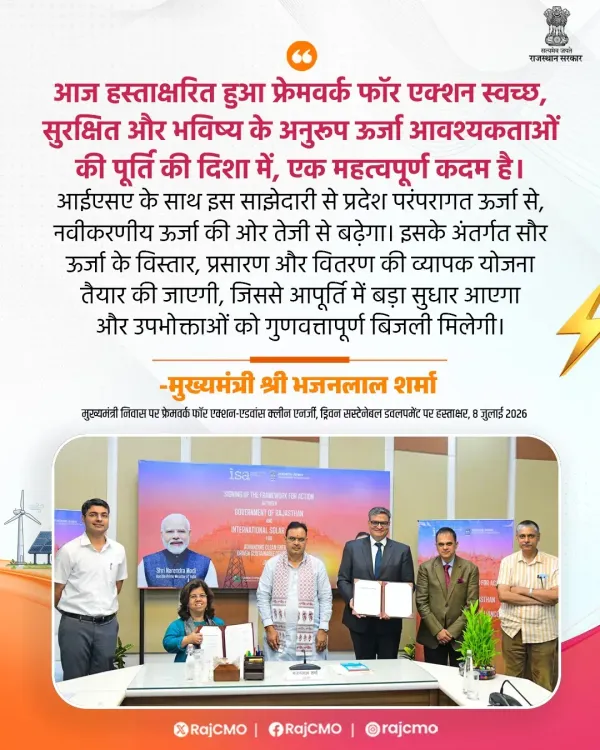
Rajasthan Chief Minister Bhajan Lal Sharma's office announced the signing of a Framework for Action on 9 July 2026, calling it a key step toward clean, safe, and future-ready energy for the state, in line with India's broader renewable energy targets.
Key Takeaways
The Chief Minister's Office of Rajasthan announced the signing of a Framework for Action on 9 July 2026 .
The framework is described as a step toward meeting clean, safe, and future-oriented energy needs for Rajasthan.
The announcement is attributed to Chief Minister Bhajan Lal Sharma of the BJP, who took office after the 2023 state elections .
Rajasthan is home to the Bhadla Solar Park and has been a leading state in India's renewable energy expansion.
India has committed to 50 per cent non-fossil fuel power capacity by 2030 under its updated NDCs from COP26 2021 .
Details on counterparties, funding, and implementation timelines are yet to be publicly disclosed.
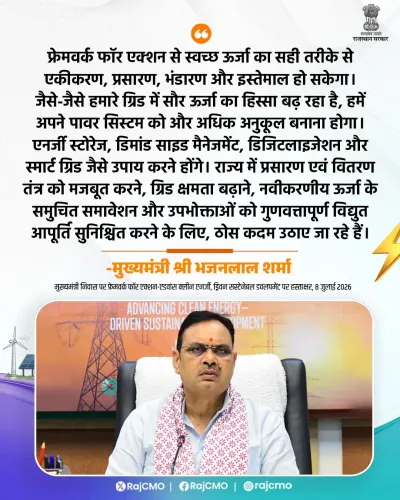
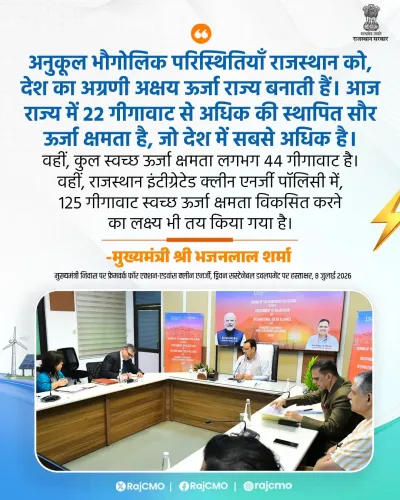
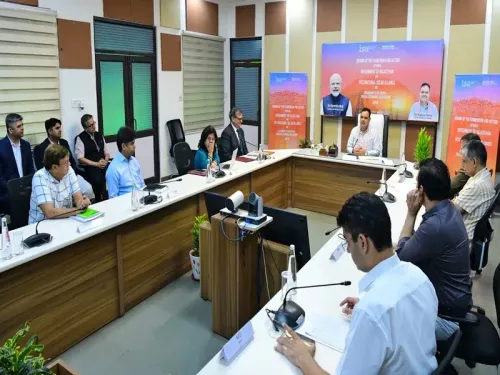
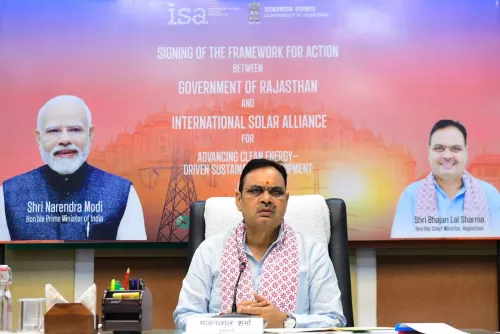
The Chief Minister's Office of Rajasthan announced on Thursday, 9 July 2026 that a Framework for Action was signed, describing it as a significant step toward meeting the state's clean, safe, and future-ready energy needs. The announcement was made by Chief Minister Bhajan Lal Sharma's office under the campaign hashtag #आपणो_अग्रणी_राजस्थान ('Our Leading Rajasthan').
Context
The post states that the Framework for Action, signed today, is 'स्वच्छ, सुरक्षित और भविष्य के अनुरूप ऊर्जा आवश्यकताओं की पूर्ति की दिशा में एक महत्वपूर्ण कदम' — 'an important step toward fulfilling clean, safe, and future-oriented energy needs.' The announcement was attributed directly to Chief Minister Bhajan Lal Sharma, who is tagged in the post. The hashtag #आपणो_अग्रणी_राजस्थान ('Our Leading Rajasthan') situates the signing within the BJP-led state government's broader development narrative.
Policy Backdrop
Rajasthan has been among India's most active states in expanding renewable energy capacity. The state's Solar Energy Policy 2019 laid out targets for solar power addition, and Rajasthan is home to the Bhadla Solar Park, one of the world's largest solar installations. These efforts align with India's updated Nationally Determined Contributions submitted at COP26 in 2021, which committed the country to sourcing 50 per cent of its power capacity from non-fossil fuel sources by 2030 and achieving net-zero emissions by 2070.
Chief Minister Bhajan Lal Sharma, who took office after the 2023 Rajasthan assembly elections, has continued the state's push to attract investment in clean energy infrastructure. A formal framework document of this nature typically sets out governance structures, timelines, and commitments for coordinated action across government departments and potential private or international partners.
Stakeholders and Impact
The Framework for Action is expected to have direct implications for Rajasthan's residents, who stand to benefit from more reliable and cleaner power supply, particularly in rural and semi-urban areas that have historically faced energy access challenges. Renewable energy developers operating in the state — and those considering entry — will watch closely for implementation details, including land allocation, grid connectivity commitments, and any incentive structures embedded in the framework.
The state's large geographic footprint and high solar irradiance make it a critical node in India's national renewable energy buildout. Any binding commitments within the framework could unlock further central government support and private capital flows into the sector.
What's Next
The specific counterparties to the Framework for Action and its detailed provisions have not yet been publicly disclosed. Observers will look to subsequent announcements from Rajasthan's energy department and the upcoming state budget cycle for rollout timelines, funding allocations, and any international or private-sector partnerships formalised under the agreement. The #आपणो_अग्रणी_राजस्थान campaign signals that the state government intends to position this signing as a flagship governance milestone ahead of future electoral and policy cycles.
Point of View
Not just symbolically. However, the impact will depend entirely on implementation specifics — counterparties, timelines, and capital commitments — none of which have been disclosed yet. The deployment of the 'Our Leading Rajasthan' campaign hashtag suggests the state government is building a political narrative around clean energy as a governance achievement.
NationPress
9 Jul 2026
Frequently Asked Questions
What is the Framework for Action signed by Rajasthan on 9 July 2026?
The Framework for Action is a policy document signed by the Rajasthan government under Chief Minister Bhajan Lal Sharma on 9 July 2026, aimed at fulfilling the state's clean, safe, and future-ready energy requirements. Specific details on counterparties and provisions have not yet been made public.
Who is Bhajan Lal Sharma?
Bhajan Lal Sharma is the Chief Minister of Rajasthan from the BJP, who assumed office following the 2023 Rajasthan state assembly elections.
What is Rajasthan's role in India's renewable energy sector?
Rajasthan is one of India's leading states in renewable energy, hosting the Bhadla Solar Park — among the world's largest solar installations — and has set ambitious solar and wind capacity targets under its Solar Energy Policy 2019.
What is India's renewable energy target under the Paris Agreement?
Under its updated Nationally Determined Contributions submitted at COP26 in 2021, India committed to sourcing 50 per cent of its electricity capacity from non-fossil fuel sources by 2030 and achieving net-zero emissions by 2070.
What does 'Aapno Agrani Rajasthan' mean?
'Aapno Agrani Rajasthan' translates from Rajasthani/Hindi as 'Our Leading Rajasthan' and is a campaign hashtag used by the state government to brand its development and governance initiatives.