Rajasthan CMO backs Framework for Clean Energy Integration
Synopsis
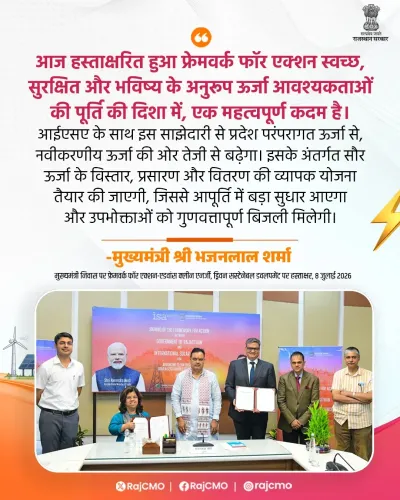
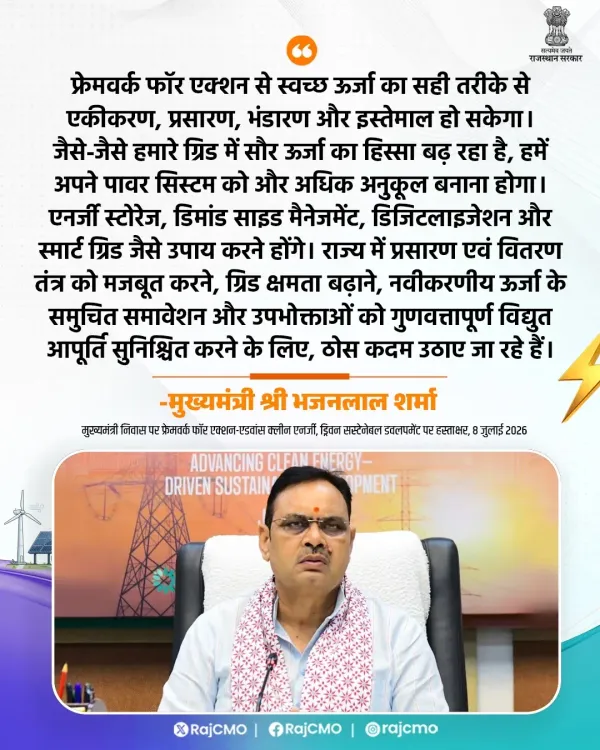
The Chief Minister's Office of Rajasthan on 9 July 2026 announced a Framework for Action to enable proper integration, transmission, storage, and utilisation of clean energy, tagging CM Bhajanlal Sharma under the 'Our Leading Rajasthan' campaign.
Key Takeaways
The Rajasthan CMO announced a Framework for Action on 9 July 2026 to streamline clean energy integration across the state.
The framework covers the full energy value chain: integration, transmission, storage, and end-use of clean power.
Chief Minister Bhajanlal Sharma was directly tagged, indicating political ownership of the initiative.
Rajasthan hosts Bhadla Solar Park , the world's largest solar park, and has updated renewable targets aligned with India's 500 GW non-fossil goal by 2030 .
Key beneficiaries include renewable developers, state discoms, and rural consumers who face unreliable power supply.
Budget allocations and tenders for transmission and battery storage projects will indicate how the framework is operationalised.
The Chief Minister's Office of Rajasthan on Thursday, 9 July 2026 highlighted a Framework for Action aimed at enabling the proper integration, transmission, storage, and utilisation of clean energy in the state, tagging Chief Minister Bhajanlal Sharma in the post shared under the campaign hashtag #आपणो_अग्रणी_राजस्थान ('Our Leading Rajasthan').
Context
The post, shared on the official Rajasthan CMO account, states that the Framework for Action will allow clean energy to be 'properly integrated, transmitted, stored and utilised' — addressing the full value chain from generation to consumption. The message directly tags Chief Minister Bhajanlal Sharma, signalling his office's ownership of the initiative. The hashtag links the announcement to a broader state branding campaign positioning Rajasthan as a frontrunner in national development.
Policy Backdrop
Rajasthan holds one of the highest solar irradiation levels in India and hosts the world's largest solar park — Bhadla Solar Park in Jodhpur district — developed in phases since 2015 with multi-gigawatt capacity. The state's Solar Energy Policy 2019 set formal targets for capacity addition, and updated renewable targets in 2023 aligned the state's roadmap with India's national goal of 500 GW of non-fossil fuel capacity by 2030. Despite this scale, Rajasthan has faced persistent transmission bottlenecks and a lack of storage infrastructure to manage variable renewable generation — gaps the Framework for Action appears designed to address.
The emphasis on integration, transmission, storage, and end-use in a single framework reflects the maturation of Rajasthan's energy policy: the state is moving beyond merely adding generation capacity toward ensuring that clean power actually reaches consumers reliably and efficiently.
Stakeholders and Impact
Renewable energy developers operating in Rajasthan stand to benefit from clearer rules on grid integration and transmission access, reducing the risk of curtailment that has historically eroded project returns. State distribution companies (discoms) would gain a structured pathway for absorbing large volumes of variable solar and wind power without destabilising the grid. Rural consumers across the state — many still dependent on unreliable supply — are the downstream beneficiaries of a system that can store and dispatch clean power on demand.
The framework also has implications for India's broader energy transition commitments. Rajasthan is among the states whose renewable capacity additions are critical to meeting national 2030 targets, and an operationalised integration framework here could serve as a model for other high-potential states.
What's Next
Observers will watch for state budget allocations or tender announcements tied to transmission line upgrades and battery storage projects that would give the Framework for Action operational teeth. Chief Minister Bhajanlal Sharma's direct association with the announcement suggests political priority, which typically accelerates bureaucratic follow-through. If the framework translates into concrete procurement and grid investment, Rajasthan could significantly close the gap between its generation potential and its actual clean-energy delivery capacity — reinforcing its claim as a national leader in the energy transition.
Point of View
Transmission, storage, and utilisation signals a deliberate shift from capacity-first to system-first thinking in state energy policy — a more sophisticated posture than simple megawatt targets. Tagging CM Bhajanlal Sharma directly is a political choice that ties his personal brand to the energy transition narrative ahead of what remains a competitive policy environment among states. The '#आपणो_अग्रणी_राजस्थान' hashtag situates this as part of a sustained image-building effort, suggesting the government views clean energy leadership as electorally and reputationally valuable. The real test will be whether the framework produces measurable grid investments or remains an aspirational document.
NationPress
8 Oct 2026
Frequently Asked Questions
What is the Rajasthan Framework for Action on clean energy?
The Framework for Action is a policy instrument announced by the Rajasthan Chief Minister's Office on 9 July 2026 to enable proper integration, transmission, storage, and utilisation of clean energy across the state.
What role does CM Bhajanlal Sharma play in Rajasthan's energy policy?
Chief Minister Bhajanlal Sharma, who has led Rajasthan since December 2023, was directly tagged in the CMO's announcement, indicating his office is driving the clean energy framework as a priority initiative.
Why is Rajasthan important for India's renewable energy goals?
Rajasthan has among the highest solar irradiation levels in India, hosts the world's largest solar park at Bhadla in Jodhpur, and is central to meeting India's national target of 500 GW non-fossil fuel capacity by 2030.
What problems does the clean energy framework aim to solve in Rajasthan?
Rajasthan has faced transmission bottlenecks and insufficient storage infrastructure that prevent variable solar and wind power from reaching consumers reliably — gaps the Framework for Action is designed to address.
What should we watch for after this Rajasthan clean energy announcement?
Key indicators will include state budget allocations for transmission upgrades, tenders for battery storage projects, and any formal gazette notifications or policy documents that give the Framework for Action legal and operational standing.