Rajasthan CMO highlights world-class solar park push
Synopsis
The Chief Minister's Office of Rajasthan on 5 July 2026 announced that world-class solar parks are under construction in the state, tagging PM Modi and linking the push to India's broader renewable energy targets and the '500 GW by 2030' goal.
Key Takeaways
The Chief Minister's Office of Rajasthan on 5 July 2026 confirmed that construction of world-class solar parks in the state is actively underway.
Rajasthan has among the highest solar irradiance levels in India, anchoring its role in national renewable energy strategy.
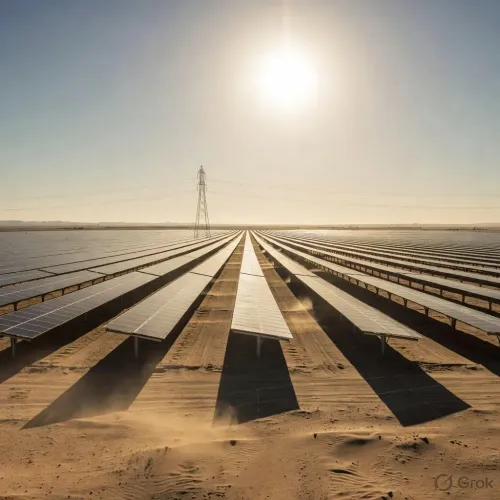
The Bhadla Solar Park in Jodhpur district is the world's largest single-location solar park and a model for subsequent projects.
India targets 500 GW of non-fossil energy capacity by 2030 , with Rajasthan's solar parks as key contributors.
The post tagged Prime Minister Narendra Modi , signalling state-centre alignment on the #PMModi4ViksitRajasthan development agenda.
Next milestones include fresh capacity auctions, transmission corridor completions, and new land-allocation agreements.
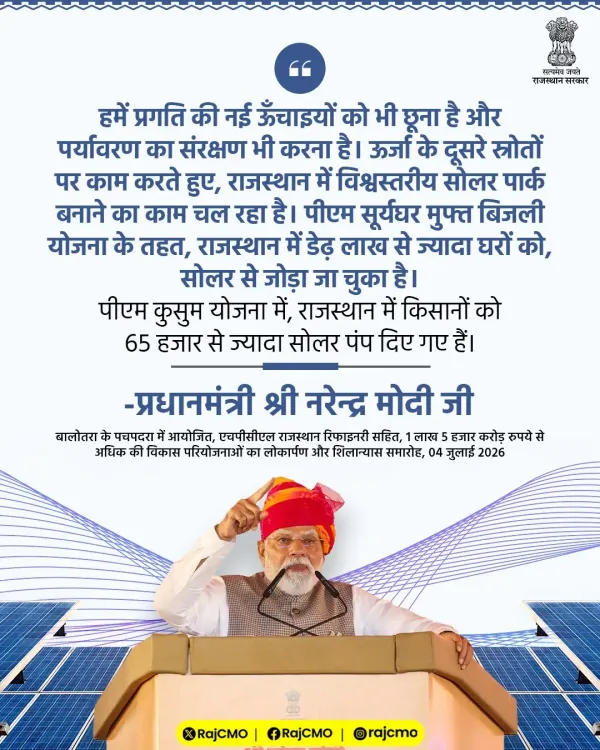
The Chief Minister's Office of Rajasthan on Sunday, 5 July 2026 reaffirmed the state government's commitment to building world-class solar parks as part of a broader push to diversify energy sources, tagging Prime Minister Narendra Modi in the post on X.
The post, in Hindi, stated: 'ऊर्जा के दूसरे स्रोतों पर काम करते हुए, राजस्थान में विश्वस्तरीय सोलर पार्क बनाने का काम चल रहा है।' — 'While working on other sources of energy, the construction of world-class solar parks in Rajasthan is underway.' The message was shared under the hashtags #PMModi4ViksitRajasthan and #आपणो_अग्रणी_राजस्थान ('Our Leading Rajasthan'), signalling alignment between the state administration and the Centre's development agenda.
Context
Rajasthan holds one of the highest solar irradiance levels of any Indian state, making it a natural anchor for utility-scale renewable energy infrastructure. The state's flat, arid terrain — particularly in districts such as Jodhpur and Barmer — offers vast tracts of land suitable for large solar installations with minimal displacement concerns. This geographic advantage has made Rajasthan central to India's national renewable energy ambitions for over a decade. The Bhadla Solar Park in Jodhpur district, developed in phases since the mid-2010s, is recognised as the world's largest single-location solar park by installed capacity. Its development set a template for land aggregation, transmission linkage, and competitive tariff discovery that subsequent projects in the state have sought to replicate and expand upon.Policy Backdrop
India's solar mission traces its formal origins to the Jawaharlal Nehru National Solar Mission, launched in 2010, which aimed to scale grid-connected solar power across the country. Rajasthan followed with its own Solar Energy Policy in 2014, subsequently revised, to facilitate dedicated land banks and streamline park development approvals. At the national level, successive governments have pursued rapid renewable capacity addition to honour Paris Agreement commitments and reduce dependence on fossil fuel imports. India has set a target of 500 GW of non-fossil energy capacity by 2030, with solar parks in Rajasthan positioned as flagship contributors to that goal. The CMO's post reinforces that the state views itself as a lead executor of this national mandate.Stakeholders and Impact
The solar park buildout affects a wide range of stakeholders. Private and public solar developers benefit from the state's land-bank model, which reduces project-development risk. Transmission utilities face the parallel challenge of building adequate evacuation infrastructure to carry power from remote desert locations to consumption centres. Arid-zone communities near the parks stand to gain from local employment in construction and operations, though land-use negotiations remain a recurring consideration in large-scale deployments. For consumers and industry across Rajasthan and connected states, expanded solar capacity promises a larger share of low-cost, clean electricity in the grid mix — a factor increasingly relevant to industrial competitiveness and household energy security alike.What's Next
Attention will now turn to the next rounds of solar park capacity auctions, the pace of transmission corridor completions linking park output to the national grid, and any fresh state-centre agreements on additional land allocation. The CMO's public communication, directed at Prime Minister Modi, suggests the state is positioning these projects as a joint achievement ahead of broader development milestones. Progress on inter-state transmission and grid balancing will determine how quickly the installed capacity translates into delivered clean energy.Point of View
The state government is staking a claim to Rajasthan's geographic dividend in the renewable energy race, a dividend that spans multiple administrations but is now being actively claimed by the current dispensation. The reference to 'other sources of energy' alongside solar suggests a diversification pitch — possibly covering wind, pumped hydro, or green hydrogen — that could attract fresh central or private investment. Analysts will watch whether the rhetoric is matched by accelerated transmission infrastructure, which has historically been the bottleneck limiting Rajasthan's solar ambitions from translating fully into delivered power.
NationPress
5 Oct 2026
Frequently Asked Questions
Which solar park in Rajasthan is the largest in the world?
The Bhadla Solar Park in Jodhpur district , Rajasthan, is recognised as the world's largest single-location solar park by installed capacity, developed in phases since the mid-2010s.
What did the Rajasthan CMO post about solar energy on 5 July 2026?
The Chief Minister's Office of Rajasthan posted on X that 'the construction of world-class solar parks in Rajasthan is underway,' tagging Prime Minister Narendra Modi and using hashtags linked to the Viksit Rajasthan agenda.
What is India's renewable energy target by 2030?
India has set a target of 500 GW of non-fossil energy capacity by 2030 , with large solar parks in states like Rajasthan serving as flagship contributors.
Why is Rajasthan important for solar energy in India?
Rajasthan has one of the highest solar irradiance levels in the country and large tracts of flat, arid land, making it ideal for utility-scale solar parks that feed into the national grid.
What is the Jawaharlal Nehru National Solar Mission?
The Jawaharlal Nehru National Solar Mission , launched in 2010 , was India's foundational policy to scale grid-connected solar power nationally, providing the framework within which state-level solar parks like those in Rajasthan were developed.