Rajasthan CMO Sets 2027 Power Self-Reliance Goal Under CM Sharma
Synopsis
The Chief Minister's Office of Rajasthan has set a goal of making the state self-reliant in the power sector by 2027, tagging Chief Minister Bhajan Lal Sharma and framing it under the 'Our Leading Rajasthan' campaign. The target lands amid the state's expanding solar and wind base and continuing discom stress.
Key Takeaways
Rajasthan CMO announced a goal of power-sector self-reliance by 2027 on 4 June 2026 .
The post tags Chief Minister Bhajan Lal Sharma and uses the hashtag #आपणो_अग्रणी_राजस्थान .
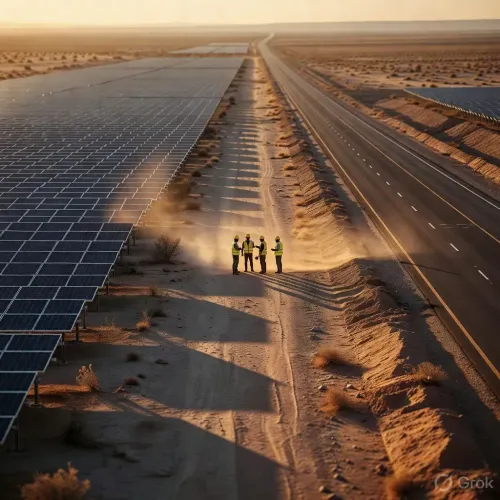
Rajasthan hosts the Bhadla Solar Park and is among India's largest solar and wind capacity contributors.
State discoms — JVVNL , AVVNL and JdVVNL — face long-standing financial stress.
No specific capacity, investment or generation-mix figures were disclosed in the post.
Detail is expected in forthcoming state power budget and renewable policy updates.
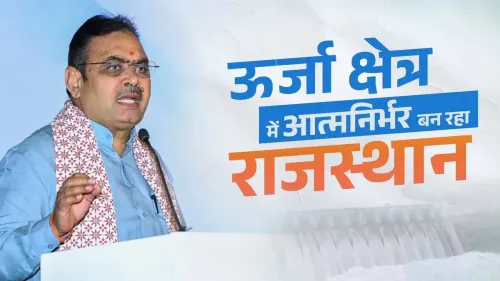
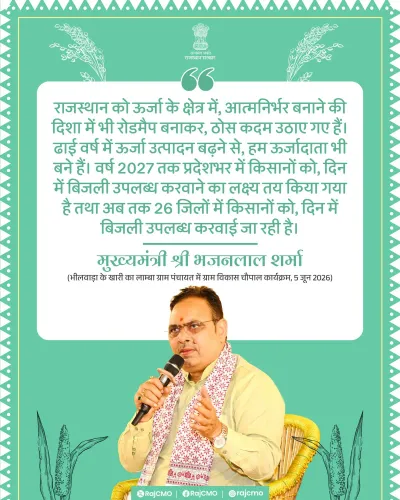
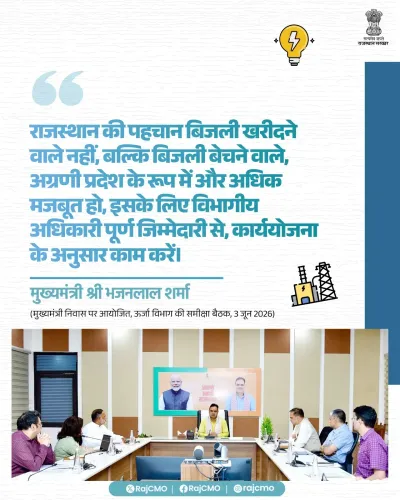
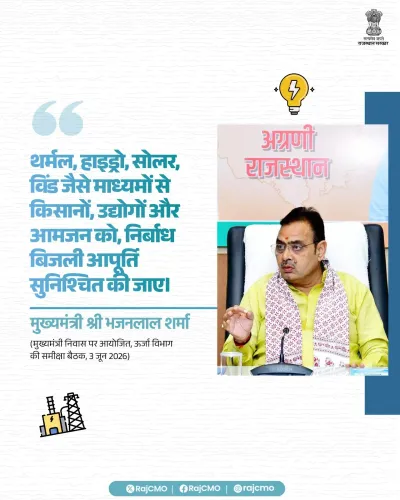
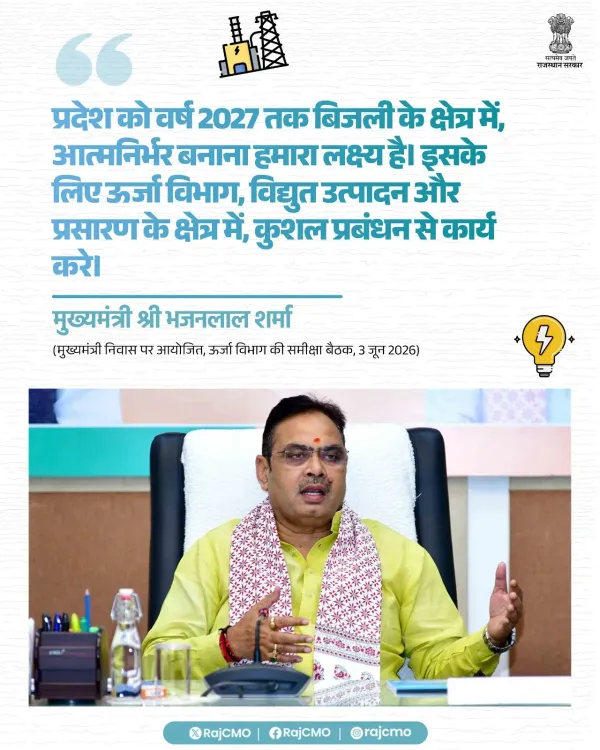
The Chief Minister's Office of Rajasthan on 4 June 2026 declared that making the state self-reliant in the power sector by 2027 is a stated goal of the government led by Chief Minister Bhajan Lal Sharma. The announcement, posted on X with the campaign hashtag #आपणो_अग्रणी_राजस्थान ('Our Leading Rajasthan'), frames electricity sufficiency as a central plank of the administration's development pitch.
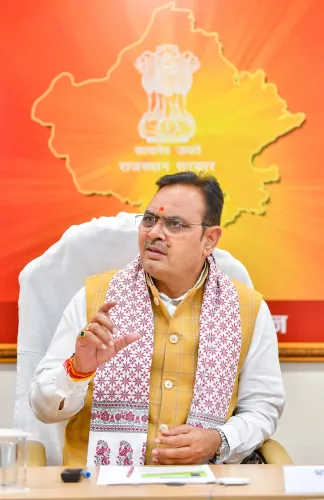
Translated from Hindi, the post reads, 'Making the state self-reliant in the power sector by the year 2027 is our goal.' The message tags Chief Minister Bhajan Lal Sharma directly and was accompanied by an image, signalling that the target is being positioned as a headline commitment of the current dispensation.
Context
Rajasthan has historically depended on a mix of central thermal allocations, state-owned generation and a rapidly expanding renewable base to meet peak demand that climbs sharply during the summer months. The state's discoms — Jaipur Vidyut Vitran Nigam, Ajmer Vidyut Vitran Nigam and Jodhpur Vidyut Vitran Nigam — have been working through long-standing financial stress even as installed capacity in the state has grown.
Chief Minister Bhajan Lal Sharma, who took office in December 2023 after the BJP's win in the assembly elections, has repeatedly placed infrastructure and power among his administration's priority areas. The CMO's latest message effectively puts a calendar on that ambition.
Policy backdrop
India's renewable build-out since the launch of the National Solar Mission in 2010 has leaned heavily on western states with high solar irradiance. Rajasthan, home to the Bhadla Solar Park in Jodhpur district, has emerged as one of the country's largest contributors to grid-connected solar capacity over the past decade.
The state's wind corridor in the Jaisalmer-Barmer belt and its expanding solar footprint give policymakers a base from which to argue for energy self-sufficiency. 'Self-reliance' in this context typically combines higher in-state generation, firmer transmission links and tighter demand-side management to reduce dependence on central pool allocations and imported fuel.
Stakeholders and impact
The most immediate constituencies are the state's electricity consumers — households, farmers running agricultural pumps, and industrial users in clusters such as Bhiwadi, Neemrana, Kota and Jodhpur. Reliable supply is a politically sensitive issue in rural Rajasthan, where unscheduled cuts during the kharif sowing window can quickly translate into farmer protests.
Renewable energy developers eyeing fresh solar and wind tenders in the state stand to benefit if the 2027 goal is backed by accelerated project allocations and land-use clearances. State discoms, meanwhile, will be watched for whether the self-reliance push is matched by tariff rationalisation and reduction of aggregate technical and commercial losses.
What's next
The CMO has not, in this post, disclosed the specific capacity addition, investment outlay or generation mix that the 2027 target rests on. Detail is likely to surface in the state's forthcoming power budget statements and any revised renewable energy or distribution policies.
For now, the message functions as a political marker — pinning the Sharma government to a deliverable timeline well within its current term. How that translates into megawatts on the ground, transmission upgrades and the financial health of discoms will determine whether the slogan of an 'agrani' (leading) Rajasthan in power is matched by measurable supply gains by 2027.
Point of View
Locally branded targets. For the Sharma government, electricity is both a development and political variable — rural supply and farm-pump reliability remain decisive in Rajasthan's electoral arithmetic. The real test will be whether the slogan is backed by tender pipelines, transmission upgrades and discom reform, or whether it stays largely aspirational. Watch the next state budget for the operational scaffolding.
NationPress
16 Sept 2026
Frequently Asked Questions
What is Rajasthan's 2027 power goal?
The Rajasthan CMO has stated that making the state self-reliant in the power sector by 2027 is a goal of the Bhajan Lal Sharma-led government. The post did not disclose specific capacity or investment figures.
Who is the Chief Minister of Rajasthan?
Bhajan Lal Sharma is the Chief Minister of Rajasthan. He took office in December 2023 after the BJP's win in the state assembly elections.
Why is Rajasthan important for India's renewable energy?
Rajasthan has high solar irradiance and strong wind corridors, making it one of India's largest contributors to solar and wind capacity. It hosts the Bhadla Solar Park, among the world's largest solar installations.
What does 'आपणो अग्रणी राजस्थान' mean?
It translates to 'Our Leading Rajasthan' and is used as a campaign hashtag by the Rajasthan CMO to package the current government's development messaging.
What are Rajasthan's main power distribution companies?
Rajasthan's electricity distribution is handled by three discoms — Jaipur Vidyut Vitran Nigam, Ajmer Vidyut Vitran Nigam and Jodhpur Vidyut Vitran Nigam — which have faced persistent financial stress.