Tharoor at Richard von Weizsäcker Forum on middle powers
Synopsis
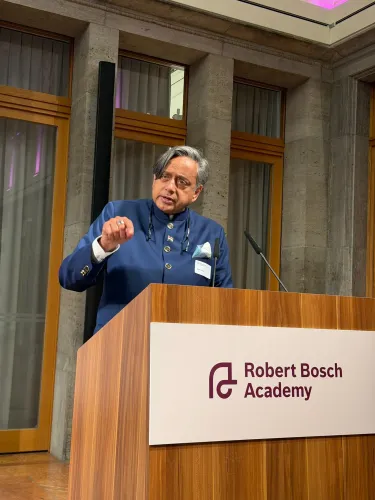
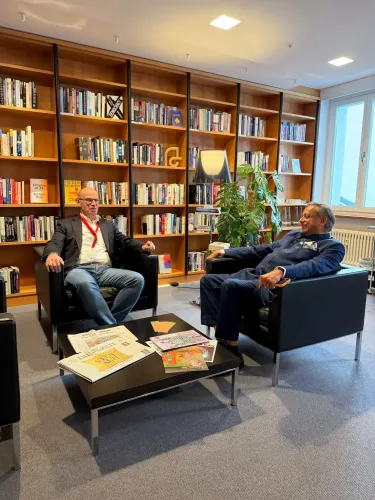
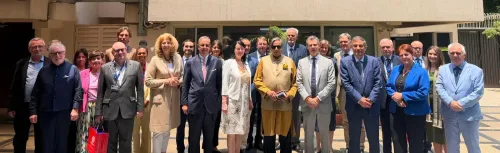
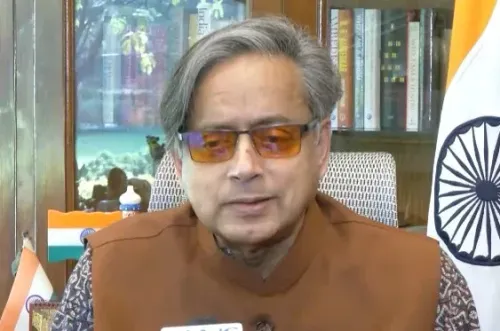
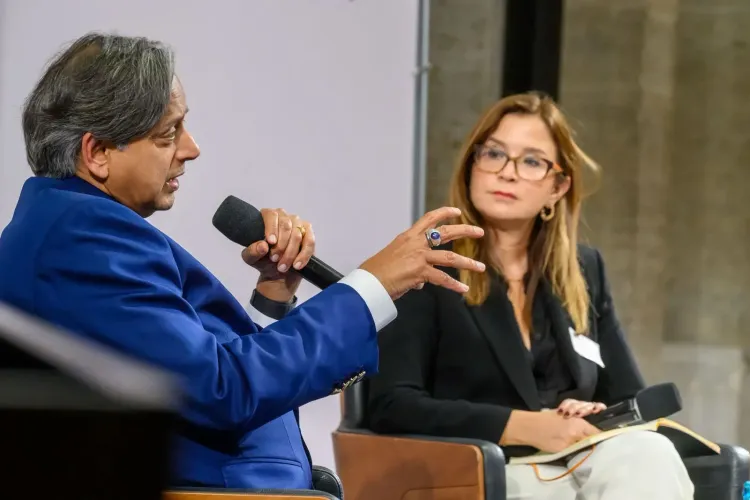
Congress MP Dr. Shashi Tharoor joined Prof. Dr. Senem Aydin Düzgit at the Richard von Weizsäcker Forum 2026 for a fireside discussion on middle powers, strategic autonomy, and influence in a world of competing power centres.
Key Takeaways
Shashi Tharoor appeared at the Richard von Weizsäcker Forum 2026 on October 6, 2026 .
The fireside conversation was held with Prof.
Senem Aydin Düzgit , a noted European scholar of international relations.
Key themes included the changing role of middle powers , the limits of strategic autonomy , and exercising influence amid competing global power centres.
The session concluded with a Q&A with the forum audience, reflecting broad international interest in these questions.
Tharoor brings a rare combination of credentials — former UN Under-Secretary-General , former Union Minister , and sitting MP — to such global forums.
In a world fracturing along competing axes of power, Congress MP Dr. Shashi Tharoor took the stage at the Richard von Weizsäcker Forum 2026 on Tuesday, October 6, for a fireside conversation that cut to the heart of one of global diplomacy's most urgent questions: can middle powers still chart their own course?
Tharoor engaged in the discussion with Prof. Dr. Senem Aydin Düzgit, a prominent scholar of European politics and international relations, covering the shifting role of middle powers, the possibilities and hard limits of strategic autonomy, and how nations can exercise meaningful influence when great-power rivalry increasingly sets the terms.
The Middle-Power Moment — and Its Contradictions
The timing of this conversation is pointed. As the United States, China, and a resurgent Russia compete to redraw the rules of the international order, a cluster of nations — India, Türkiye, Brazil, South Africa, the Gulf states — find themselves courted by all sides and pressured by each. Strategic autonomy, the doctrine of preserving independent foreign-policy space without formal alignment, has become both a shield and a tightrope for these countries. For India, the tension is vivid. New Delhi has deepened its Quad partnership while sustaining its historic ties with Moscow, bargained for discounted Russian oil through the Ukraine conflict, and pushed its own candidacy for a reformed UN Security Council seat. The question Tharoor and Düzgit explored — how much room for manoeuvre genuinely exists in a bipolar or multipolar squeeze — is not theoretical for Indian policymakers. It is a weekly calculation.Prof. Düzgit and the Forum's Significance
Prof. Dr. Senem Aydin Düzgit is a leading European academic voice on transatlantic and EU-neighbourhood politics, known for rigorous comparative work on democracy, foreign policy, and Türkiye's geopolitical pivot. The Richard von Weizsäcker Forum, named after the late German Federal President and statesman celebrated for his moral clarity on post-war reconciliation, convenes policymakers, scholars, and public intellectuals to debate exactly the kind of structural shifts reshaping global governance. Tharoor's presence there — as a former UN Under-Secretary-General, former Union Minister of State for External Affairs, and a sitting parliamentarian from Thiruvananthapuram — signals the forum's draw toward voices that straddle the Global South and international institutions simultaneously.A Lively Q&A and What It Signals
The session closed with what Tharoor described as 'a lively Q&A with the engaged audience', a detail that matters: these forums often function as informal diplomatic corridors where ideas get stress-tested and positions get refined. The questions from the floor, in a room likely populated by European policymakers and academics, would themselves reflect how the West is rethinking its assumptions about countries that refuse clean alignment. For India's foreign-policy watchers, the exchange underscores a growing global appetite to understand — not just manage — the logic of strategic autonomy as practiced by the world's most populous democracy. Middle powers are no longer just swing votes. They are increasingly the stage on which the next architecture of global order gets drafted — and Tharoor, in Berlin, was helping write the script.Point of View
The conceptual vocabulary of 'strategic autonomy' is being debated not just in South Block but in academic and policy forums across Europe. Tharoor's role as an articulate bridge between the Global South and Western institutions gives such appearances outsized significance — they shape how influential European audiences frame India's choices. The conversation signals that middle-power doctrine is maturing from a reactive posture into a proactive, exportable idea.
NationPress
6 Oct 2026
Frequently Asked Questions
What is the Richard von Weizsäcker Forum?
The Richard von Weizsäcker Forum is a high-level international dialogue platform named after the late German Federal President, convening policymakers, scholars, and intellectuals to debate global governance and geopolitical shifts.
Who is Prof. Dr. Senem Aydin Düzgit?
Prof. Dr. Senem Aydin Düzgit is a prominent European academic specialising in international relations, EU politics, and Turkish foreign policy, known for her comparative research on democracy and geopolitical alignment.
What is strategic autonomy and why does it matter for India?
Strategic autonomy refers to a country's ability to pursue independent foreign policy without binding alignment to any single power bloc. For India, it underpins New Delhi's approach of engaging both Western partners and Russia simultaneously.
What is Shashi Tharoor's background in international affairs?
Dr. Shashi Tharoor served as UN Under-Secretary-General for Communications and Public Information and as India's Minister of State for External Affairs before becoming a Congress MP from Thiruvananthapuram.
Why are middle powers gaining attention in global diplomacy?
As great-power rivalry between the US and China intensifies, middle powers like India, Brazil, and Türkiye are seen as pivotal actors whose alignment — or non-alignment — significantly shapes the emerging international order.