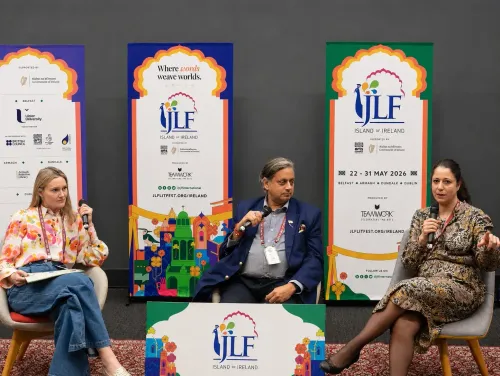
Tharoor Backs Campus Free Speech Debate, Slams University Curbs

Synopsis
Congress MP Dr. Shashi Tharoor welcomed public pushback from former Foreign Secretary Kanwal Sibal on social media, calling it 'free and fair debate' and contrasting it with what he described as university authorities' attempts to stifle open discourse on campuses.
Key Takeaways
Shashi Tharoor posted on July 25, 2026 , welcoming criticism from former Foreign Secretary Kanwal Sibal and others on social media.
Tharoor framed the online exchange as an example of 'free and fair debate' that university authorities are allegedly trying to suppress.
The post does not name the specific university or the topic of the underlying dispute.
Indian higher education institutions have faced recurring criticism over restrictions on campus events and speaker invitations.
Tharoor's intervention follows a pattern of opposition parliamentarians using social media to highlight perceived threats to free expression in academic settings.
Responses from the concerned university and academic bodies are awaited.
Congress MP Dr. Shashi Tharoor on Saturday, July 25, 2026, publicly welcomed criticism directed at him on social media, framing the exchange as an example of the open debate that university authorities have been attempting to suppress. Tharoor specifically acknowledged pushback from former Indian Foreign Secretary Kanwal Sibal and others, calling it 'free and fair debate.'
Context
In his post, Tharoor wrote: 'I welcome this pushback from Kanwal Sibal and others in this space. Because this is free and fair debate — precisely of the kind that the University authorities seek to stifle!' The remark positions an online disagreement as a demonstration of the very democratic discourse he argues is being curtailed within institutional settings.
Kanwal Sibal, a veteran diplomat who served as India's Foreign Secretary, is a prominent commentator on strategic and foreign policy matters. His engagement with Tharoor on the platform represents a substantive exchange between two figures with long records in public service and policy debate.
Policy Backdrop
Indian higher education institutions have faced recurring scrutiny over restrictions placed on campus events, speaker invitations, and organised discussions. Administrative decisions to cancel talks or bar certain voices have periodically drawn sharp responses from parliamentarians, civil society groups, and academics who view such moves as threats to institutional autonomy and free expression.
Tharoor's intervention fits a broader pattern in which opposition voices use social media platforms to highlight incidents of perceived institutional overreach. As a sitting MP and former UN Under-Secretary-General, Tharoor carries institutional weight when he speaks on questions of governance and democratic norms.
Stakeholders and Impact
The immediate stakeholders in this debate are university students and faculty, who depend on open campus environments to engage with diverse viewpoints. When administrators restrict events or discussions, the chilling effect extends beyond any single incident, shaping the culture of inquiry within institutions.
Public figures amplifying such concerns on platforms with large followings can raise the political cost of administrative overreach. Tharoor's post, by framing the online exchange itself as a model of healthy debate, implicitly contrasts it with what he characterises as the suppressive posture of unnamed university authorities.
What's Next
Attention will now turn to whether the university or universities in question respond publicly to the criticism, and whether academic bodies or student groups issue follow-up statements on campus speech norms. Parliamentary committees that oversee higher education could also take note if the issue gains wider traction. The episode underscores a continuing tension in Indian public life between institutional authority and the principle of open discourse.
Point of View
He signals confidence in open contestation — and uses that confidence to sharpen his critique of university administrations that he implies lack the same tolerance. The episode reflects a recurring tension in Indian governance: the gap between constitutional guarantees of free expression and the administrative instincts of institutions that prefer managed environments. If the unnamed university becomes identified, this post could serve as a rallying point for student and faculty advocacy groups already pushing back against campus speech restrictions.
NationPress
24 Oct 2026
Frequently Asked Questions
What did Shashi Tharoor say about Kanwal Sibal?
Tharoor welcomed Kanwal Sibal's public pushback against him on social media, calling it an example of 'free and fair debate' that he contrasted with university authorities' alleged attempts to stifle open discussion.
Which university is Tharoor criticising for stifling debate?
Tharoor's post does not name the specific university. The institution and the underlying dispute have not been publicly identified in connection with this post.
Who is Kanwal Sibal?
Kanwal Sibal is a former Indian Foreign Secretary and career diplomat who is now a prominent commentator on strategic and foreign policy issues.
Why is campus free speech a concern in India?
Indian universities have periodically faced criticism for cancelling events, barring speakers, or restricting student discussions due to administrative or external pressure, raising concerns about academic freedom.
What is Shashi Tharoor's position on free speech in universities?
Tharoor has consistently defended open debate in academic settings. His July 2026 post reaffirms that stance by framing social media disagreement as a healthier model than what he describes as institutional suppression of discourse.