Tharoor Speaks on India-China Thaw at Essay Launch

Synopsis
Congress MP Dr. Shashi Tharoor addressed the launch of Ambassador K. Surendra Kumar's essay compilation on India-China relations, describing a 'cautious thaw' and a 'welcome shift from confrontation' in one of Asia's most consequential bilateral relationships.
Key Takeaways
Shashi Tharoor spoke at the launch of Ambassador K.
Surendra Kumar 's essay compilation on India-China relations .
Tharoor described the current bilateral moment as a 'cautious thaw' and a 'welcome shift from confrontation.' The compilation is titled 'Is it Time for the Indian Elephant to Dance with the Chinese Dragon?' The India-China relationship deteriorated sharply after the Galwan Valley clash in June 2020 , which killed 20 Indian soldiers .
Tharoor's framing positions the Opposition as a stakeholder in diplomatic progress, not an opponent of it.
Structural questions — border trust, the Quad, Pakistan-China ties — remain unresolved even as the thaw deepens.
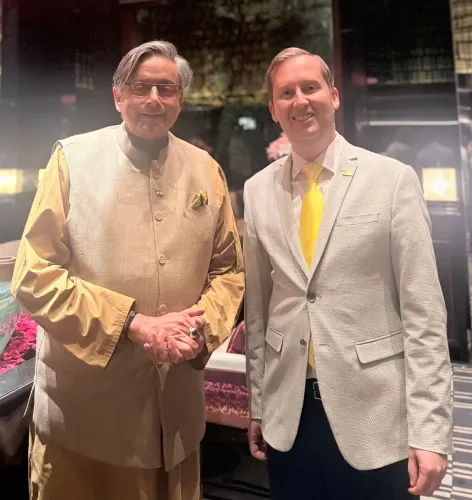
A cautious diplomatic thaw — that was the phrase Congress MP Dr. Shashi Tharoor reached for when he addressed the launch of a new essay compilation on India-China relations, signalling that one of Asia's most consequential bilateral equations may be quietly shifting register.
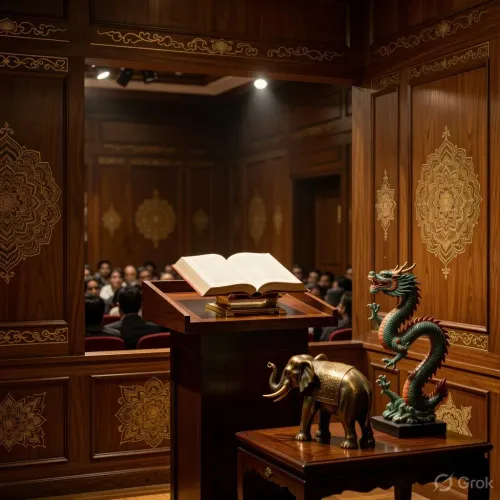
Tharoor delivered the speech at the launch of a volume compiled by Ambassador K. Surendra Kumar, titled 'Is it Time for the Indian Elephant to Dance with the Chinese Dragon?' — a title that captures, with pointed elegance, the central question hovering over New Delhi and Beijing's fraught relationship. The former Union Minister described the current moment as a 'welcome shift from confrontation,' framing it as a development worthy of measured optimism.
From Galwan to Guarded Engagement
The India-China relationship has spent the better part of half a decade in the deep freeze. The June 2020 clash in the Galwan Valley — which left 20 Indian soldiers dead and an unspecified number of Chinese casualties — shattered decades of managed coexistence along the Line of Actual Control. Trade was disrupted, apps were banned, and high-level diplomatic contact was reduced to a minimum. The border standoff in eastern Ladakh became the defining symbol of a relationship that had run out of goodwill.
Against that backdrop, even a 'cautious thaw' is a significant data point. Disengagement at several friction points along the LAC, resumed direct flights, and tentative diplomatic re-engagement have all nudged the needle — without resolving the underlying territorial disputes that triggered the crisis in the first place.
Why Ambassador Kumar's Volume Matters
Ambassador K. Surendra Kumar, a career diplomat with deep expertise in South and East Asian affairs, has assembled a set of essays that interrogates whether the structural conditions now exist for a more stable, even cooperative, India-China framework. The compilation's provocative title poses the question as a choice — a dance implying synchrony, not just proximity. Tharoor's participation as a speaker at the launch lends the volume a prominent political-intellectual platform at a moment when the debate is anything but academic.
For a politician who has long engaged with foreign policy — from his years at the United Nations to his tenure as Minister of State for External Affairs — Tharoor's framing of the shift as 'welcome' is deliberate. It positions the Opposition not as a spoiler of diplomatic progress but as a stakeholder in it, even as questions about border security and strategic trust remain sharply contested across party lines.
The Bigger Question the Title Asks
The metaphor embedded in Ambassador Kumar's title deserves unpacking. The elephant and the dragon are not natural dance partners — one is deliberate, territorial, and deeply rooted; the other is fast, expansive, and assertive. A dance between them would require choreography, trust, and a shared floor. Whether India and China can agree on those terms — especially with Taiwan Strait tensions, the Quad's deepening architecture, and Pakistan's China ties complicating the geometry — is the real policy question the book, and Tharoor's speech, places on the table.
The conversation has moved from whether to engage to how to engage — and that, in itself, is a shift worth tracking.
Point of View
Unresolved question — and Tharoor's participation ensures it lands in the political mainstream, not just in think-tank corridors. Watch whether the ruling dispensation responds, and how.
NationPress
1 Oct 2026
Frequently Asked Questions
What did Shashi Tharoor say about India-China relations?
Dr. Shashi Tharoor described the current state of India-China relations as a 'cautious thaw' and called the shift away from confrontation 'welcome,' speaking at the launch of an essay compilation on the subject.
Who is Ambassador K. Surendra Kumar?
Ambassador K. Surendra Kumar is an Indian career diplomat with expertise in South and East Asian affairs who compiled the essay volume titled 'Is it Time for the Indian Elephant to Dance with the Chinese Dragon?'
What is the India-China essay compilation about?
The compilation edited by Ambassador K. Surendra Kumar brings together essays examining whether the conditions now exist for a more stable and cooperative India-China relationship, using the metaphor of the elephant and the dragon dancing together.
Why did India-China relations deteriorate?
Relations hit a historic low after the Galwan Valley clash in June 2020, in which 20 Indian soldiers were killed, triggering diplomatic freezes, trade disruptions, and a prolonged military standoff along the Line of Actual Control in eastern Ladakh.
What is Shashi Tharoor's foreign policy background?
Dr. Shashi Tharoor is a Congress MP from Thiruvananthapuram who previously served as Minister of State for External Affairs and as Under-Secretary-General of the United Nations, giving him extensive foreign policy credentials.