Tharoor Meets Vijayan Bala, Recalls Rajan Bala's Cricket Legacy
Synopsis
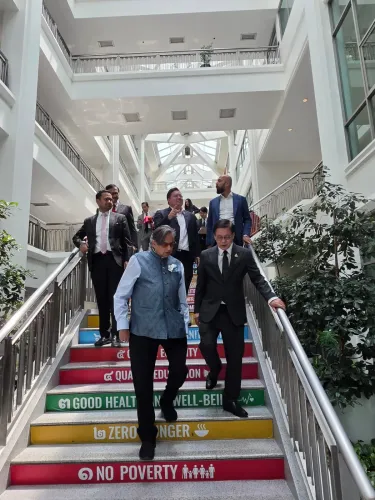
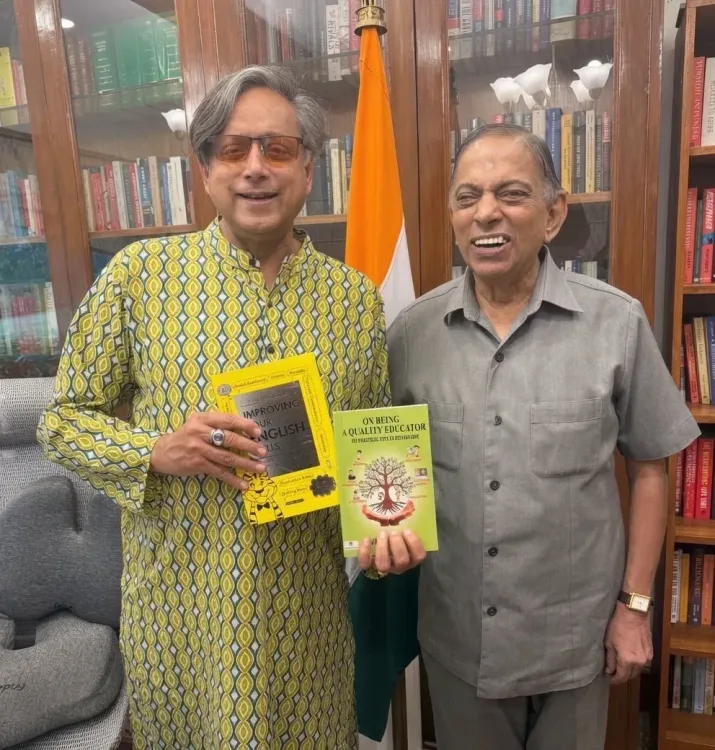
Congress MP Dr. Shashi Tharoor met educator and sportswriter Vijayan Bala on 5 July 2026, recalling his childhood friendship with the late cricket journalist Rajan Bala and exchanging books in a meeting that bridged politics, sport, and literature.
Key Takeaways
Shashi Tharoor met educator and sportswriter Vijayan Bala on 5 July 2026 .
The meeting was described by Tharoor as 'a stimulating exchange of views on both education and sports.' Rajan Bala , Vijayan's late brother, was a childhood friend of Tharoor's and one of India's most respected cricket writers.
The encounter included an informal exchange of books, which Tharoor said he felt he benefited from more.
Tharoor has a longstanding public engagement with cricket literature and Indian cultural writing.
Congress MP Dr. Shashi Tharoor on Sunday, 5 July 2026, shared a warm account of meeting educator and sportswriter Vijayan Bala, whose late brother Rajan Bala was both a childhood friend of Tharoor's and one of India's most celebrated cricket writers.
Context
Tharoor described the encounter as 'a stimulating exchange of views on both education and sports,' capping it with what he called a book swap in which he felt he 'got the better of the deal.' The meeting brought together two distinct worlds — parliamentary politics and sports literature — through a personal bond that stretches back to Tharoor's childhood.
Rajan Bala was widely regarded as one of the finest cricket journalists India produced, known for his nuanced prose and deep knowledge of the game. His passing left a notable gap in Indian sports writing, and Tharoor's tribute underscores how personally he felt that loss.
Policy Backdrop
Tharoor has long occupied an unusual space in Indian public life as both a legislator and a prolific author — he has written on cricket, Indian culture, history, and politics. His sustained engagement with sports literature is not incidental; cricket writing in India sits at the intersection of national identity, history, and popular culture, themes Tharoor returns to repeatedly in his public work.
Vijayan Bala, as an educator and sportswriter, represents a generation of commentators who have chronicled Indian cricket's evolution from the pre-liberalisation era through to the present. Meetings of this kind often surface networks linking journalists, academics, and public figures across decades of shared intellectual history.
Stakeholders and Impact
For India's cricket-writing community, Tharoor's public acknowledgement of Rajan Bala's legacy serves as a reminder of a body of work that younger readers may be less familiar with. It also signals continued institutional memory within literary and journalistic circles that value long-form cricket writing.
Educators and sportswriters who operate outside the mainstream spotlight — as Vijayan Bala does — occasionally gain wider visibility through such high-profile associations. The exchange of books, though informal, points to a living culture of intellectual exchange that persists beyond formal policy or institutional settings.
What's Next
Tharoor's post hints at an ongoing dialogue on cricket history and education, and observers will watch for any follow-up — joint events, forewords, or collaborative writing — that may emerge from this meeting. More broadly, the encounter is a reminder that India's sports-literary tradition, though often eclipsed by the commercial machinery of modern cricket, continues to find champions in unexpected quarters.
Point of View
Journalistic, and political classes across generations. By publicly honouring Rajan Bala's memory, Tharoor performs a role he has cultivated carefully — that of the politician-intellectual who keeps faith with India's cultural heritage. The book swap, however informal, reinforces his brand as an author-legislator distinct from most of his parliamentary peers. Over time, such gestures help sustain the ecosystem of long-form sports writing at a moment when it competes for attention with instant digital commentary.
NationPress
5 Jul 2026
Frequently Asked Questions
Who is Vijayan Bala?
Vijayan Bala is an Indian educator and sportswriter, and the brother of the late cricket journalist Rajan Bala.
Why did Shashi Tharoor meet Vijayan Bala?
Tharoor met Vijayan Bala for a discussion on education and sports, and the two also exchanged books during the meeting.
What did Shashi Tharoor say about Rajan Bala?
Tharoor described Rajan Bala as a childhood friend and 'one of the best cricket writers India ever had.'
When did Shashi Tharoor meet Vijayan Bala?
The meeting took place on Sunday, 5 July 2026 , as shared by Tharoor on his official X account.