Tharoor Pays Tribute to Gandhi on Jayanti
Synopsis
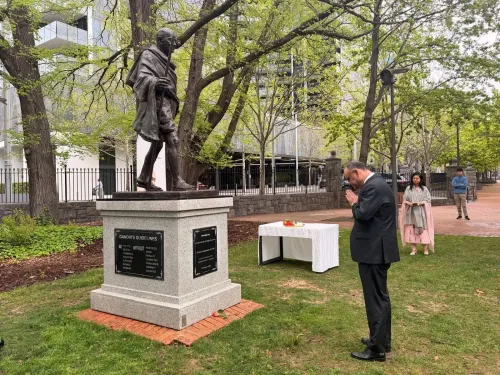
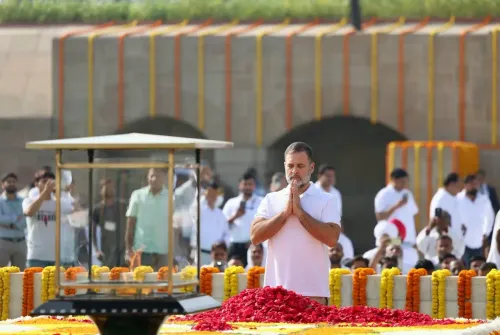
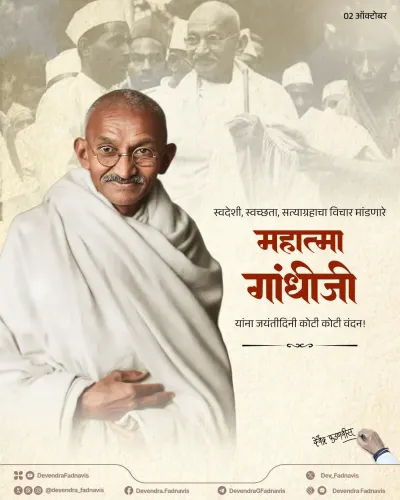
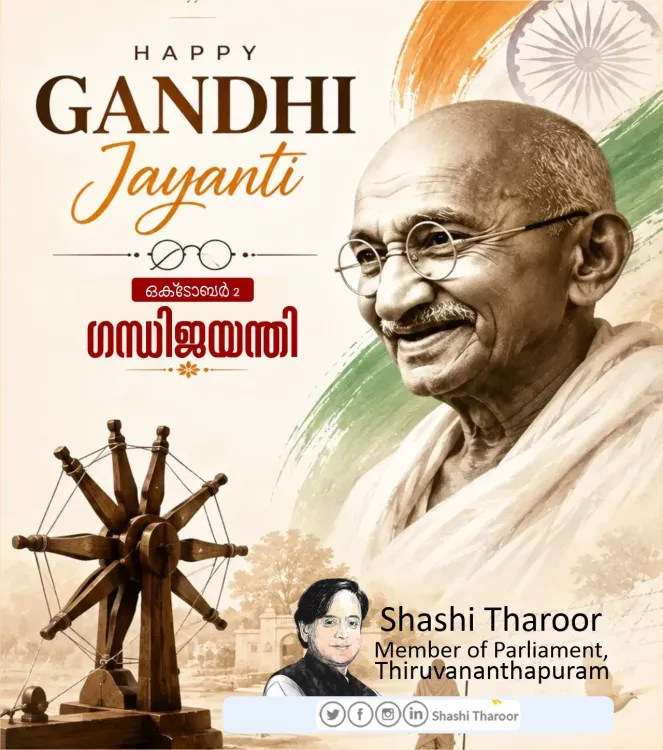
On Gandhi Jayanti 2026, Congress MP Dr. Shashi Tharoor paid tribute to Mahatma Gandhi, offering 'pranaams to the Great Soul' on the 157th birth anniversary of the Father of the Nation and the UN-designated International Day of Non-Violence.
Key Takeaways
Shashi Tharoor marked Gandhi Jayanti on 2 October 2026 with a tribute post on X.
Mahatma Gandhi was born on 2 October 1869 in Porbandar, Gujarat — making this his 157th birth anniversary .
The United Nations designated 2 October as the International Day of Non-Violence in 2007 .
Tharoor used the word pranaams , signalling deep reverence consistent with his long record of engagement with India's civilisational heritage.
The Swachh Bharat mission was launched on Gandhi Jayanti 2014 , linking the date to active national policy.
On the 157th birth anniversary of Mahatma Gandhi, Congress MP Dr. Shashi Tharoor offered his reverence to the Father of the Nation with a simple, heartfelt salutation on Friday, 2 October 2026 — a day India pauses to remember the man who reshaped the moral imagination of a civilisation.
Tharoor's post read: 'Pranaams to the Great Soul on #GandhiJayanti' — the word pranaams (a gesture of deep, folded-hands reverence) carrying particular weight from a parliamentarian and former diplomat known for engaging seriously with India's intellectual and philosophical inheritance.
Why 2 October Carries Undiminished Weight
Mahatma Gandhi, born Mohandas Karamchand Gandhi on 2 October 1869 in Porbandar, Gujarat, led India's non-violent independence struggle against British colonial rule and became one of the most consequential figures of the 20th century. The United Nations formally designated 2 October as the International Day of Non-Violence in 2007, extending Gandhi's legacy into a global framework for peace and conflict resolution.
Across India, the day is marked by prayer meetings, cleanliness drives under the Swachh Bharat initiative — launched on Gandhi Jayanti 2014 — and tributes at Raj Ghat, Gandhi's memorial in New Delhi, where leaders from across the political spectrum gather each year.
Tharoor and the Gandhian Dialogue
Dr. Tharoor, MP from Thiruvananthapuram and a former UN Under-Secretary-General, has written and spoken extensively about India's civilisational legacy, making his annual Gandhi Jayanti tribute consistent with a long record of public engagement with the Mahatma's philosophy — non-violence, truth, and the ethics of political life. His use of pranaams rather than a generic 'happy birthday' underscores that register of seriousness.
As India navigates a fast-changing geopolitical and social landscape, Gandhi Jayanti remains one of the few moments when the entire political class — cutting across ideology — returns to the same set of foundational questions the Mahatma posed: what does just governance look like, and at what cost is it pursued?
That question, 157 years on, has lost none of its urgency.
Point of View
Philosophical register. For a Congress leader, invoking Gandhi without an explicit political edge in 2026 is itself a positioning choice, emphasising continuity with the party's founding moral compact. The annual return to Gandhi also serves as an implicit benchmark against which contemporary governance is quietly, if wordlessly, measured.
NationPress
2 Oct 2026
Frequently Asked Questions
Why is 2 October celebrated as Gandhi Jayanti?
2 October is celebrated as Gandhi Jayanti because it marks the birth anniversary of Mahatma Gandhi , born on 2 October 1869 in Porbandar. It is a national holiday in India and is also observed globally as the International Day of Non-Violence , as designated by the United Nations in 2007 .
What did Shashi Tharoor post on Gandhi Jayanti 2026?
Congress MP Dr. Shashi Tharoor posted 'Pranaams to the Great Soul on #GandhiJayanti' on X on 2 October 2026 , paying his respects on Mahatma Gandhi's 157th birth anniversary .
What is the International Day of Non-Violence?
The International Day of Non-Violence is observed every year on 2 October — Mahatma Gandhi's birthday. The United Nations General Assembly established the day in 2007 to promote the principles of non-violence through education and public awareness.
What is Swachh Bharat and its connection to Gandhi Jayanti?
Swachh Bharat Abhiyan (Clean India Mission) was launched on 2 October 2014 on Gandhi Jayanti, drawing on Gandhi's emphasis on cleanliness and sanitation. The date was chosen deliberately to connect the initiative to his legacy.
Who is Shashi Tharoor?
Dr. Shashi Tharoor is a Congress MP from Thiruvananthapuram, Kerala , a former Union Minister of State , and a former UN Under-Secretary-General . He is widely known as an author, orator, and public intellectual.