Tharoor Recommends Survey on India's Freedom Poetry
Synopsis
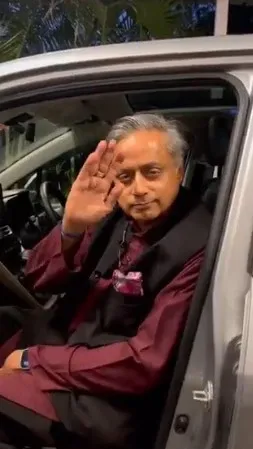
On Quit India Movement Day, Congress MP Dr. Shashi Tharoor recommended Dr. Ashwani Kumar's Tribune survey on India's freedom-era poetry and songs, calling it a 'good survey' well worth reading — a quiet act of cultural stewardship ahead of Independence Day.
Key Takeaways
Shashi Tharoor publicly recommended a survey article on India's freedom poetry and songs on 9 August 2026 .
The article, authored by Dr.
Ashwani Kumar , was published in The Tribune , a Chandigarh-based daily.
Tharoor described the piece as a 'good survey of the poetry and songs of freedom that have emerged from our culture' and called it 'well worth reading.' The post was made on Quit India Movement Day , the anniversary of Gandhi's 1942 'Do or Die' call — lending the recommendation pointed historical timing.
Indian parliamentarians frequently use Independence Day-adjacent dates to highlight literary and cultural heritage linked to the freedom struggle.
As India approaches Independence Day, Congress MP Dr. Shashi Tharoor has turned the public's attention toward a quieter but enduring archive of resistance — the poetry and songs that carried the freedom struggle in their verses.
On Sunday, 9 August 2026 — a date that itself carries historical weight as Quit India Movement Day — Tharoor took to X to recommend a survey article by Dr. Ashwani Kumar, describing it as a 'good survey of the poetry and songs of freedom that have emerged from our culture' and calling it 'well worth reading.'
Why Freedom Songs Still Matter in August
The timing is deliberate. August 9 marks the anniversary of the 1942 Quit India Movement, when Mahatma Gandhi's call of 'Do or Die' ignited a nationwide uprising. The literature born from that era — protest poems, folk songs, patriotic verses — was not merely ornamental. It was mobilisation. It crossed caste and language barriers in ways that pamphlets often could not. Dr. Ashwani Kumar's survey, published in the Chandigarh-based daily The Tribune, maps this cultural output — drawing together the poetry and music that freedom fighters composed, sang, and died for. Tharoor, himself a prolific writer and a long-time advocate for India's literary and historical heritage, lending his platform to the piece signals its broader relevance beyond academic circles.A Parliamentarian's Endorsement as Cultural Signal
Indian parliamentarians periodically use social media to spotlight cultural expressions tied to the freedom struggle, and such endorsements tend to cluster around Independence Day. But Tharoor's recommendation carries particular weight: as a former UN Under-Secretary-General, a Union Minister, and the author of multiple books on Indian history and identity, his reading list functions as a form of soft curation for a large, engaged audience. The gesture is small but pointed. In a media environment saturated with political noise, a sitting MP pausing to say 'read this poem, read this survey' is its own quiet act of cultural stewardship. Freedom literature is not a closed archive. It lives in school assemblies, in Bollywood background scores, in the lyrics people half-remember and half-invent. Surveys like Dr. Kumar's do the work of anchoring that living tradition to its actual roots — names, lines, contexts that deserve to be known precisely, not just felt vaguely.Point of View
Suggesting the timing is conscious rather than incidental. Indian politicians increasingly use social media not just for political combat but as a form of cultural agenda-setting — and endorsements from high-profile, intellectually credible figures like Tharoor carry genuine amplification power. The broader pattern here is a recurring effort by Opposition leaders to claim ownership of the freedom-struggle narrative, particularly as India's 80th Independence Day approaches. Whether such gestures translate into sustained public engagement with freedom-era literature, or remain a seasonal ritual, is the real question.
NationPress
9 Aug 2026
Frequently Asked Questions
What did Shashi Tharoor post on 9 August 2026?
Tharoor recommended a survey article by Dr. Ashwani Kumar on the poetry and songs of India's freedom struggle, published in The Tribune, calling it 'well worth reading.'
Who is Dr. Ashwani Kumar in Shashi Tharoor's post?
Dr. Ashwani Kumar is the author of the survey article on freedom-era poetry and songs that Tharoor recommended on X on 9 August 2026.
Why is 9 August significant in India?
9 August marks the anniversary of the Quit India Movement of 1942 , when Mahatma Gandhi launched the 'Do or Die' call for immediate British withdrawal from India.
What is The Tribune newspaper?
The Tribune is a long-established English-language daily based in Chandigarh , widely read across northern India.
Why do Indian politicians highlight freedom struggle literature near Independence Day?
Independence Day and related anniversaries provide a culturally resonant moment for public figures to draw attention to the literary and artistic heritage of the freedom movement, reinforcing national identity and historical memory.