Tamil Nadu expands Kamarajar Breakfast Scheme to Classes 6-8 with SHG-led SOP
Synopsis
Tamil Nadu has moved to extend its flagship Kamarajar Breakfast Scheme to Classes 6-8, issuing a granular SOP that puts self-help group women at the centre of delivery — with fixed cooking windows, mandatory app-based reporting, and a ₹1,500 distribution charge for remote school runs. It is one of the most operationally detailed school meal expansions the state has undertaken.
Key Takeaways
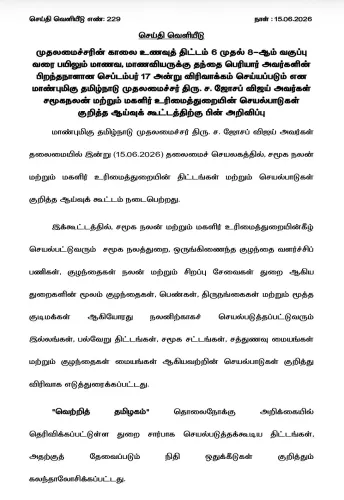
The Tamil Nadu Women Development Corporation has issued an SOP to extend the Perunthalaivar Kamarajar Breakfast Scheme to Classes 6 to 8 in government and aided schools.
Meals will be prepared by self-help group members affiliated with the State Rural Livelihoods Mission , who must have at least 3 years of SHG experience.
Cooking must begin by 6 am and hot breakfast served between 8 am and 9 am daily.
Core supplies — rice, pulses, oil, and salt — must come exclusively from the Tamil Nadu Civil Supplies Corporation .
Schools with fewer than 10 students will receive food from larger nearby centres; delivery workers get a ₹1,500 distribution charge.
Accountability measures include daily registers, photographic app-based reporting, food sample preservation, and social audits .
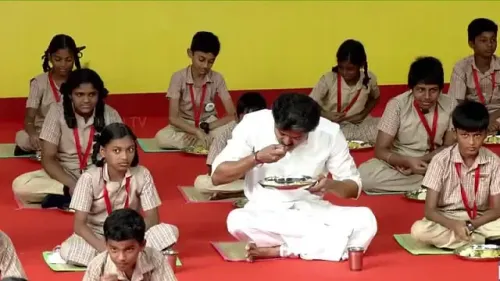
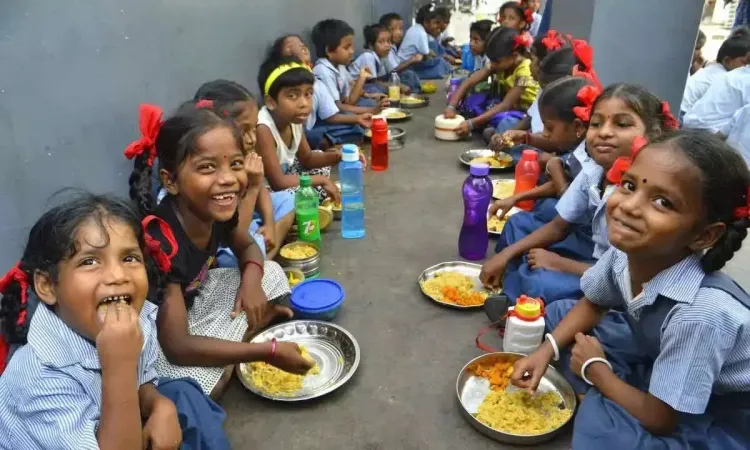
The Tamil Nadu Women Development Corporation has issued a detailed standard operating procedure (SOP) to extend the Perunthalaivar Kamarajar Breakfast Scheme to students of Classes 6 to 8 in government and government-aided schools across Tamil Nadu. The move significantly widens the scheme's reach, bringing free morning meals to older students who were previously excluded from the programme.
Who Will Prepare and Serve the Meals
Breakfast will be prepared and served by selected members of self-help groups (SHGs) affiliated with the State Rural Livelihoods Mission. To qualify, applicants must have a minimum of three years of SHG membership, reside in the same village or town panchayat as the school, and demonstrate basic cooking skills. Their children must also be enrolled in the school where they will serve.
The minimum educational qualification is Class 10, though this has been relaxed to Class 8 for applicants in hilly, tribal, and remote areas. Candidates must also own an Internet-enabled Android phone and maintain a satisfactory loan-repayment record with their bank or federation.
Training and Operational Guidelines
Before the programme launches, SHG members must complete mandatory training covering cooking, food safety, hygienic handling, register maintenance, and data submission via the scheme's dedicated mobile application. Training on the approved menu must be completed at least 15 days before implementation begins.
Cooking must commence by 6 am and conclude by 8 am. Hot breakfast is to be served between 8 am and 9 am, with utensils cleaned and workers leaving school premises by 9.30 am.
Supply Chain and Sourcing Rules
Core ingredients — rice, pulses, cooking oil, and salt — cannot be procured locally. These must be supplied exclusively through the Tamil Nadu Civil Supplies Corporation. Vegetables, however, may be sourced locally or grown in school and panchayat gardens, allowing for some community-level flexibility.
Schools with fewer than 10 students will not run independent cooking operations; instead, they will receive food from nearby larger cooking centres. SHG members responsible for delivering breakfast to such schools will receive a distribution charge of ₹1,500.
Accountability and Quality Checks
The SOP mandates a multi-layered accountability framework. Schools must maintain daily registers, submit photographic reports through the mobile application, and preserve food samples for inspection. The guidelines also require regular inspections, independent evaluations, and social audits to ensure consistent quality, hygiene, and transparency across all participating institutions.
This expansion builds on the existing Kamarajar Breakfast Scheme, which has been operational for younger classes, and represents one of the most structured mid-morning meal rollouts in the state's recent welfare history. With SHG empowerment at its core, the initiative also doubles as a livelihood support mechanism for rural women. Implementation timelines for the Class 6-8 rollout are expected to be communicated to districts shortly.
Point of View
But the SOP's operational density is also its risk. Tying eligibility to Android phone ownership and app-based reporting in hilly and tribal areas — where connectivity is patchy — could create compliance gaps that undermine the very accountability the guidelines aim to build. The ₹1,500 distribution charge for remote school deliveries is also modest given travel costs in such terrain. The state's decision to channel procurement through the Civil Supplies Corporation is sound from a quality-control standpoint, but past delays in that supply chain have disrupted school meal programmes before. Execution, not intent, will determine whether this SOP becomes a model or a cautionary tale.
NationPress
1 Oct 2026
Frequently Asked Questions
What is the Perunthalaivar Kamarajar Breakfast Scheme?
The Perunthalaivar Kamarajar Breakfast Scheme is a Tamil Nadu government initiative that provides free morning meals to students in government and government-aided schools. It is now being expanded from lower classes to cover students in Classes 6 to 8 across the state.
Who will prepare breakfast under the expanded scheme?
Self-help group members affiliated with the State Rural Livelihoods Mission will prepare and serve breakfast. They must have at least three years of SHG experience, live in the same panchayat as the school, and complete mandatory training before the programme begins.
What are the eligibility criteria for SHG members to participate?
Applicants must have a minimum of three years of SHG membership, reside locally, have basic cooking skills, own an Internet-enabled Android phone, and have a satisfactory loan-repayment record. The minimum education required is Class 10, relaxed to Class 8 in hilly, tribal, and remote areas.
How will quality and hygiene be ensured under the SOP?
The SOP mandates daily registers, photographic reporting via a mobile application, preservation of food samples, regular inspections, independent evaluations, and social audits to maintain quality, hygiene, and accountability across all participating schools.
What happens for schools with very few students?
Schools with fewer than 10 students will receive food from nearby larger cooking centres rather than running their own operations. SHG members who deliver breakfast to these schools will be paid a distribution charge of ₹1,500.