Did the TN Government Overstep in the Karthigai Deepam Ritual Dispute?
Click to start listening
Synopsis
The Tamil Nadu government's legal battle over the Karthigai Deepam ritual raises questions of authority and public order. As tensions flare in Thiruparankundram, the conflict highlights the delicate balance between tradition and jurisdiction, prompting significant protests from various organizations.
Key Takeaways
- The Tamil Nadu government is challenging a court order regarding the Karthigai Deepam ritual.
- This dispute highlights the conflict between tradition and legal authority.
- Protests have erupted, demonstrating community sentiment around religious practices.
- Section 144 was imposed to manage escalating tensions in the area.
- The case raises significant questions about communal harmony and public order.
Madurai, Dec 4 (NationPress) The government of Tamil Nadu has justified its stance before the Madurai Bench of the Madras High Court, asserting that Justice Swaminathan had surpassed his authority by mandating the lighting of the Karthigai Deepam at the hilltop lamp post on Thiruparankundram Hill and ordering the deployment of CISF personnel for safety measures.
The controversy erupted following the filing of a petition requesting permission to illuminate the traditional Karthigai Deepam at the lamp post situated within one of the barrack areas on Thiruparankundram Hill.
In response to the appeal, the judge directed that the Maha Deepam be lit at the hilltop and instructed the temple administration to coordinate the arrangements. Although initial preparations were underway on Wednesday morning, the temple authorities suddenly called off the plans.
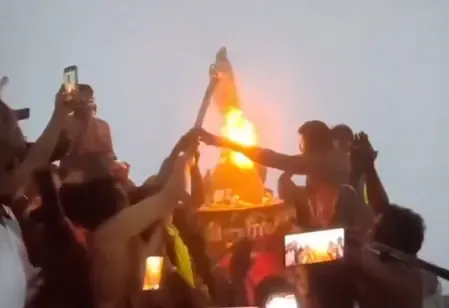
This cancellation incited protests from groups such as Hindu Makkal Katchi, Akhila Bharath Hanuman Sena, and South India Forward Bloc, among others, who marched in demand of lighting the lamp at the petitioner's requested location. Despite the protests, adhering to temple customs, the Deepam was lit at 6 p.m. near the Uchchipillaiyar Temple on the hilltop, not at the lamp post. The petitioner and supporters remained dissatisfied, advocating for the Deepam to be lit at the lamp post with CISF protection.
Justice Swaminathan permitted them to proceed to the site with security personnel.
The order incited tense moments on Wednesday evening, as BJP supporters and Hindu organization members chanted slogans near the 16-foot hall and attempted to scale the hill, breaching barricades. Police intervened, leading to clashes that resulted in injuries to two officers.
In light of the escalating situation, District Collector Praveen Kumar enforced Section 144 prohibitory orders in the vicinity. Several protesters were detained for breaching the restrictions. Some groups subsequently lit camphor along the pathway and conducted rituals before dispersing.
The state government quickly appealed to the Administrative Judge of the Madurai Bench, Justice Jayachandran, in an effort to suspend and overturn the single judge’s order.
The Additional Chief Public Prosecutor contended that the judge lacked the authority to deploy CISF, which is designated solely for the security of High Court premises, not for maintaining public order.
The state further maintained that the order directly jeopardized communal harmony and law and order within Thiruparankundram. Concurrently, the Collector submitted another petition seeking a stay on the contempt plea initiated by the original petitioner.
Both issues were prioritized by Justices Jayachandran and Ramakrishnan. The state argued that no action could be taken against the temple administration without hearing them, and that contempt proceedings cannot lead to immediate punishment on the same day of filing.
The government urged the court to annul the single judge’s directives, claiming they were beyond judicial authority and had heightened tensions in the area.
Point of View
The ongoing dispute in Tamil Nadu regarding the Karthigai Deepam ritual underscores the complex interplay of law, tradition, and community sentiment. Balancing these factors is crucial for maintaining peace and upholding the values that define our society. NationPress remains committed to providing unbiased coverage of such significant issues.
NationPress
04/12/2025
Frequently Asked Questions
What triggered the Karthigai Deepam ritual controversy?
A petition was filed requesting permission to light the Karthigai Deepam at a specific lamp post on Thiruparankundram Hill, leading to a court order and subsequent protests.
What was the government’s position on the judge's order?
The Tamil Nadu government argued that the judge exceeded his jurisdiction and that the order could disrupt communal harmony and public order.
What actions were taken by the District Collector?
The District Collector imposed Section 144 prohibitory orders due to escalating tensions and several protesters were arrested for violating these restrictions.
What was the outcome of the initial court ruling?
The Tamil Nadu government sought to suspend the judge's order, arguing it was beyond judicial authority and adversely affected local peace.
How did the situation evolve during the protests?
Protests escalated with clashes between police and demonstrators, leading to injuries and the enforcement of prohibitory orders.