CM Fadnavis: Road Rescue Underway for Passengers Stranded in Palghar
Synopsis
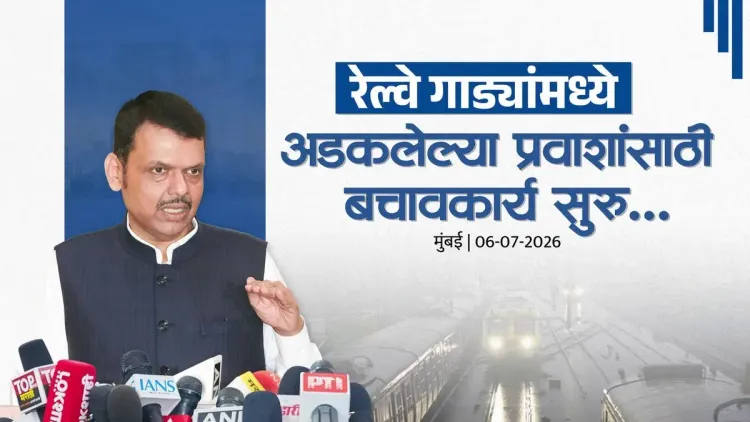
Maharashtra Chief Minister Devendra Fadnavis confirmed on 6 July 2026 that trains from Gujarat are stranded in Palghar due to heavy rainfall. Road-based rescue operations are underway to evacuate passengers. The Mumbai–Gujarat rail corridor is a recurring monsoon flashpoint, with Palghar frequently affected by waterlogging and landslides.
Key Takeaways
Several trains travelling from Gujarat to Mumbai are stranded in Palghar district due to heavy rainfall as of 6 July 2026 .
CM Devendra Fadnavis personally confirmed the situation via a bilingual post on X in Marathi and Hindi.
Road-based rescue operations have been activated to evacuate passengers from the stranded trains.
Palghar lies on the critical Mumbai–Gujarat rail corridor and is a documented seasonal flood-risk zone.
Maharashtra's post-2005 inter-departmental monsoon emergency protocols govern the state's coordination with railway authorities in such events.
Track restoration timelines and potential central assistance remain to be confirmed by authorities.
Maharashtra Chief Minister Devendra Fadnavis on Monday, 6 July 2026, confirmed that several trains arriving from Gujarat have been stranded in the Palghar district due to heavy rainfall, and that road-based rescue operations are underway to evacuate passengers safely.
Posting in both Marathi and Hindi, CM Fadnavis stated: 'गुजरातहून येणाऱ्या काही रेल्वे अतिवृष्टीमुळे पालघर भागात अडकल्या असून या रेल्वेमध्ये अडकलेल्या प्रवाशांच्या सुटकेसाठी रस्तेमार्गाने मदतकार्य सुरू आहे.' ['Some trains coming from Gujarat are stranded in the Palghar area due to heavy rainfall, and road-based relief work is underway to rescue the passengers stuck in these trains.']
Context
Palghar district, located on the northern stretch of the Mumbai–Gujarat rail corridor, is among the zones most vulnerable to waterlogging and landslides during the southwest monsoon. The announcement came on the evening of 6 July 2026, with the Chief Minister's post tagged #HeavyRainfall, #Maharashtra, and #Mumbai, signalling an active emergency response rather than a precautionary alert.
The post included a video, suggesting ground-level documentation of either the stranded trains or the ongoing rescue operations was already available to the administration.
Policy Backdrop
Maharashtra's inter-departmental monsoon emergency protocols were significantly strengthened following the devastating 2005 Mumbai floods, which exposed critical gaps in coordinated disaster response. Under those protocols, the state government is empowered to deploy road transport assets in coordination with the relevant railway zone when tracks become impassable.
The Western Railway zone, which operates passenger services between Gujarat and the Mumbai Metropolitan Region, has historically been the primary railway authority involved in such disruptions. Seasonal extreme precipitation affecting the coastal western corridor — particularly the foothills of the northern Western Ghats — is a documented annual pattern, with Palghar frequently at the epicentre.
Stakeholders and Impact
The most immediate stakeholders are the train passengers stranded aboard the affected services, who face prolonged delays and potential safety risks from rising water levels. Road-based evacuation, while operationally complex, allows state agencies to move passengers to safety even when rail movement is fully suspended.
Broader impact extends to freight and passenger rail traffic across the Mumbai–Ahmedabad corridor, one of the busiest inter-state rail routes in western India. Disruptions on this corridor have cascading effects on commuters, logistics, and inter-state commerce between Maharashtra and Gujarat.
What's Next
Official updates on track restoration timelines and the safe evacuation of all stranded passengers are expected from both the state administration and railway authorities. The scale of any central assistance — including National Disaster Response Force deployment — will depend on how quickly floodwaters recede in the Palghar region.
With the southwest monsoon typically intensifying through July, the incident underscores the need for real-time coordination between the Maharashtra government, Western Railway, and district-level disaster management units to minimise disruption and protect passenger safety across this critical corridor.
Point of View
Bilingual public update reflects a deliberate governance communication posture — acknowledging a live emergency promptly rather than waiting for full resolution. This approach, increasingly common among state executives on social media, serves both an operational purpose (signalling active response to affected passengers) and a political one (demonstrating administrative grip during a crisis). The incident fits a well-established seasonal pattern of monsoon disruption on the western coastal corridor, yet each recurrence tests the state's inter-agency coordination anew. The speed and scale of the road evacuation response will be the real measure of whether Maharashtra's strengthened disaster protocols deliver on their intent.
NationPress
5 Oct 2026
Frequently Asked Questions
Which trains are stranded in Palghar due to heavy rain?
CM Devendra Fadnavis confirmed that several trains arriving from Gujarat are stranded in the Palghar area due to heavy rainfall on 6 July 2026, but specific train numbers have not been officially disclosed in the post.
What is the Maharashtra government doing about trains stuck in Palghar?
Road-based rescue operations have been activated to safely evacuate passengers from the stranded trains, as confirmed by CM Fadnavis on 6 July 2026.
Why does Palghar face flooding during monsoon?
Palghar district sits on the Mumbai–Gujarat rail corridor near the northern Western Ghats, making it highly vulnerable to waterlogging and landslides during the southwest monsoon season each year.
Who is responsible for train operations on the Mumbai–Gujarat route?
The Western Railway zone of Indian Railways operates passenger services between Gujarat and the Mumbai Metropolitan Region and is the primary railway authority involved in managing such disruptions.
Has this happened before on the Mumbai–Gujarat rail corridor?
Yes, heavy monsoon rainfall regularly disrupts rail links along this corridor. Maharashtra has maintained inter-departmental emergency protocols since the 2005 Mumbai floods specifically to handle stranded-passenger scenarios.