Tripura to spend ₹100 crore restoring Dumboor hydropower plant by December
Synopsis
Tripura's Dumboor hydropower plant — hobbled by decades of declining output and battered by 2024 floods — is set for a ₹100 crore revival. With NIT, IIT Guwahati, BHEL and NHPC having assessed the damage and an underwater robot deployed to inspect the dam, the state now has a blueprint to push generation back from 2–3 MW to 10–11 MW, with spades in the ground by December.
Key Takeaways
Tripura Power Minister Ratan Lal Nath announced a ₹100 crore investment to restore the Dumboor hydropower plant on 9 October 2026 .
The plant, originally capable of generating 15 MW , now produces only 2–3 MW following years of decline and severe 2024 flood damage.
Restoration targets 10–11 MW of output; work is scheduled to begin in December 2025 .
Assessment involved NIT , IIT Guwahati , BHEL , NHPC , and an underwater robot brought from Kerala to inspect the dam.
The Dam Safety Act 2021 mandates regular pre- and post-monsoon inspections of India's more than 7,000 dams .
Tripura's Cabinet also approved BSNL network expansion and mobile tower installation in connectivity-deprived areas of the state.
Tripura Power Minister Ratan Lal Nath announced on Friday, 9 October 2026, that the state government plans to invest ₹100 crore to restore the Dumboor hydropower plant in Gomati district, targeting a revived generation capacity of 10 to 11 MW of electricity. Restoration work is scheduled to commence in December 2025, according to the Minister.
Key Developments at Dumboor
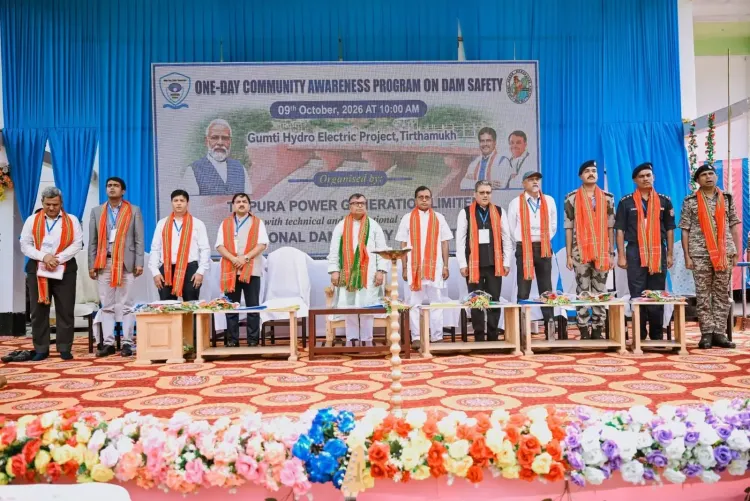
Nath made the announcement while addressing a one-day Community Awareness Programme on Dam Safety at the Gumti Hydro Electric Project in Tirthamukh, southern Tripura. The event was held under the leadership of the National Dam Safety Authority. The Gumti hydroelectric project was established 56 years ago at the confluence of the Raima and Saima rivers, a site of geographical and historical significance as it is associated with the source of the Gomati river in Tripura.
The plant originally housed three generation units capable of producing 15 MW of power. Output declined progressively over the years, and following the Bharatiya Janata Party (BJP) government assuming office, generation had dropped to just 2 to 3 MW. Severe flooding in 2024 dealt a further blow to the infrastructure, significantly curtailing its power generation capacity.
Survey and Assessment Process
Following the flood damage, a detailed technical survey was commissioned with the involvement of the National Institute of Technology (NIT), IIT Guwahati, Bharat Heavy Electricals Limited (BHEL), and the National Hydroelectric Power Corporation (NHPC). The assessment examined the project's current structural and operational condition to determine the feasibility of restoring generation capacity.
Notably, an underwater robot was brought from Kerala to inspect the condition of the Dumboor Dam and evaluate subsurface damage to its infrastructure — an indication of the technical complexity of the restoration effort.
Dam Safety and Legislative Context
The Minister highlighted that India enacted a Dam Safety Act in 2021 under Prime Minister Narendra Modi, covering more than 7,000 dams across the country. He described the legislation as a forward-looking preventive measure rather than a response to any immediate crisis. Regular pre-monsoon and post-monsoon inspections of dams are now mandatory under the law, conducted in coordination with relevant agencies to identify and mitigate structural risks.
'Ensuring the safety of people living downstream is our highest priority,' Nath said, underlining the importance of inter-agency coordination and public awareness to prevent dam-related disasters.
Beyond Power: Livelihoods and Connectivity
Nath also highlighted the broader socio-economic significance of the Dumboor area, noting that its 48 lakes support fish cultivation on which thousands of residents depend for their livelihoods. He described the Gomati project as Tripura's first power generation project and a place of historical importance to the state.
In a related announcement, the Minister said the last state Cabinet meeting approved a plan to extend Bharat Sanchar Nigam Limited (BSNL) network coverage and install mobile towers in connectivity-deprived and remote areas of the state. Work on that initiative is also expected to begin soon.
What Comes Next
With restoration work at the Dumboor plant slated to begin in December, Tripura is seeking to reclaim a significant share of its legacy hydropower capacity. The success of the ₹100 crore investment will depend on execution timelines and the durability of refurbished infrastructure against future flood events — a recurring challenge for projects in the region's river systems.
Point of View
IIT Guwahati, BHEL and NHPC simultaneously signals serious intent, but the project's history — capacity sliding from 15 MW to 2 MW over decades — points to chronic maintenance failures that a one-time capital infusion alone cannot fix. With northeastern states increasingly exposed to extreme flood events, the deeper question is whether the restoration design builds in flood resilience, or simply reconstructs what was there before. The BSNL connectivity rider is a useful add-on but risks diluting focus on the core infrastructure task.
NationPress
10 Oct 2026
Frequently Asked Questions
What is the Dumboor hydropower plant restoration project in Tripura?
It is a ₹100 crore state government initiative to revive the ageing Dumboor hydropower plant in Gomati district, Tripura, targeting a generation capacity of 10 to 11 MW. The plant, part of the Gumti Hydro Electric Project established 56 years ago, was severely damaged by floods in 2024 and currently generates only 2–3 MW.
When will restoration work on the Dumboor plant begin?
Restoration work is scheduled to commence in December 2025, according to Power Minister Ratan Lal Nath. The investment of ₹100 crore has already been planned following technical surveys by NIT, IIT Guwahati, BHEL, and NHPC.
Why did the Dumboor hydropower plant's output decline so sharply?
The plant's output declined gradually over the years from its original capacity of 15 MW to just 2–3 MW, a fall attributed to ageing infrastructure and deferred maintenance. Severe flooding in 2024 caused further structural damage, prompting the detailed multi-agency technical assessment.
What is India's Dam Safety Act 2021 and why is it relevant here?
The Dam Safety Act 2021 is a central law enacted to regulate the monitoring, inspection and maintenance of India's more than 7,000 large dams. Minister Nath highlighted it as a forward-looking preventive measure, noting that mandatory pre-monsoon and post-monsoon inspections are now conducted under its framework.
Who carried out the technical assessment of the Dumboor Dam?
The assessment involved NIT, IIT Guwahati, BHEL, and NHPC, who collectively surveyed the project's structural and operational condition. An underwater robot sourced from Kerala was also deployed to inspect subsurface damage to the dam infrastructure.