CM Yogi Launches ₹5 Lakh Cashless Medical Scheme for UP Teachers
Synopsis
Uttar Pradesh has launched the Mukhya Mantri Shikshak Cashless Chikitsa Yojana for higher education institutions, providing ₹5 lakh per year in cashless medical cover to over 2 lakh teachers and non-teaching staff — reaching approximately 10 lakh beneficiaries including their families.
Key Takeaways
The Mukhya Mantri Shikshak Cashless Chikitsa Yojana for higher education institutions was formally launched on 26 July 2026 .
The scheme provides ₹5 lakh per year in cashless medical treatment to eligible beneficiaries.
Over 2 lakh teachers and non-teaching employees of higher education institutions in Uttar Pradesh are covered.
Including family members, the total beneficiary count reaches approximately 10 lakh individuals .
The initiative extends the cashless model pioneered under Ayushman Bharat to a specific organised employee group in the state.
Implementation will require hospital empanelment and beneficiary card issuance across all 75 districts of Uttar Pradesh.
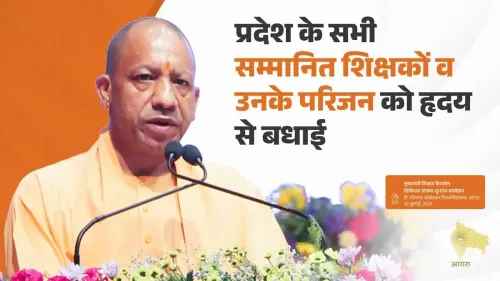
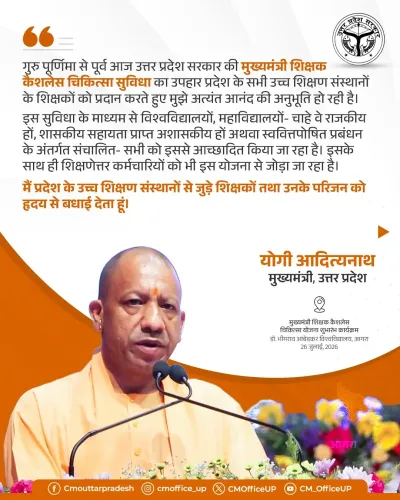
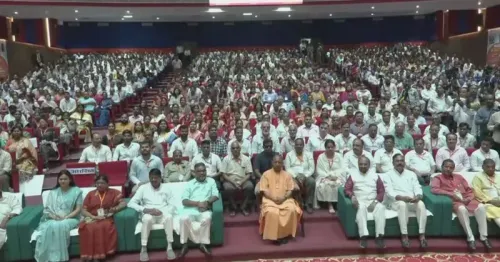
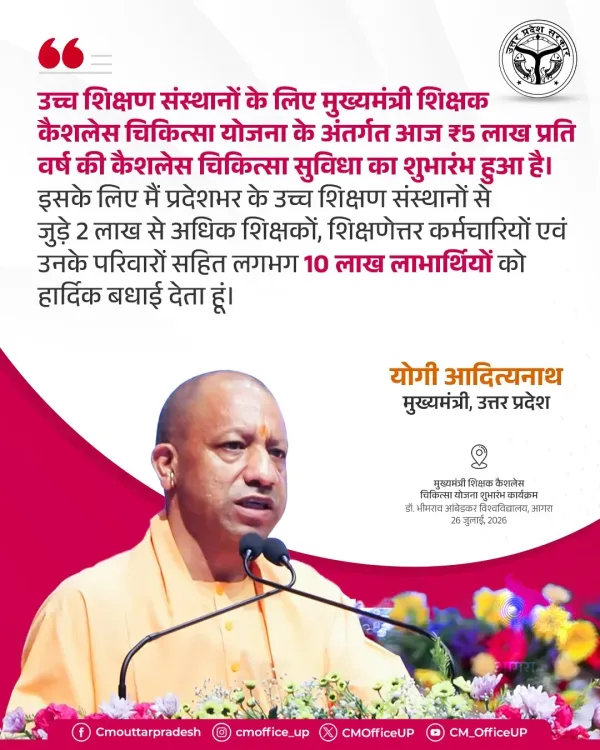
The Chief Minister's Office of Uttar Pradesh announced on Sunday, 26 July 2026 the launch of the Mukhya Mantri Shikshak Cashless Chikitsa Yojana for higher education institutions, extending cashless medical coverage of ₹5 lakh per year to teachers, non-teaching staff, and their families across the state.
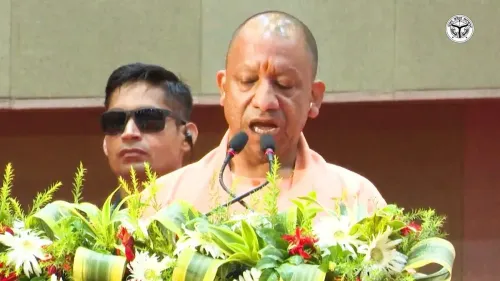
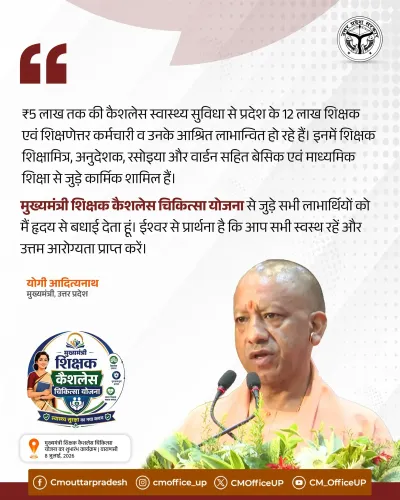
Chief Minister Yogi Adityanath, in a message shared via the official CMO account, said: 'उच्च शिक्षण संस्थानों के लिए मुख्यमंत्री शिक्षक कैशलेस चिकित्सा योजना के अंतर्गत आज ₹5 लाख प्रति वर्ष की कैशलेस चिकित्सा सुविधा का शुभारंभ हुआ है' — ('Today, cashless medical facilities worth ₹5 lakh per year have been launched under the Chief Minister Teacher Cashless Medical Scheme for higher education institutions.'). He extended congratulations to approximately 10 lakh beneficiaries, including over 2 lakh teachers and non-teaching employees and their families attached to higher education institutions across Uttar Pradesh.
Context
The scheme targets the organised workforce in state-run and state-aided colleges and universities, a segment that has historically relied on reimbursement-based medical claims — a process prone to delays and out-of-pocket burdens. The new cashless model allows beneficiaries to access treatment at empanelled hospitals without upfront payment, with the state settling bills directly. The announcement marks a formal expansion of the scheme's coverage to the higher education sector specifically.
Policy Backdrop
The initiative builds on the architecture established by the national Ayushman Bharat Pradhan Mantri Jan Arogya Yojana, launched in 2018, which introduced cashless secondary and tertiary care at scale. Several Indian states have since layered sector-specific employee schemes on top of that central framework, and Uttar Pradesh follows the same pattern by tailoring coverage to occupational groups with large family dependencies. The ₹5 lakh annual ceiling aligns with the standard benchmark used across comparable state-level employee health programmes.
The Yogi Adityanath government has progressively extended health coverage to organised public-sector employee groups since 2017, positioning such schemes as part of a broader social-security push for state government workers. The inclusion of non-teaching staff alongside teachers broadens the scheme's reach beyond the classroom to administrative and support personnel in higher education.
Stakeholders and Impact
The scheme's stated beneficiary base of approximately 10 lakh individuals — spanning 2 lakh-plus employees and their dependants — makes it one of the larger single-sector employee health launches in the state's recent history. For families of college and university staff, cashless access removes a critical financial barrier during medical emergencies, particularly for high-cost treatments such as surgery, hospitalisation, and specialist consultations. Non-teaching staff, who typically earn less than faculty, stand to benefit disproportionately from the removal of upfront payment requirements.
Higher education institutions across Uttar Pradesh — from large state universities to district-level colleges — fall within the scheme's ambit, meaning the rollout will require coordinated hospital empanelment and issuance of health cards across a geographically dispersed workforce.
What's Next
Implementation will hinge on the speed of hospital empanelment, issuance of beneficiary cards, and publication of operational guidelines by the state health and higher education departments. Observers will watch whether the government extends similar cashless cover to teachers in school education or other public-sector categories in upcoming state budget announcements. The success of hospital network integration across Uttar Pradesh's 75 districts will determine how quickly the announced benefit translates into on-ground access for the scheme's 10 lakh intended beneficiaries.
Point of View
Named welfare schemes for discrete voter blocs within the organised public sector ahead of electoral cycles. By targeting higher education staff — a relatively vocal and networked constituency — the government signals that social security expansion is not limited to below-poverty-line populations but extends to the salaried middle class. The ₹5 lakh ceiling and the cashless modality are politically legible benchmarks that are easy to communicate and difficult for opponents to oppose. The real test will be operational: whether empanelled hospital networks are adequate and claims are settled without the bureaucratic friction that has historically plagued state employee health schemes.
NationPress
25 Oct 2026
Frequently Asked Questions
What is the Mukhya Mantri Shikshak Cashless Chikitsa Yojana in UP?
It is a Uttar Pradesh government scheme that provides cashless medical treatment of up to ₹5 lakh per year to teachers, non-teaching staff of higher education institutions, and their families.
Who is eligible for the UP teacher cashless medical scheme?
Teachers and non-teaching employees of higher education institutions — such as state universities and colleges — in Uttar Pradesh are eligible, along with their dependent family members, covering approximately 10 lakh beneficiaries in total.
How much cashless medical cover does the UP teacher scheme provide?
The scheme provides ₹5 lakh per year in cashless medical treatment per beneficiary, allowing hospital bills to be settled directly by the state government without upfront payment.
When was the Mukhya Mantri Shikshak Cashless Chikitsa Yojana launched?
The cashless medical facility under the scheme for higher education institutions was launched on 26 July 2026 , as announced by Chief Minister Yogi Adityanath through the official CMO account.
How many people benefit from the UP teacher cashless health scheme?
The scheme covers over 2 lakh teachers and non-teaching staff of higher education institutions in Uttar Pradesh, and including their families, the total beneficiary count is approximately 10 lakh individuals .