UPI hits 24,000 crore transactions in 2026, now half of global real-time payments
Synopsis
What began with 90,000 transactions in August 2016 now processes 24,000 crore annually and handles nearly half the world's real-time payments. The IMF has formally crowned UPI the largest retail fast-payment system on the planet — and countries from France to Qatar are already using it. India didn't just build a payments app; it built the global benchmark.
Key Takeaways
UPI processed more than 24,000 crore transactions worth nearly ₹314 lakh crore in FY 2025-26 .
The platform now accounts for 84% of India's digital payments and nearly half of all global real-time payment transactions.
Banks live on UPI grew from 44 in FY 2016-17 to 703 in FY 2025-26.
The IMF named UPI the world's largest retail fast-payment system by volume in its June 2025 report.
UPI is accepted in Bhutan, Nepal, France, UAE, Singapore, Cyprus, and Qatar , with further expansions under way.
Multiple countries are reportedly exploring UPI-like platforms , reflecting its growing influence as a global policy model.
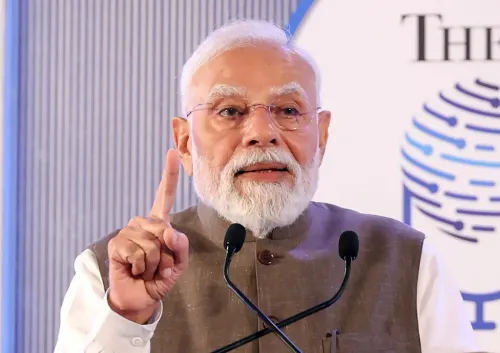
Unified Payments Interface (UPI), launched on 31 December 2016 by Prime Minister Narendra Modi at the DigiDhanMela inauguration, has grown from roughly 90,000 transactions in its first month to more than 24,000 crore transactions worth nearly ₹314 lakh crore in FY 2025-26 — a journey the Prime Minister on Tuesday described as something 'every Indian can be proud of.' UPI now accounts for nearly half of all global real-time payment transactions, cementing India's position as the world's foremost digital payments economy.
A Decade of Scale
The numbers chart a near-vertical trajectory. In its first full year, UPI processed fewer than 2 crore transactions. By FY 2025-26, it commanded 84 per cent of India's total digital payments volume. The number of banks live on the platform expanded from 44 in FY 2016-17 to 703 in FY 2025-26, spanning public and private sector lenders, small finance banks, and cooperative banks. Prime Minister Modi, in a post on X, noted that UPI had registered 'nearly a 13,000-fold rise in transaction value' — a figure that underscores how rapidly digital payments displaced cash in everyday Indian life.
IMF Recognition and Global Standing
In its June 2025 report titled Growing Retail Digital Payments: The Value of Interoperability, the International Monetary Fund (IMF) identified UPI as the largest retail fast-payment system globally by transaction volume. The IMF credited UPI's scale and interoperability — its ability to let users freely choose among multiple apps and banks while maintaining seamless transactions — as the primary drivers of rapid adoption. Developed by the National Payments Corporation of India (NPCI), the platform supports apps including BHIM, PhonePe, Google Pay, and Paytm.
Going Global: UPI's International Footprint
UPI has been integrated across several countries to serve Indian tourists, expatriates, and businesses, primarily through QR-code-based acceptance. The platform is currently live in Bhutan, Nepal, France, the UAE, Singapore, Cyprus, and Qatar, with ongoing expansions across Europe, Southeast Asia, and the Middle East. Notably, multiple institutions across different countries are reportedly exploring the development of UPI-like platforms of their own — a signal of the system's influence as a policy model.
Inclusion at the Core
Beyond macroeconomic metrics, UPI's impact has been deeply social. Shopkeepers, street vendors, farmers, and students have adopted digital payments at scale, transforming the platform into what observers call a citizen-centric financial revolution. The platform's design — interoperable, app-agnostic, and free for most users — deliberately lowered barriers that had historically excluded large sections of the population from formal financial infrastructure.
What Comes Next
As UPI enters its second decade, policymakers and industry bodies are focused on deepening its international integration and strengthening bilateral economic partnerships through payment-system linkages. The platform's trajectory suggests it will remain both a domestic financial backbone and an instrument of India's broader digital soft power ambitions in the years ahead.
Point of View
000-fold rise in transaction value is a genuine infrastructure achievement — but the more consequential story is geopolitical. When the IMF benchmarks your payments rail and seven countries accept your QR codes, a domestic fintech tool becomes a foreign policy instrument. India's challenge now is governance at scale: ensuring interoperability standards, fraud frameworks, and cross-border settlement rules keep pace with an ambition that has clearly outgrown its original mandate. The risk of complacency — assuming dominance is self-sustaining — is real.
NationPress
26 Aug 2026
Frequently Asked Questions
How many transactions does UPI process today?
UPI processed more than 24,000 crore transactions worth nearly ₹314 lakh crore in FY 2025-26, up from fewer than 2 crore transactions in its first full year of operations. This represents a nearly 13,000-fold rise in transaction value since launch.
What did the IMF say about UPI in 2025?
In its June 2025 report titled 'Growing Retail Digital Payments: The Value of Interoperability', the IMF identified UPI as the largest retail fast-payment system globally by transaction volume. It credited UPI's interoperability — letting users choose freely among apps and banks — as the key driver of its rapid adoption.
Which countries accept UPI payments?
UPI is currently accepted in Bhutan, Nepal, France, the UAE, Singapore, Cyprus, and Qatar, primarily through QR-code-based systems. Expansions are ongoing across Europe, Southeast Asia, and the Middle East.
When was UPI launched and by whom?
UPI was launched on 31 December 2016 by Prime Minister Narendra Modi at the DigiDhanMela event. It was developed by the National Payments Corporation of India (NPCI) and initially recorded around 90,000 transactions in its first month of operations in August 2016.
What share of global real-time payments does UPI handle?
According to figures cited by Prime Minister Modi, UPI now accounts for nearly half of all global real-time payment transactions. In India, it represents 84% of total domestic digital payments volume as of FY 2025-26.