Vaishnaw Flags Muri Jn, Piska as Amrit Stations in Jharkhand
Synopsis
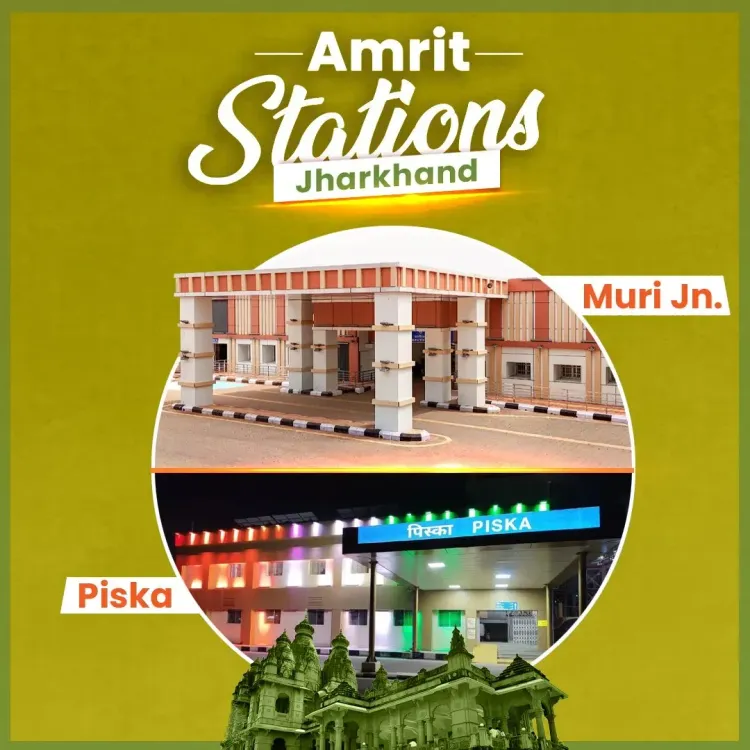
Union Minister Ashwini Vaishnaw on 17 July 2026 identified Muri Junction and Piska as Jharkhand's Amrit Bharat stations, citing their role in supporting the state's industrial growth and improving urban connectivity under the 1,300-plus station redevelopment scheme launched in 2023.
Key Takeaways
Muri Junction and Piska in Jharkhand have been identified as Amrit Bharat redevelopment stations by Union Minister Ashwini Vaishnaw .
The Amrit Bharat Station Scheme , launched in February 2023 , covers more than 1,300 railway stations across India.
Muri Junction is a key node on the Ranchi–Dhanbad corridor serving coal and steel freight traffic.
Piska station serves the suburban and regional commuter network around Ranchi , Jharkhand's capital.
The redevelopment aims to provide modern, airport-like amenities and multimodal integration at both stations.
Jharkhand's mineral and manufacturing economy makes improved rail connectivity a priority under the national infrastructure push.
Union Minister Ashwini Vaishnaw on Friday, 17 July 2026 highlighted two Jharkhand stations — Muri Junction and Piska — as part of the ongoing redevelopment under the Amrit Bharat Station Scheme, describing them as platforms for supporting the state's industrial growth and expanding urban connectivity.
Context
The minister's post, the 17th in a series flagging Amrit stations across states, identified Muri Junction and Piska as stations receiving modern upgrades aimed at delivering a 'seamless travel experience' for passengers. Both stations serve Jharkhand, a state with a dense industrial base anchored in coal, steel, and manufacturing. Muri Junction lies on the strategically important Ranchi–Dhanbad rail corridor, while Piska provides suburban and regional connectivity in the Ranchi capital region.
Policy Backdrop
The Amrit Bharat Station Scheme, launched in February 2023, targets the redevelopment of more than 1,300 railway stations across India with airport-like passenger amenities, improved circulation areas, and multimodal integration. The scheme builds on earlier initiatives — including the Adarsh Station programme begun in 2018 — but operates at a significantly larger scale and budget. The Ministry of Railways has been rolling out station-wise announcements in batches, with the current series covering stations in multiple states simultaneously.
Jharkhand's inclusion in the scheme reflects a deliberate policy focus on eastern India's mineral-rich corridor, where improved rail infrastructure is seen as a multiplier for freight efficiency and industrial logistics. Better passenger facilities at junction stations such as Muri also serve the dual purpose of easing commuter load and projecting a modern face for railway travel in Tier-2 and Tier-3 catchment areas.
Stakeholders and Impact
The primary beneficiaries of the redevelopment at Muri Junction and Piska are daily railway passengers, industrial workers, and freight operators who depend on these corridors for movement of goods and people. Jharkhand's economy, heavily reliant on steel plants, collieries, and allied manufacturing, stands to benefit from smoother passenger throughput that reduces pressure on road networks. Local vendors, small businesses, and commuters in the Ranchi metropolitan region are also expected to gain from upgraded station facilities.
For the central government, each Amrit Station announcement serves as a visible proof-point of the infrastructure push in states where industrial growth is a political and economic priority. Eastern states such as Jharkhand have historically received comparatively lower per-capita railway investment, making the current redevelopment cycle politically significant ahead of state-level electoral cycles.
What's Next
Observers will watch for the completion timelines and passenger-readiness audits for Muri Junction and Piska, as well as any state-level memoranda of understanding or budget line-items in the forthcoming Railway Budget that earmark funds specifically for Jharkhand. The broader series of Amrit Station announcements suggests that the Ministry of Railways intends to maintain a high communication tempo on infrastructure delivery through the second half of 2026, keeping station modernisation at the centre of the government's development narrative.
Point of View
State by state — is a deliberate communications strategy by the Ministry of Railways to sustain visibility for a scheme that spans multiple budget cycles and electoral calendars. Highlighting Jharkhand specifically signals continued central investment in eastern India's industrial belt, a region the BJP has been working to consolidate politically. The pairing of Muri Junction, an industrial freight hub, with Piska, a suburban passenger station, suggests the scheme is being positioned as serving both economic and everyday commuter interests simultaneously. Whether the on-ground redevelopment pace matches the announcement cadence will be the metric that ultimately defines the scheme's legacy.
NationPress
16 Oct 2026
Frequently Asked Questions
What is the Amrit Bharat Station Scheme?
The Amrit Bharat Station Scheme is a central government programme launched in February 2023 to modernise more than 1,300 railway stations across India with improved passenger amenities, better circulation areas, and multimodal connectivity, similar to airport-level facilities.
Which Jharkhand stations are being redeveloped under Amrit Bharat?
Union Minister Ashwini Vaishnaw announced on 17 July 2026 that Muri Junction and Piska are among the Jharkhand stations being redeveloped under the Amrit Bharat Station Scheme.
Where is Muri Junction located and why is it important?
Muri Junction is a major railway station in Jharkhand situated on the Ranchi–Dhanbad corridor. It plays a critical role in the movement of coal, steel, and industrial freight in the region.
What is Piska station and which city does it serve?
Piska is a railway station located near Ranchi, Jharkhand's state capital, providing suburban and regional connectivity to commuters in the capital region.
How many stations are covered under the Amrit Bharat Station Scheme?
The Amrit Bharat Station Scheme covers more than 1,300 railway stations across India, making it one of the largest station redevelopment programmes in the country's history.