Vedic Chants Welcome PM Modi in Philippines
Synopsis
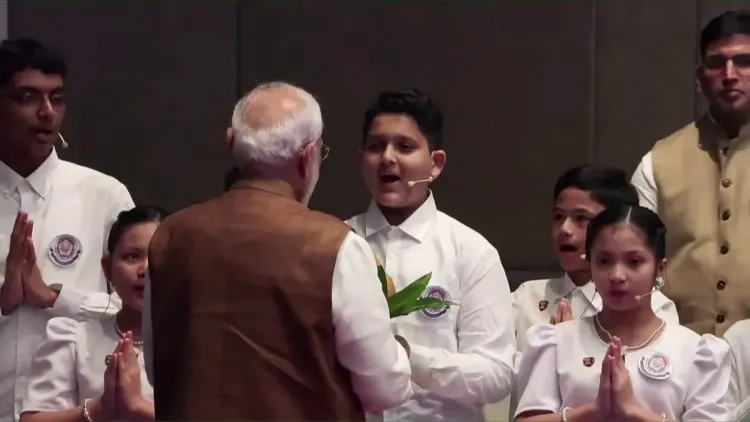
Union Culture and Tourism Minister Gajendra Singh Shekhawat announced that Prime Minister Modi was welcomed in the Philippines with Vedic recitations from the Taittiriya Aranyaka's Mahanarayanopanishad, underscoring India's cultural soft-power strategy in the ASEAN region.
Key Takeaways
PM Narendra Modi was welcomed in the Philippines with recitations from the Mahanarayanopanishad of the Taittiriya Aranyaka on 16 November 2026 .
Union Culture and Tourism Minister Gajendra Singh Shekhawat shared the moment on X, framing it as a cultural milestone in Indian diplomacy.
Two specific Vedic verses were cited — one invoking the pure inner consciousness, and one identifying the supreme being with the primordial Vedic sound.
The gesture aligns with India's Act East Policy (2014) , which prioritises cultural and people-to-people links with ASEAN partners including the Philippines.
Prime Minister Modi's foreign visits have consistently featured Vedic recitations as a soft-power instrument across the Indo-Pacific.
Thousands of miles from the banks of the Ganga, the ancient syllables of the Taittiriya Aranyaka rang out in the Philippines — as Union Culture and Tourism Minister Gajendra Singh Shekhawat shared that Prime Minister Narendra Modi was welcomed with Vedic recitations from the Mahanarayanopanishad during his ongoing visit on Monday, 16 November 2026.
Shekhawat's post highlighted two specific Sanskrit verses from the reception. The first, from the Mahanarayanopanishad, reads: 'dahrṃ vipāpaṃ parameśmabhūtaṃ yatpuṇḍarīkaṃ puramadhyasaṃstham' — invoking the pure, stainless space within the lotus-heart, the innermost consciousness worthy of contemplation. The second verse identifies the supreme being as the one proclaimed as the primordial sound at the beginning of the Vedas and established at the Vedanta: 'yo vedādau svaraḥ prokto vedānte ca pratiṣṭhitaḥ, tasya prakṛtilīnasya yaḥ paraḥ sa maheśvaraḥ' — 'that which is beyond, dissolved into nature, is the great lord.' These are not decorative incantations; they are among the most philosophically dense passages in the Vedic canon.
Soft Power Lands in Southeast Asia
The gesture fits a well-established template in India's cultural diplomacy playbook. Since the articulation of the Act East Policy in 2014, New Delhi has consistently woven Vedic heritage into the ceremonial fabric of Prime Minister Modi's foreign visits — particularly across ASEAN nations — as a signal of civilisational continuity rather than purely transactional statecraft. The Philippines, as an expanding strategic and economic partner in this framework, now joins that arc.
Shekhawat, as the minister directly responsible for India's cultural projection abroad, framed the moment with evident pride: 'Filippīns mein gūñjī vedoṃ kī vāṇī!' — 'The voice of the Vedas echoed in the Philippines!' The exclamation carries institutional weight, not just personal enthusiasm, signalling that the cultural programming around this visit was deliberate and ministry-coordinated.
Philippines and India: A Partnership With Deep-Rooted Ambitions
The Philippines has hosted several high-level Indian delegations in recent years, with bilateral conversations spanning defence cooperation, digital infrastructure, and people-to-people ties. For the Indian diaspora and Vedic scholars watching the visit, the recitation of the Mahanarayanopanishad in Manila is a marker that cultural diplomacy remains a first-order instrument — not an afterthought — in India's Indo-Pacific outreach. Watch for joint cultural agreements or a follow-up India-ASEAN heritage forum as the visit concludes.
Point of View
Not an improvised flourish. Minister Shekhawat's public amplification of the moment underscores that the Culture Ministry views ASEAN outreach as an active front in civilisational soft power, distinct from purely economic or security bilaterals. As the Philippines deepens its strategic alignment with both India and the United States in the Indo-Pacific, New Delhi's choice to open with Vedic heritage suggests it wants the relationship anchored in an older, deeper narrative than defence procurement alone. The question going forward is whether these cultural overtures translate into durable institutional frameworks — joint heritage programmes, scholarship exchanges, or cultural centres — or remain largely symbolic touchstones.
NationPress
16 Nov 2026
Frequently Asked Questions
Which Vedic text was recited to welcome PM Modi in the Philippines?
The recitation was from the Mahanarayanopanishad , part of the Taittiriya Aranyaka within the Krishna Yajurveda tradition — one of the most philosophically significant texts in the Vedic canon.
Why was PM Modi given a Vedic welcome in the Philippines?
The Vedic reception reflects India's deliberate use of cultural heritage as soft power during Prime Minister Modi's foreign visits, a practice closely tied to the Act East Policy that prioritises deeper ties with ASEAN nations including the Philippines.
What does the Mahanarayanopanishad verse recited in Manila mean?
The first verse invokes the pure, stainless inner space within the lotus-heart as the supreme object of contemplation. The second identifies the great lord as the one who is the primordial sound proclaimed at the start of the Vedas and established at the Vedanta — both are among the deepest metaphysical passages in Vedic literature.
What is India's Act East Policy and how does it relate to this visit?
India's Act East Policy , articulated in 2014 , prioritises strategic, economic, and cultural engagement with ASEAN nations. The Philippines is a key partner under this framework, and cultural programming like Vedic recitations is part of the people-to-people pillar of this policy.
What is Gajendra Singh Shekhawat's role in Indian cultural diplomacy?
Gajendra Singh Shekhawat is India's Union Minister of Culture and Tourism and a senior BJP leader and Lok Sabha MP from Jodhpur, Rajasthan. His ministry oversees cultural outreach programmes that form part of India's broader soft-power strategy abroad.