Vijay's Janmashtami greetings: A break from Tamil Nadu's Dravidian rationalist tradition?
Synopsis
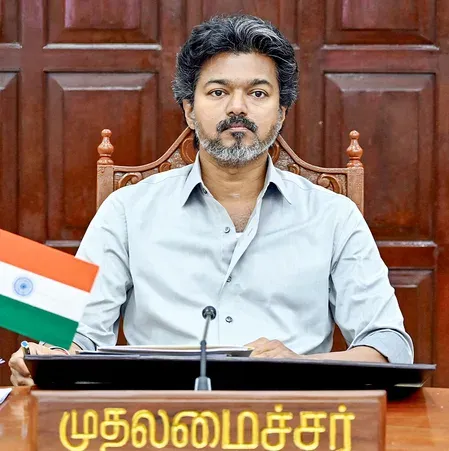
Tamil Nadu CM Vijay's Janmashtami greeting — invoking Lord Krishna's teachings on dharma — is a small act with large political implications. In a state where Dravidian leaders from Periyar to Stalin kept religious symbolism out of political discourse, the TVK chief's move signals a potential rewriting of the ideological rulebook, and it is drawing scrutiny from rationalist quarters.
Key Takeaways
Joseph Vijay extended Janmashtami greetings on 4 September , invoking Lord Krishna 's teachings on dharma and righteousness.
The move is seen as a departure from the Dravidian rationalist tradition established by Periyar E.V.
Ramasamy and carried forward by C.N.
Stalin has no publicly reported history of extending greetings on Hindu festivals.
Vijay leads Tamilaga Vettri Kazhagam (TVK) and is reportedly testing a hybrid model blending Tamil pride with selective religious inclusivity.
Analysts warn the strategy could alienate rationalist supporters while potentially attracting moderate Hindu voters.
Tamil Nadu Chief Minister C. Joseph Vijay's decision to extend Janmashtami greetings on Friday, 4 September, invoking Lord Krishna's teachings on dharma, righteousness, and love, has drawn attention in political circles as a potential departure from the rationalist, secular tradition that has defined Dravidian politics in the state for nearly a century. The move is being read by some analysts as a deliberate recalibration of Tamilaga Vettri Kazhagam (TVK)'s political positioning in a crowded electoral landscape.
Dravidian Rationalism: The Ideological Backdrop
The Dravidian movement, which has shaped Tamil Nadu's political identity since the early 20th century, was built on a foundational rejection of religious orthodoxy and caste hierarchy. Periyar E.V. Ramasamy, its ideological architect, sought to dismantle what he characterised as Brahminical dominance perpetuated through Hindu ritual and mythology.
This rationalist legacy was carried forward by C.N. Annadurai, founder of the Dravida Munnetra Kazhagam (DMK), who championed Tamil cultural pride while consciously avoiding overt religious symbolism. His successor, M. Karunanidhi, went further, explicitly critiquing Hindu rituals in his writings and speeches. Notably, there are no publicly reported instances of Karunanidhi's son and former Chief Minister M.K. Stalin extending greetings on Hindu festivals.
What Vijay's Greeting Signals
Against this historical backdrop, Chief Minister Vijay's Janmashtami message represents a meaningful break from precedent. By invoking Lord Krishna's teachings in a political communication, he introduced religious symbolism into a space that Dravidian leaders had reportedly kept secular for decades.
Some analysts interpret the move as part of a broader strategy to carve out a distinct identity for TVK. Vijay's background as one of Tamil cinema's most celebrated actors gives him an unusual ability to connect with younger voters, many of whom may not be as ideologically anchored to Periyarist rationalism as older generations.
A Hybrid Political Model
The approach Vijay appears to be testing blends Tamil cultural pride with selective religious inclusivity — a model that has no direct precedent in mainstream Dravidian politics. M.G. Ramachandran (MGR), who founded the All India Anna Dravida Munnetra Kazhagam (AIADMK), reportedly never subscribed to the atheist ideology of Periyar's Dravidar Kazhagam (DK), yet he too avoided overt religious endorsements, preferring welfare politics and his cinematic persona.
Vijay's strategy, critics argue, goes a step further by actively incorporating devotional symbolism into political messaging — a distinction that sets it apart from both the DMK's secular rationalism and the AIADMK's welfare-first populism.
Risks and Opportunities
The political calculus carries both promise and risk. On one hand, the gesture may broaden Vijay's appeal among moderate Hindu voters who value cultural inclusivity, potentially expanding TVK's electoral base beyond traditional Dravidian constituencies. On the other, it risks alienating rationalist groups and hardcore Dravidian supporters who may view any integration of religious symbolism as a betrayal of foundational principles.
Whether this signals a lasting ideological shift or a tactical move ahead of electoral cycles remains to be seen. What is clear is that Tamil Nadu's long-stable political identity — anchored in Dravidian rationalism — is facing a new stress test under Chief Minister Vijay's leadership.
Point of View
And any dilution of that posture hands the DMK a ready attack line. But Vijay's bet may be that Tamil Nadu's younger electorate is less doctrinally Periyarist than its leadership assumes — and that cultural inclusivity, not ideological purity, is the new electoral currency.
NationPress
20 Oct 2026
Frequently Asked Questions
What did Tamil Nadu CM Vijay say in his Janmashtami greetings?
CM Vijay extended greetings on the occasion of Janmashtami, invoking Lord Krishna's teachings on dharma, righteousness, and love. The message introduced religious symbolism into his political communication, which analysts have noted as a departure from Dravidian tradition.
Why is Vijay's Janmashtami greeting considered significant in Tamil Nadu politics?
Tamil Nadu's Dravidian political tradition, rooted in the rationalist ideology of Periyar E.V. Ramasamy, has historically avoided overt religious symbolism. Leaders such as C.N. Annadurai, M. Karunanidhi, and M.K. Stalin maintained a secular public posture, making Vijay's greeting a notable break from that norm.
What is Tamilaga Vettri Kazhagam (TVK) and who leads it?
Tamilaga Vettri Kazhagam (TVK) is the political party led by Tamil Nadu Chief Minister C. Joseph Vijay, the former Tamil film star. The party is positioning itself as a new force in the state's crowded political landscape.
How did MGR's AIADMK approach religion in politics?
M.G. Ramachandran (MGR), founder of the All India Anna Dravida Munnetra Kazhagam (AIADMK), reportedly did not subscribe to the atheist ideology of Periyar's Dravidar Kazhagam, but he too avoided overt religious endorsements, preferring welfare schemes and his cinematic appeal as political tools.
What are the political risks of Vijay's approach for TVK?
Analysts argue the strategy could alienate rationalist groups and hardcore Dravidian supporters who may see religious symbolism in political messaging as a betrayal of foundational Dravidian principles. At the same time, it could expand TVK's appeal among moderate Hindu voters and younger voters less tied to Periyarist ideology.