Omar Abdullah questions BJP states' UCC push: 'Bring it to Parliament first'
Synopsis
J&K Chief Minister Omar Abdullah has cut to the heart of the BJP's UCC strategy: if it's truly uniform, why introduce it only in states you govern? His pointed challenge — 'Bring it to Parliament' — is amplified by the reported refusal of NDA ally JD-U to implement the code in Bihar, exposing a coalition fault line the BJP cannot easily dismiss.
Key Takeaways
J&K CM Omar Abdullah on 15 September questioned BJP-ruled states pursuing the Uniform Civil Code (UCC) independently, calling for the legislation to be brought before Parliament first.
Abdullah argued a code cannot be called 'uniform' if it applies only to BJP -governed states, noting that a significant number of states and territories are not ruled by the party.
He highlighted that Janata Dal-United (JD-U) has reportedly stated the UCC will not be implemented in Bihar , pointing to cracks within the NDA .
Abdullah drew a parallel with other pending legislation — including 'One Nation, One Election' and reservation — none of which have been brought to Parliament.
The UCC proposes replacing religion-based personal laws with a single framework for all Indian citizens; Uttarakhand enacted such a law in 2024 .
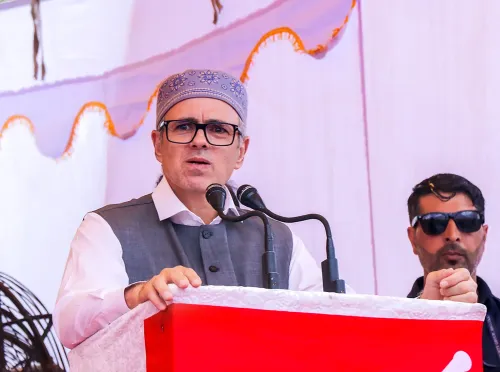
Jammu & Kashmir Chief Minister Omar Abdullah on Tuesday, 15 September challenged the decision of BJP-ruled states to independently pursue a Uniform Civil Code (UCC), asserting that legislation of such national significance must first come before Parliament rather than being introduced piecemeal across individual states. Abdullah made the remarks while speaking to reporters in Srinagar.
Abdullah's Core Challenge
'If you have the numbers, bring it to Parliament. Why are you doing it separately in different states?' Abdullah asked pointedly. He argued that a code described as 'uniform' loses its very meaning if it is enforced only in states governed by the Bharatiya Janata Party (BJP). 'The whole country is not BJP-ruled. There are a number of states and territories that the BJP does not govern,' he said.
Cracks Within the NDA
Abdullah also drew attention to reported divisions within the BJP-led National Democratic Alliance (NDA) itself. He noted that Janata Dal-United (JD-U) has reportedly stated it will not implement the UCC in Bihar. 'So if their own allies are not ready for it, how can they say that it should be implemented across the country?' he said. The JD-U's public resistance, according to Abdullah, undercuts the BJP's claim of a broad consensus even within its own coalition.
The Parliamentary Argument
The J&K Chief Minister argued that Parliament — not individual state assemblies — is the legitimate arena for a reform of this scale, since it alone represents the entire country. 'Something of this nature should not be decided by individual states. It has to be decided by the country as a whole. The entire country is represented not in the states, but in the Parliament. Let the legislation come to Parliament,' he said.
He also juxtaposed the UCC push with other high-profile legislative ambitions. 'So far, whenever they have talked about legislation in the Parliament, whether it is 'One Nation, One Election' or reservation, they have not brought it to the Parliament. Now, with this too, they are talking about bringing it in the states. Bring it to the Parliament and let us see whether you can pass it,' Abdullah said.
What Is the UCC
The Uniform Civil Code is a proposed single legislative framework that would replace religion-based personal laws — governing marriage, divorce, inheritance, and adoption — with a common set of rules applicable to all citizens of India, irrespective of religion. It has remained one of the most politically contested reform proposals in the country. Uttarakhand became the first state to enact a UCC law in 2024, and several other BJP-governed states have since indicated they may follow suit.
Political Context
Abdullah's remarks come amid a broader debate over whether individual states have the constitutional authority or political mandate to enact a UCC independently, given that personal law is a concurrent subject under the Indian Constitution. Critics of the state-by-state approach argue it creates a fragmented legal landscape rather than a genuinely uniform one. Supporters counter that state-level implementation can serve as a model for eventual national legislation. With the BJP lacking a majority in the Rajya Sabha to push through transformative legislation unilaterally, the state route is widely seen as a political and legislative workaround.
Point of View
By definition, not uniform — and the reported JD-U stance on Bihar makes the BJP's coalition arithmetic look shaky before a single parliamentary vote is cast. The state-by-state route increasingly reads as a hedge against Parliament, where the BJP does not command the numbers for sweeping personal law reform. The deeper question — whether India's plural federal democracy can absorb a single civil code at all — remains largely unaddressed in the political theatre around it.
NationPress
15 Sept 2026
Frequently Asked Questions
What did Omar Abdullah say about the UCC on 15 September 2026?
J&K Chief Minister Omar Abdullah said BJP-ruled states should not pursue the Uniform Civil Code independently and instead bring the legislation to Parliament. He argued that a code cannot be called 'uniform' if it is implemented only in states governed by the BJP.
Why is the UCC being introduced in individual states rather than Parliament?
The BJP does not currently command a majority in the Rajya Sabha sufficient to pass sweeping personal law reform unilaterally, making the state-level route a practical legislative option. Critics, including Abdullah, argue this approach produces a fragmented rather than genuinely uniform code.
What is the Uniform Civil Code and why is it controversial?
The UCC is a proposed single legal framework to replace religion-based personal laws governing marriage, divorce, inheritance, and adoption with common rules for all citizens. It is contested because it is seen by some communities as an encroachment on religious and cultural autonomy.
Which NDA ally has reportedly opposed the UCC in its state?
Janata Dal-United (JD-U) has reportedly stated that the UCC will not be implemented in Bihar. Abdullah cited this as evidence that even the BJP's own coalition partners are not uniformly behind the proposal.
Which state first enacted a UCC law?
Uttarakhand became the first Indian state to enact a Uniform Civil Code law in 2024. Several other BJP-governed states have since indicated they may follow with similar legislation.