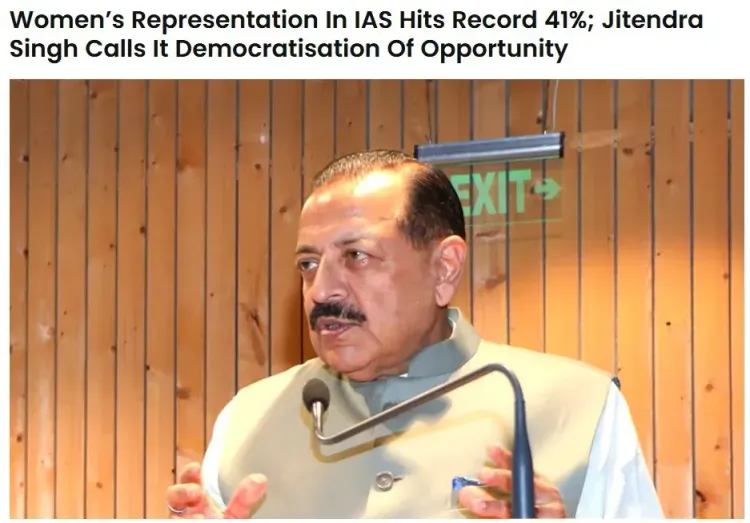
Jitendra Singh: Women in IAS hit record 41% share
Synopsis
Union Minister Dr. Jitendra Singh has highlighted that women's representation in the IAS has hit a record 41 per cent, calling it a 'democratisation of opportunity.' The milestone, flagged under the DoPT's watch, reflects a decades-long upward trend in female participation in India's premier civil service.
Key Takeaways
Women's representation in the IAS has reached a record 41 per cent , according to the statement shared by Dr.
Jitendra Singh holds charge of the Department of Personnel and Training (DoPT) , the nodal body for IAS cadre management.
The minister described the milestone as a 'democratisation of opportunity,' framing it within the government's inclusive-governance narrative.
The UPSC has documented a steady rise in women qualifying the Civil Services Examination since at least the 1990s.
The 41 per cent figure is expected to be formally confirmed in the forthcoming UPSC annual report carrying gender-wise CSE data.
Sustained diversity will depend on continued female participation in the CSE pipeline and supportive cadre-management policies.
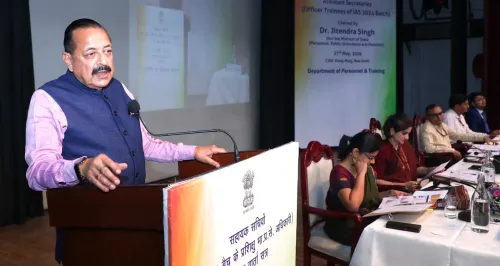
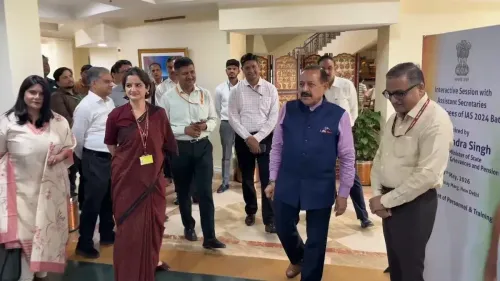
Union Minister of State (Independent Charge) for Science and Technology and Earth Sciences, and Minister of State in the Prime Minister's Office with charge of the Department of Personnel and Training (DoPT), Dr. Jitendra Singh, on Thursday, 28 May 2026, highlighted that women's representation in the Indian Administrative Service (IAS) has reached a record 41 per cent, describing the milestone as a 'democratisation of opportunity.'
Context
The statement, shared by Dr. Singh on X, references a report indicating that women now account for 41 per cent of IAS officers — the highest proportion recorded in the service's history. Dr. Singh framed the development not merely as a statistical achievement but as evidence of structural change in how the Indian state recruits and retains administrative talent. The hashtag #DoPT signals the post's institutional grounding in the ministry he oversees.
Policy Backdrop
The IAS, recruited through the annual Civil Services Examination (CSE) conducted by the Union Public Service Commission (UPSC), has seen a documented, decades-long rise in the share of women qualifiers. DoPT, as the nodal department for cadre management of All India Services, regularly publishes gender-disaggregated data drawn from UPSC results and state allocations. Post-2014, successive government statements have treated improving gender balance in the IAS as a marker of broader administrative reform, and the 41 per cent figure — if confirmed in the forthcoming UPSC annual report — would represent a significant acceleration of that trend.
The UPSC has released gender-wise CSE qualifier data since at least the 1990s, and the trajectory has been consistently upward, though the pace has varied across examination cycles. Policymakers have pointed to factors such as rising female literacy, urban and semi-urban aspirational growth, and coaching ecosystem expansion as drivers of increased women's participation at the examination stage.
Stakeholders and Impact
The immediate beneficiaries of this trend are women civil services aspirants across India, for whom the rising representation figure serves as both inspiration and evidence that the examination system is yielding more equitable outcomes. For the IAS cadre as an institution, a more gender-balanced composition has implications for policy sensitivity, district administration, and the delivery of welfare programmes — areas where research has consistently found that gender diversity in decision-making roles correlates with improved outcomes for women beneficiaries.
Dr. Singh's framing — 'democratisation of opportunity' — positions the development within the government's wider narrative of inclusive governance, linking administrative recruitment outcomes to constitutional values of equality and social justice. The DoPT's stewardship of cadre diversity data gives the ministry a direct institutional stake in publicising such milestones.
What's Next
Attention will now turn to the release of the next UPSC annual report, which is expected to carry detailed, category- and gender-wise breakdowns of CSE results and cadre allocations that would either substantiate or contextualise the 41 per cent figure. Parliamentary standing committees and opposition benches may seek a formal DoPT reply — through a written statement or question hour — to place the number on official record. Sustained progress will depend on whether the pipeline of women clearing the CSE at the final-selection stage continues to grow, and whether cadre-management policies support retention and senior-level deployment of women officers over the long term.
Point of View
If officially confirmed, would mark a structural inflection point in IAS gender composition rather than a marginal gain — making it politically significant for a government that has consistently linked administrative reform to social equity. Dr. Singh's choice to amplify the data under the #DoPT banner is deliberate: it ties a measurable outcome to his ministry's stewardship, strengthening the narrative ahead of any parliamentary scrutiny. The 'democratisation of opportunity' framing is also notable because it shifts the credit for the trend from reservation or affirmative-action mechanisms to the open-competition architecture of the UPSC — a framing that aligns with the BJP's meritocracy messaging. Analysts will watch whether the government follows the announcement with concrete cadre-management measures — such as senior posting parity or mentorship programmes — to sustain the pipeline beyond the headline number.
NationPress
19 Sept 2026
Frequently Asked Questions
What is the current percentage of women in the IAS?
According to a statement by Union Minister Dr. Jitendra Singh on 28 May 2026, women's representation in the IAS has reached a record 41 per cent, the highest proportion documented in the service's history.
Who is responsible for IAS cadre management in India?
The Department of Personnel and Training (DoPT), currently under the charge of Union Minister of State Dr. Jitendra Singh, is the nodal body responsible for recruitment policy, cadre management, and training of the IAS and other All India Services.
How are women selected into the IAS?
Women enter the IAS through the Civil Services Examination conducted annually by the Union Public Service Commission (UPSC), a constitutional body. There is no gender-specific quota in the main examination; selection is based on merit in a common competitive process.
What does 'democratisation of opportunity' mean in the context of the IAS?
Dr. Jitendra Singh used the phrase 'democratisation of opportunity' to describe the record 41 per cent women's representation in the IAS, suggesting that the civil services recruitment process is yielding more equitable outcomes across gender lines.
What is the UPSC Civil Services Examination?
The UPSC Civil Services Examination is an annual all-India competitive examination that recruits officers into the IAS, IPS, IFS, and other central services. It is widely considered one of the most competitive examinations in India, with candidates progressing through a preliminary test, mains, and a personality interview.