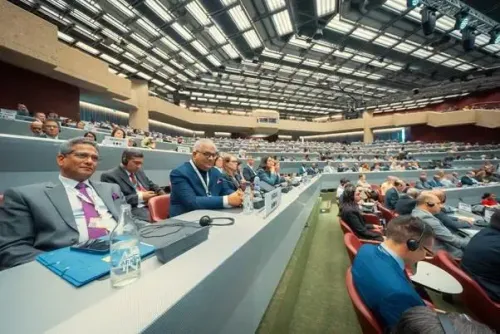
Yadav Answers Rajya Sabha Query on Biodiversity Finance for Local Communities

Synopsis
Union Environment Minister Bhupender Yadav answered a Rajya Sabha question on July 30, 2026, on whether global biodiversity finance is reaching indigenous peoples and local communities, a key obligation under India's commitments to the Convention on Biological Diversity and the Nagoya Protocol.
Key Takeaways
Union Environment Minister Bhupender Yadav answered a question in Rajya Sabha on July 30, 2026 on biodiversity finance reaching indigenous and local communities.
India ratified the Convention on Biological Diversity in 1994 and the Nagoya Protocol in 2012 , obligating equitable benefit-sharing with local custodians of genetic resources.
The Biological Diversity Act, 2002 established Biodiversity Management Committees (BMCs) as the statutory mechanism for local-level benefit-sharing.
The National Biodiversity Authority (NBA) is the apex body overseeing implementation and periodically publishes fund utilisation reports.
The question reflects ongoing parliamentary scrutiny of whether multilateral biodiversity finance translates into real community-level benefit-sharing.
In the upper house of Parliament on Thursday, July 30, 2026, Union Environment Minister Bhupender Yadav stepped up to answer a pointed question on one of India's most consequential conservation commitments — whether global biodiversity finance is actually reaching the indigenous peoples and local communities it is meant to serve.
The Question at the Heart of India's Biodiversity Compact
The query, raised on the floor of Rajya Sabha, zeroed in on the flow of biodiversity finance to indigenous and local communities — a perennial pressure point in India's implementation of its international conservation obligations. India ratified the Convention on Biological Diversity in 1994 and the Nagoya Protocol in 2012, both of which enshrine the principle that communities who are the custodians of genetic resources must receive an equitable share of the benefits derived from them.
The mechanism on the ground is the network of Biodiversity Management Committees (BMCs) established under the Biological Diversity Act, 2002 — statutory bodies at the local level designed to be the first point of contact between global conservation finance and grassroots communities. How effectively money moves through that chain is precisely what Parliament was probing.
Why Rajya Sabha Keeps Asking This Question
Parliamentary scrutiny of biodiversity finance is not new — it is a recurring feature of budget and policy sessions, reflecting genuine legislative concern about whether multilateral fund flows translate into real benefit-sharing or get absorbed higher up the governance chain. The National Biodiversity Authority (NBA), the apex statutory body overseeing implementation, periodically publishes utilisation reports, but members of Parliament have consistently pressed for more granular, community-level accounting.
The timing matters. Global momentum around biodiversity finance has accelerated since the Kunming-Montreal Global Biodiversity Framework set ambitious targets for mobilising resources for nature — with an explicit emphasis on indigenous peoples and local communities as both beneficiaries and stewards. India, as a megadiverse nation and a party to the framework, faces heightened expectation to demonstrate that domestic architecture is delivering on those commitments.
What Comes Next From Parliament's Floor
The full text of Minister Yadav's reply — including any supplementary answers to follow-up questions from members — will form part of the official Rajya Sabha record for the current session. Observers and advocacy groups working on tribal rights and forest conservation will watch closely for any figures on BMC fund utilisation or new policy commitments the minister may have signalled.
For indigenous and forest-dwelling communities across India's biodiversity-rich states, the answer given in that chamber is not merely procedural. It is a measure of whether the promise written into law in 2002 — and reaffirmed in international treaty after treaty — is moving from principle to practice.
Point of View
Minister Yadav's response is an opportunity to demonstrate that India's post-Kunming-Montreal commitments are backed by functional domestic delivery mechanisms, not just diplomatic posture. The focus on indigenous and local communities also intersects with the government's broader tribal welfare narrative, making this a policy moment with both environmental and political resonance. How comprehensively the minister's reply accounts for BMC-level fund flows will signal how seriously Parliament intends to hold the NBA to its benefit-sharing mandate.
NationPress
30 Jul 2026
Frequently Asked Questions
What was the Rajya Sabha question answered by Bhupender Yadav on July 30 2026?
Union Environment Minister Bhupender Yadav answered a question in Rajya Sabha on July 30, 2026, about how biodiversity finance is being channelled to indigenous peoples and local communities in India.
What is biodiversity finance and why does it matter for local communities in India?
Biodiversity finance refers to funds — including from multilateral sources — earmarked for conservation and the equitable sharing of benefits from genetic resources. Under the Nagoya Protocol and the Biological Diversity Act 2002, indigenous and local communities are entitled to a share of benefits derived from biological resources they have traditionally stewarded.
What are Biodiversity Management Committees and how do they work?
Biodiversity Management Committees (BMCs) are statutory bodies established under the Biological Diversity Act, 2002, at the local level. They are the primary institutional mechanism through which benefit-sharing arrangements and conservation responsibilities are administered at the grassroots.
What is India's international commitment on biodiversity benefit-sharing?
India ratified the Convention on Biological Diversity in 1994 and the Nagoya Protocol in 2012. Both frameworks require that communities who are custodians of genetic resources receive an equitable share of benefits — a commitment reinforced by the Kunming-Montreal Global Biodiversity Framework.
What is the National Biodiversity Authority of India?
The National Biodiversity Authority (NBA) is the apex statutory body set up under the Biological Diversity Act, 2002, responsible for overseeing implementation of India's biodiversity commitments, including the regulation of access to biological resources and benefit-sharing with local communities.