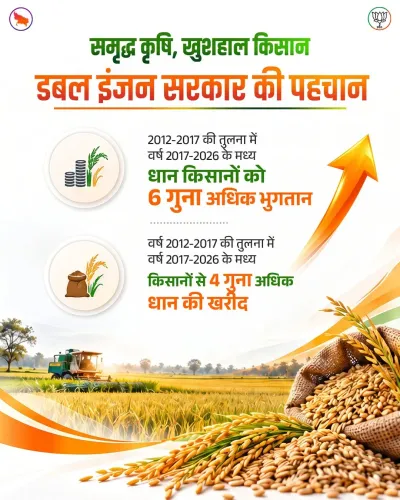
Yogi govt's paddy procurement reached 37.49 lakh farmers, 152% more than SP era
Synopsis
Uttar Pradesh's Yogi Adityanath government claims it extended paddy procurement benefits to 37.49 lakh farmers in just four years — 152% more than the SP government managed in five. The year-by-year data shows a notable dip in 2023–24 and 2024–25 before a recovery in 2025–26, a detail that complicates the headline narrative of uninterrupted progress.
Key Takeaways
The Yogi Adityanath government in Uttar Pradesh reported paddy procurement benefits for 37,49,219 farmers over its last four years.
This is approximately 152% more than the 14,87,519 farmers benefited under the SP government's five-year tenure.
The current government reached roughly 22.62 lakh more farmers than its predecessor, in a shorter period.
The highest single-year count was in 2025–26 with 10,53,561 farmers , after a dip in 2023–24 ( 8,01,730 ) and 2024–25 ( 7,98,731 ).
Government procurement provides farmers access to the Minimum Support Price (MSP) , a key safeguard against distress selling.
The Yogi Adityanath-led government in Uttar Pradesh on 27 October 2026 released official figures showing that paddy procurement benefits were extended to 37,49,219 farmers over its last four years — a rise of approximately 152% compared with the Samajwadi Party (SP)'s preceding five-year tenure. The numbers, cited by state officials, position the current Bharatiya Janata Party (BJP) administration's outreach as roughly 2.52 times that of its predecessor.
The Numbers in Comparison
According to official figures, the Akhilesh Yadav-led SP government reportedly benefited 14,87,519 farmers during its five-year term. The Adityanath government, in four years, extended benefits to approximately 22.62 lakh more farmers than that figure. Officials note the expanded reach was achieved in a shorter timeframe, underscoring what the government describes as a structural improvement in its procurement machinery.
Year-by-Year Breakdown
The highest single-year beneficiary count under the current administration was recorded in 2025–26, when 10,53,561 farmers received paddy procurement benefits. This compares with 10,95,197 farmers in 2022–23, 8,01,730 in 2023–24, and 7,98,731 in 2024–25. The data suggests a dip in the middle two years before recovering in the most recent cycle.
Why Paddy Procurement Matters
In a predominantly agrarian state like Uttar Pradesh, government procurement provides farmers with a guaranteed institutional channel to sell their produce at the Minimum Support Price (MSP) — a critical safeguard against distress selling to private traders at below-floor rates. The reach of the procurement system is widely regarded as a proxy for how effectively agricultural support policy translates to rural incomes. The Food and Civil Supplies Department stated it is making 'continuous efforts to extend the benefits of the paddy procurement system to as many farmers as possible.'
What the Government Said
Officials from the Food and Civil Supplies Department attributed the expansion to efforts to make the government procurement process 'more accessible, transparent and efficient.' The Adityanath government said its priority is to 'ensure that farmers receive a fair price for their produce' and that 'ensuring that eligible farmers receive the benefits of the scheme remains a priority for the state.'
Political and Policy Context
The data release comes ahead of what analysts expect to be a politically charged agricultural policy season in Uttar Pradesh. The BJP has consistently highlighted paddy and wheat MSP procurement as a core rural governance metric, and the comparison with the SP tenure is widely seen as an effort to consolidate farmer support ahead of the state's electoral cycle. Critics from the opposition have in the past questioned whether farmer registration numbers fully reflect actual procurement volumes and payments received — a dimension the official statement does not address. The forward trajectory will depend on whether the 2025–26 figures — the highest on record under this administration — can be sustained or exceeded in the next procurement season.
Point of View
But the year-by-year data tells a more nuanced story — beneficiary numbers dipped sharply in 2023–24 and 2024–25 before recovering in 2025–26, suggesting the expansion has not been linear. More critically, farmer registration counts and actual procurement disbursements are not the same metric; a larger beneficiary count does not automatically mean more farmers were paid at MSP. With Uttar Pradesh's electoral cycle approaching, the data release reads as much as political messaging as it does as a governance report. Independent verification of procurement volumes and payment completions would provide the fuller picture that is conspicuously absent from the official statement.
NationPress
27 Oct 2026
Frequently Asked Questions
How many farmers benefited from paddy procurement under the Yogi Adityanath government?
According to official figures released on 27 October 2026, the Yogi Adityanath-led government in Uttar Pradesh extended paddy procurement benefits to 37,49,219 farmers over the last four years. This is approximately 152% more than the 14,87,519 farmers who reportedly benefited under the previous SP government's five-year tenure.
How does the BJP government's paddy procurement compare with the SP government's record?
The BJP-led government benefited around 22.62 lakh more farmers in four years than the SP government did in five years. In proportional terms, the Adityanath government's count is roughly 2.52 times that of the SP's five-year total, according to official state data.
Which year saw the highest paddy procurement beneficiaries under the current UP government?
The highest beneficiary count was recorded in 2022–23, when 10,95,197 farmers received paddy procurement benefits. The 2025–26 season came close with 10,53,561 farmers, after a relative dip in 2023–24 (8,01,730) and 2024–25 (7,98,731).
Why is paddy procurement through the government system important for farmers?
Government procurement provides farmers in Uttar Pradesh with an institutional channel to sell paddy at the Minimum Support Price (MSP), protecting them from having to sell at distress prices to private traders. In a large agrarian state, the reach of this system is a key indicator of how effectively agricultural support policy translates into rural incomes.
What has the UP government said about its plans for paddy procurement?
The Adityanath government stated that its priority is to make the procurement process 'more accessible, transparent and efficient' and that 'ensuring that eligible farmers receive the benefits of the scheme remains a priority.' Officials from the Food and Civil Supplies Department said continuous efforts are under way to expand the system's reach further.