Yogi Adityanath on I-Day: Modi govt policies target poor, youth, women, farmers
Synopsis
On India's 80th Independence Day, UP CM Yogi Adityanath reframed caste politics with a pointed message: under Modi, the only 'castes' that matter in policy are the poor, youth, women, and farmers. Backed by a claim of 25 crore people lifted from poverty, it is a governing philosophy — and a campaign pitch — rolled into one flag-hoisting address.
Key Takeaways
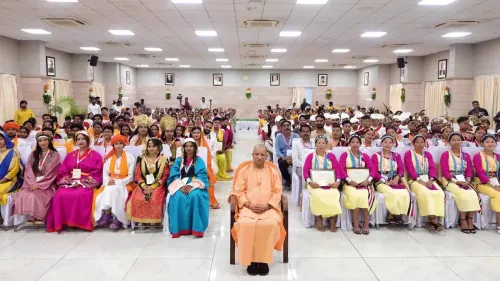
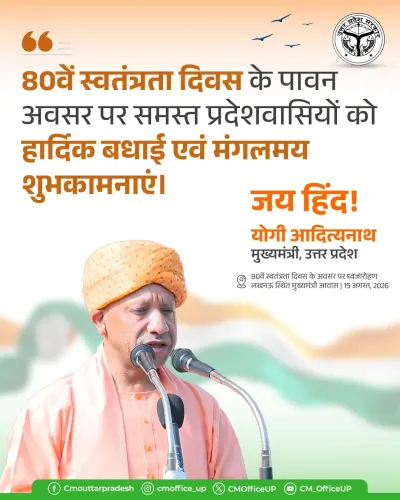
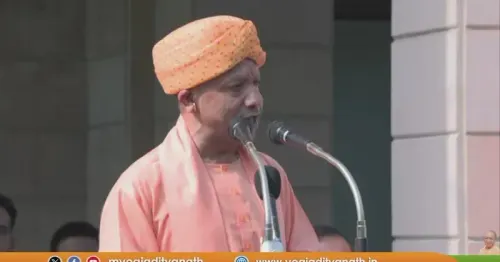
Yogi Adityanath hoisted the National Flag at his official residence in Lucknow on 15 August 2025 , India's 80th Independence Day .
He stated that PM Modi 's government has designed policies around four groups for 12 years : the poor, youth, women, and farmers.
The Chief Minister credited this approach with lifting 25 crore people out of multidimensional poverty.
He called on all 140 crore Indians to collectively preserve the country's freedom, regardless of community or caste.
Yogi referenced the First War of Independence in 1857 as a key milestone in India's freedom struggle.
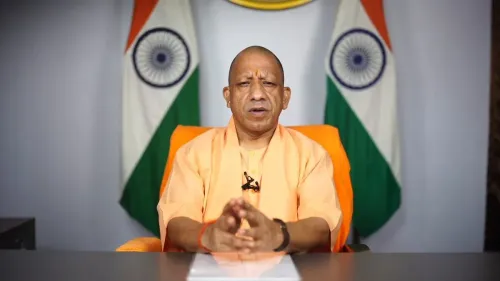
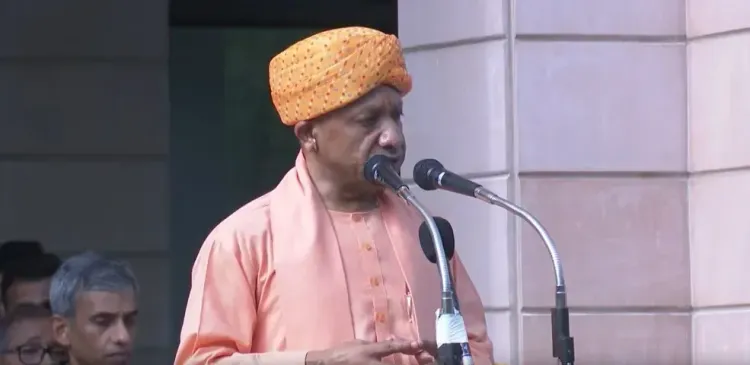
Uttar Pradesh Chief Minister Yogi Adityanath on 15 August 2025 hoisted the National Flag at his official residence in Lucknow on the occasion of the 80th Independence Day, declaring that Prime Minister Narendra Modi's government has consistently shaped policy around four core constituencies — the poor, youth, women, and farmers. The address drew on themes of collective national responsibility and measurable welfare outcomes over the past decade-plus of BJP rule.
Key Remarks by CM Yogi
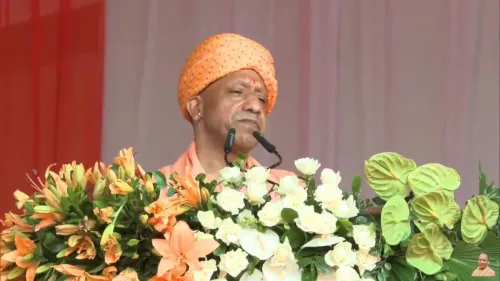
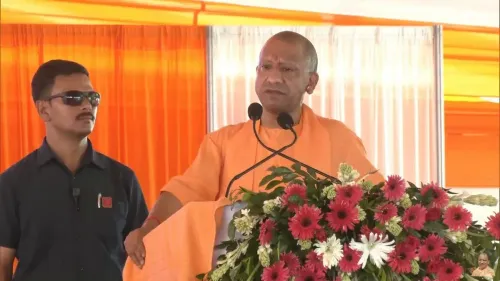
Speaking to the gathering, Yogi Adityanath extended Independence Day greetings and invoked the sacrifices of India's freedom movement. 'On this day in 1947, our country attained independence as a result of a long struggle, sacrifice and martyrdom,' he said. 'The sense of freedom that every Indian experiences today is the result of the sacrifices, penance and dedication of the great sons and martyrs of Mother India.'
He broadened the definition of freedom beyond political independence, stating: 'Freedom does not mean merely political independence. It also means complete freedom from anarchy, backwardness, poverty, illiteracy and inequality that continually weakened the country.'
Four Pillars of Modi Government Policy
Elaborating on the Central government's governance philosophy, Yogi Adityanath said: 'Under PM Modi's leadership, policies are made keeping in mind four castes — poor, youth, women and farmers. In the last 12 years, these four things were kept in mind and then policies were formed.' He credited this approach with lifting 25 crore people out of multidimensional poverty, a figure he cited as a direct outcome of sustained policy focus.
Notably, the Chief Minister used the word 'castes' in a deliberate rhetorical inversion — framing the poor, youth, women, and farmers as the only social divisions that should drive governance, a formulation that has become a recurring motif in BJP political messaging.
Collective Responsibility and the Freedom Legacy
Yogi Adityanath stressed that preserving India's freedom is not the burden of any single individual, community, or caste. 'All 140 crore Indians must collectively contribute to this effort in their respective fields,' he said, referencing the First War of Independence in 1857 as a foundational milestone in the country's long march to freedom.
He acknowledged that while many challenges inherited from 1947 — poverty, illiteracy, backwardness, and inequality — have been substantially addressed over eight decades, the work remains ongoing. 'The results of these efforts are visible today,' he said, pointing to expanded educational access and the non-discriminatory reach of government schemes.
Context and Significance
The address comes as the ruling Bharatiya Janata Party (BJP) marks the 80th Independence Day with a nationwide emphasis on welfare delivery and national pride. Uttar Pradesh, India's most populous state, has been a central testing ground for Central welfare schemes, and Yogi Adityanath's remarks align closely with the BJP's broader electoral messaging ahead of future state cycles. This is the second consecutive Independence Day address in which the Chief Minister has explicitly foregrounded the 'four pillars' framing attributed to Prime Minister Modi.
As India enters its 79th year of independence, the focus now shifts to whether welfare gains — particularly the poverty-reduction figure — can be independently verified and sustained in the years ahead.
Point of View
Drawing on NITI Aayog's MPI data, but independent economists have noted that the baseline methodology and threshold definitions make direct comparisons across years difficult. What the address signals most clearly is that the BJP intends to fight future electoral cycles in Uttar Pradesh on welfare delivery, not identity alone — a strategic shift worth watching as the state heads toward its next political cycle.
NationPress
29 Sept 2026
Frequently Asked Questions
What did CM Yogi Adityanath say on Independence Day 2025?
Uttar Pradesh Chief Minister Yogi Adityanath hoisted the National Flag in Lucknow on 15 August 2025 and said that PM Modi's government has built its policies around four groups — the poor, youth, women, and farmers — for 12 years. He also credited this approach with lifting 25 crore people out of multidimensional poverty.
What is the 'four castes' framing used by Yogi Adityanath?
Yogi Adityanath used the phrase 'four castes' to mean the poor, youth, women, and farmers — deliberately inverting the traditional caste framework to argue that Modi's governance recognises only these social and economic categories, not hereditary caste divisions. It is a recurring motif in BJP political messaging.
How many people has India lifted out of poverty according to CM Yogi?
Yogi Adityanath cited that 25 crore people have been lifted out of multidimensional poverty under PM Modi's leadership over the past 12 years. This figure is consistent with NITI Aayog's Multidimensional Poverty Index reports, though independent economists have flagged methodological caveats.
What was the significance of the 80th Independence Day address?
The 80th Independence Day marks eight decades since India's independence in 1947. Yogi Adityanath used the occasion to draw a line from the freedom struggle to present-day welfare governance, framing poverty reduction and inclusive policy as the continuation of the original independence project.
Who is affected by the policies Yogi Adityanath highlighted?
According to Yogi Adityanath, the primary beneficiaries of Modi government policies are India's poor, youth, women, and farmers — groups that collectively represent the vast majority of the country's 140 crore population, particularly in states like Uttar Pradesh.