China's missile AI identifies F-22, F-35 heat signatures at 90%+ accuracy
Synopsis
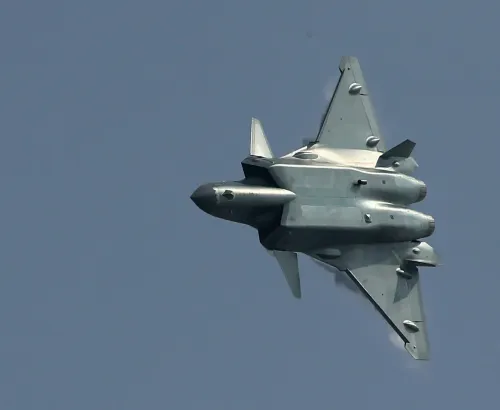
Chinese researchers have built a lightweight AI that identifies F-22 and F-35 mock-ups by their infrared heat signatures with over 90% accuracy — a breakthrough that could make flare countermeasures obsolete in future air combat.
Key Takeaways
Chinese researchers demonstrated an AI system achieving over 90% accuracy in identifying mock-up F-22 and F-35 targets via infrared heat signatures in laboratory tests.
The system runs on a Xilinx Zynq XC7Z020 chip, small enough for integration into air-to-air missile payloads.
The AI distinguishes fighter jet infrared profiles from flare decoys, potentially neutralising a core self-protection mechanism used by modern combat aircraft.
The research was conducted by teams from the China Airborne Missile Academy and the Beijing Institute of Technology , with An Jiangshan as first author.
Findings were published in the Journal of Electronic Measurement and Instrumentation on August 10, 2026 .
Results are currently limited to controlled laboratory conditions; operational validation has not been confirmed.
Chinese researchers have developed a lightweight artificial intelligence system capable of identifying advanced stealth fighters — including mock-ups of the US F-22 and F-35 — through their infrared heat signatures, with accuracy exceeding 90% in laboratory tests, according to a study published on August 10, 2026. The system is designed to be embedded directly in heat-seeking air-to-air missiles, potentially rendering traditional flare countermeasures ineffective against next-generation infrared-guided weapons.
Why it matters
Stealth fighters like the F-22 Raptor and F-35 Lightning II are engineered to minimise radar cross-sections, but their engines and airframe friction inevitably generate distinct infrared signatures that cannot be suppressed. Conventional heat-seeking missiles can be fooled by flares, which mimic the heat output of an aircraft. The new AI model, however, is trained to distinguish between the complex, multi-spectral infrared profile of a fighter jet and the simpler thermal bloom of a decoy flare, according to the research team.
The technology behind the system
The AI model runs on the Xilinx Zynq XC7Z020, a compact field-programmable gate array chip suited to the size and power constraints of a missile payload. Researchers from the China Airborne Missile Academy and the Beijing Institute of Technology used missile-borne scanning infrared imaging systems to capture thermal data and train the recognition model. An Jiangshan, first author of the study, stated on August 10: 'Lightweight recognition models could become widely used in future air-to-air missiles because they can provide high-speed recognition while maintaining strong identification capabilities.'
Competitive backdrop
The research was published in the Journal of Electronic Measurement and Instrumentation, signalling an intent to move the technology toward wider scientific and defence community scrutiny. Co-researcher Liu Ming is among the team credited with advancing the missile-borne infrared recognition architecture. The development arrives as global defence establishments are racing to integrate edge-AI into precision munitions, with infrared countermeasure systems becoming a key battleground in aerial warfare doctrine.
What's next
The current results are confined to controlled laboratory conditions using mock-up targets; real-world performance against operational aircraft under dynamic combat conditions remains unverified. Defence analysts will be watching whether the system advances to flight-test validation and whether comparable infrared-AI countermeasure upgrades emerge from US, European, or other rival programmes. The trajectory of this research could accelerate the obsolescence of flare-based self-protection suites currently standard on most Western combat aircraft.
Point of View
Where the real contest is not raw model size but inference speed within the extreme size, weight, and power constraints of a missile seeker head. Mainstream coverage focuses on stealth as a radar phenomenon, yet infrared suppression has always been the harder problem — and this study suggests that gap is now being systematically closed through machine learning. The use of an off-the-shelf FPGA like the Xilinx Zynq XC7Z020, rather than a custom ASIC, hints at how quickly such capabilities could proliferate or be iterated upon. Western air forces whose self-protection doctrine is still anchored in flare expenditure face a structural vulnerability that no firmware patch can fix.
NationPress
28 Sept 2026
Frequently Asked Questions
What did Chinese researchers develop for missile targeting?
Chinese researchers developed a lightweight AI system that identifies advanced stealth fighters by their infrared heat signatures, achieving over 90% accuracy against mock-up F-22 and F-35 targets in laboratory tests. The system is designed to run inside heat-seeking air-to-air missiles.
Why can't flares defeat this new AI missile system?
The AI model is trained to differentiate between the complex infrared profile of a fighter aircraft — produced by engine exhaust and airframe friction — and the simpler thermal signature of a flare decoy. Because the recognition is based on the unique heat pattern of the jet itself, flares no longer provide a reliable countermeasure against this type of seeker.
Which chip powers the Chinese missile AI system?
The system runs on the Xilinx Zynq XC7Z020, a compact field-programmable gate array (FPGA) chip. Its small size and low power consumption make it suitable for integration within the constrained space of a missile payload.
Who conducted this research and where was it published?
The research was conducted by teams from the China Airborne Missile Academy and the Beijing Institute of Technology, with An Jiangshan as first author. The study was published in the Journal of Electronic Measurement and Instrumentation, with An Jiangshan's statement dated August 10, 2026.
Has this AI missile system been tested in real combat conditions?
No — as of the publication date, results are limited to controlled laboratory tests using mock-up targets. Real-world performance against operational aircraft in dynamic combat scenarios has not been verified or publicly confirmed.