China's AI 'ChatBearing' agent accelerates military hardware design
Synopsis
Researchers at Chongqing University have built an AI agent called ChatBearing — published in China's top defence engineering journal — that autonomously designs rolling bearings for weapons systems, potentially compressing military hardware development timelines at scale.
Key Takeaways
ChatBearing , developed by Chongqing University's State Key Laboratory of Mechanical Transmission for Advanced Equipment , uses large language models to autonomously design rolling bearings for advanced military machinery.
The study was published last month in Acta Armamentarii , China's leading defence engineering journal, covering aerospace, missile systems, armour and guidance technologies.
The AI system autonomously handles design requirement analysis, load calculation, bearing selection, life prediction, strength verification and report generation.
Traditional bearing design relies on experienced engineers and costly testing under extreme conditions including high temperature , heavy load and high rotational speed .
The research signals a broader Chinese strategy to embed AI into foundational industrial manufacturing layers, not just autonomous weapons or command systems.
China is embedding artificial intelligence into the foundational layers of its defence manufacturing, with researchers at Chongqing University's State Key Laboratory of Mechanical Transmission for Advanced Equipment developing an AI system capable of autonomously designing critical mechanical components used in advanced weapons systems. The study, published last month in Acta Armamentarii — a leading Chinese defence engineering journal — signals a deliberate push to accelerate weapons development timelines through industrial AI.
What the research reveals
The paper, titled 'Study on Rolling Bearing Design Agent Based on Large Language Models with Reasoning and Acting', describes a system called ChatBearing that combines large language models with engineering calculation tools and industrial databases. According to the researchers, the system can autonomously perform design requirement analysis, load calculation, bearing selection, life prediction, strength verification and report generation — tasks that previously required experienced engineers and lengthy trial-and-error cycles.
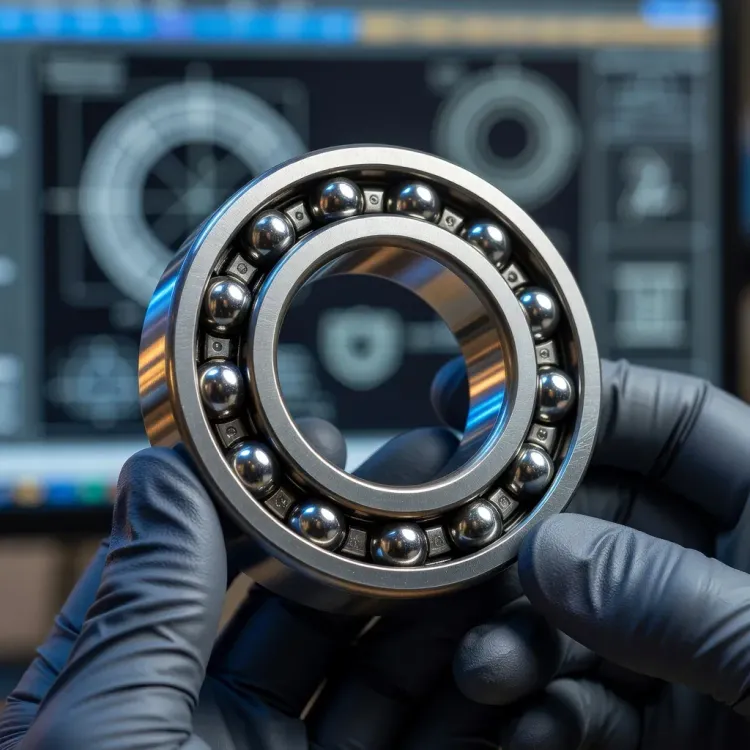
Rolling bearings are precision components embedded in a wide range of military hardware, from missile guidance systems and aircraft engines to armoured vehicle drivetrains. Their design under extreme conditions — including high temperature, heavy load and high rotational speed — has historically been a bottleneck in defence manufacturing.
Why it matters
Acta Armamentarii has long served as a primary publication platform for China's weapons industry, covering technologies linked to aerospace, missile systems, armour, guidance systems and military manufacturing. Research appearing in the journal is widely regarded as reflective of active development priorities within the defence-industrial complex. The publication of ChatBearing in this venue suggests the technology is being positioned for real-world defence applications, not merely academic exploration.
According to the researchers, traditional bearing design relies heavily on experienced engineers and expensive testing under extreme conditions. By automating this pipeline, China could meaningfully compress the development cycle for new weapons platforms, reducing dependence on scarce specialist engineers.
The competitive backdrop
While much of the global discourse around military AI centres on autonomous weapons, battlefield drones and large language model-driven command systems, this research points to a less-discussed front: AI-assisted manufacturing intelligence. US-based defence technology firms such as Palantir have pursued AI integration at the operational and logistics layers, but embedding AI into component-level engineering design represents a deeper form of industrial automation. The approach mirrors strategies seen in Sweden's Svenska Kullagerfabriken (SKF) — a global leader in bearing technology — though applied here within a closed, state-directed defence context.
The research also arrives against the backdrop of lessons drawn from the Ukraine war, where the speed of weapons production and component replenishment has proved as strategically decisive as battlefield performance.
What's next
The extent to which ChatBearing has moved beyond the laboratory into active procurement pipelines remains unclear. However, its publication in a defence-specific journal — rather than a general engineering venue — suggests institutional backing and a pathway toward operational deployment. As China continues integrating AI across its defence-industrial base, the pace at which such tools move from research to production will be a critical variable for analysts and policymakers to monitor.
Point of View
But AI that compresses the engineering cycle for precision components could have a more durable impact on production capacity and deterrence calculus. This fits a recognisable pattern in China's defence modernisation: systematically targeting the unglamorous bottlenecks — skilled labour scarcity, testing costs, design iteration speed — that constrain how fast new platforms can be fielded. What mainstream coverage misses is that publishing this in Acta Armamentarii, rather than a civilian engineering journal, is itself a signal: this is not blue-sky research, it is defence-industrial infrastructure. The US and its allies should be watching the manufacturing AI layer as closely as they watch autonomous weapons procurement.
NationPress
11 Oct 2026
Frequently Asked Questions
What is ChatBearing and what does it do?
ChatBearing is an AI system developed by researchers at Chongqing University that autonomously designs rolling bearings used in advanced military machinery. It combines large language models with engineering calculation tools and industrial databases to perform tasks including design analysis, load calculation, bearing selection, life prediction, strength verification and report generation.
Why is this research significant for China's military?
Rolling bearings are critical precision components in a wide range of weapons systems, including missile guidance units, aircraft engines and armoured vehicles. By automating their design, China could significantly reduce development timelines and dependence on scarce specialist engineers, accelerating the pace at which new weapons platforms can be produced.
Where was the ChatBearing study published?
The study was published in Acta Armamentarii, a leading Chinese defence engineering journal that covers technologies linked to aerospace, missile systems, armour, guidance systems and military manufacturing. Publication in this venue, rather than a civilian journal, indicates institutional defence backing.
How does this compare to US military AI efforts?
US defence technology firms such as Palantir have focused AI integration at the operational and logistics layers. China's ChatBearing represents a different approach — embedding AI at the component engineering level — which could prove equally or more strategically significant by accelerating the industrial production of weapons hardware.
What should analysts watch for next?
The key question is whether ChatBearing moves from published research into active defence procurement pipelines. Analysts should monitor whether similar AI-assisted design tools appear across other critical component categories — such as guidance systems or propulsion — as indicators of how broadly China is applying this manufacturing AI strategy.