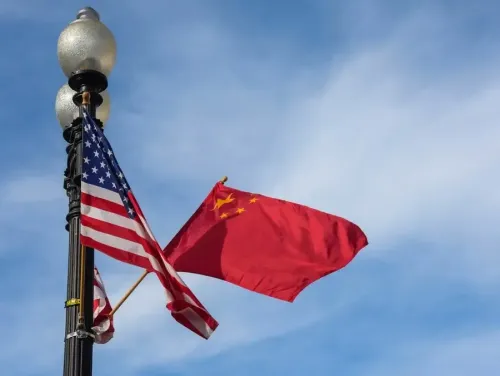
China leads AI capability race but ranks 10th in global trust poll

Synopsis
A Public First poll of 18,000+ people across 15 countries finds China is seen as the AI leader in 11 nations — including close US allies — yet Chinese AI models rank 10th on trust with a net score of -8, exposing a stark gap between perceived capability and real-world confidence.
Key Takeaways
Public First , a London -based consultancy, surveyed more than 18,000 people across 15 countries in its June 2026 poll on global AI perceptions.
Respondents in 11 of 15 nations said China leads the US in AI capability and innovation.
In Canada , Britain , and France , at least 40 per cent of respondents rated China ahead; Germany was least convinced of US leadership at only 23 per cent .
Within the US , 24 per cent of respondents said China was ahead versus 51 per cent who said the US still led.
Japan ranked first in net AI trust at +22 ; the US ranked second at +16 ; China ranked 10th with a negative score of -8 .
Public First has no affiliation with the separately named, Anthropic -backed organisation Public First Action .
China is widely perceived as outpacing the United States in artificial intelligence capability — even among populations in key US allied nations — yet Chinese AI models rank near the bottom on trust, according to a new survey published in June 2026 by London-based consultancy Public First. The poll of more than 18,000 respondents across 15 countries underscores a widening gap between perceived technological leadership and the confidence that global users place in Chinese AI systems.
The capability perception gap
Respondents in 11 out of 15 surveyed nations acknowledged China's AI leadership over the US. In Canada, Britain, and France — all considered close US allies — at least 40 per cent of those polled said China was ahead in AI capability and innovation. Germany proved the least persuaded of American dominance, with only 23 per cent of German respondents placing the US in front.
Even within the US itself, the picture was divided: nearly a quarter — 24 per cent — of American respondents said China was ahead, while 51 per cent maintained that the US still led. Public First, which has no connection with the Anthropic-backed organisation Public First Action, did not conduct its poll inside China.
Why it matters: the trust deficit
Despite the capability perception, Chinese AI models finished 10th on the trust index, recording a negative net trust score of -8 — calculated by subtracting the percentage of distrust from that of trust. US AI models ranked second with a net trust score of +16, behind only Japan, which topped the table at +22.
The divergence signals that global audiences can simultaneously acknowledge a rival's technical progress while remaining unwilling to rely on its products — a distinction with real commercial and geopolitical consequences for Chinese AI developers including companies such as Alibaba Group Holding, whose Qwen models, and Zhipu's GLM series have gained international traction on benchmarks.
The competitive backdrop
The findings arrive as Chinese technology firms push an AI-plus strategy — integrating large language models into enterprise software, cloud infrastructure, and consumer applications — to accelerate overseas adoption. Global benchmark platforms such as Code Arena have repeatedly placed Chinese models competitively against leading US counterparts, lending credibility to the public perception captured in the poll.
Yet trust remains structurally constrained by data-governance concerns, geopolitical friction, and export-control narratives that dominate coverage in Western markets. The gap between capability recognition and trust is not unique to AI: it mirrors patterns seen in earlier waves of Chinese hardware and telecommunications expansion.
What's next
For Chinese AI developers, closing the trust gap — rather than widening the capability lead — may prove the more consequential challenge in winning enterprise and government contracts outside Asia. Analysts will be watching whether firms such as Alibaba and Zhipu pursue third-party audits, open-weight model releases, or regional data-residency commitments as tools to shift sentiment. The next wave of global polling and international procurement decisions will be the clearest indicator of whether perception is beginning to convert into confidence.
Point of View
But the real battleground is procurement: enterprise buyers in Europe and allied Asia-Pacific markets will be guided by trust scores, data-residency rules, and geopolitical alignment at least as much as by benchmark rankings. Unless Beijing's AI-plus strategy is accompanied by credible international governance commitments, the capability lead risks becoming a commercial ceiling rather than a competitive advantage.
NationPress
17 Sept 2026
Frequently Asked Questions
Which countries think China is ahead of the US in AI?
Respondents in 11 of 15 surveyed countries said China leads the US in AI , according to the Public First poll. These included close US allies such as Canada , Britain , and France , where at least 40 per cent of respondents held that view.
Why do Chinese AI models rank low on trust despite leading on capability?
Chinese AI models scored a net trust rating of -8 — placing 10th among the nations measured — even as China was widely seen as the capability leader. Analysts point to data-governance concerns, geopolitical friction, and limited transparency around model training and data handling as key drivers of the trust gap.
What is the Public First AI survey and how was it conducted?
Public First is a London -based consultancy that polled more than 18,000 people across 15 countries to gauge global perceptions of AI leadership and trust. The firm did not survey respondents inside China and has no connection to the separately named, Anthropic -backed organisation Public First Action .
Which country ranks highest in AI trust globally?
Japan ranked first in net AI trust with a score of +22 , followed by the US at +16 , according to the Public First survey. China placed 10th with a negative net trust score of -8 .
How does this poll affect Chinese AI companies like Alibaba and Zhipu?
The trust deficit poses a commercial challenge for Chinese AI developers such as Alibaba Group Holding — maker of the Qwen model series — and Zhipu , whose GLM models have gained benchmark recognition internationally. Enterprise and government buyers in Western markets are likely to weigh trust scores alongside capability ratings when making procurement decisions.