China's J-36 designers warn AI hallucinations risk defence miscalculations
Synopsis
Engineers at China's AVIC Chengdu — designers of the J-20 and J-36 stealth fighters — have warned in a state-journal paper that AI hallucinations can fabricate aircraft specs and radar data, potentially triggering strategic miscalculations in military intelligence. The internal caution from within China's own defence-industrial complex is a rare public admission of AI's limits in warfare.
Key Takeaways
AVIC Chengdu Aircraft Research and Design Institute , developer of the J-20 and J-36 stealth fighters, has warned of AI hallucination risks in military intelligence.
Engineer Zhang Xianzhe published the findings on June 20 in Information Studies: Theory & Application , a journal run by state arms maker Norinco .
According to the paper, AI models can fabricate aircraft specifications including length, payload, weapons, speed, combat radius, and get radar scan ranges and frequency bands wrong.
Zhang warned that hallucinations 'could have severe consequences in the high-stakes, low-error world of defence intelligence, possibly even causing strategic miscalculations.' The warning comes as the PLA and militaries globally, including the United States , accelerate AI integration into battlefield intelligence and decision-support systems.
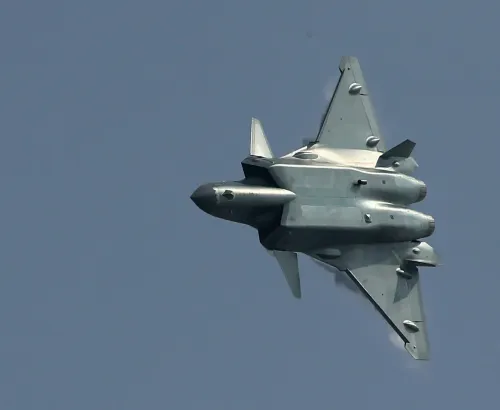
Engineers at China's AVIC Chengdu Aircraft Research and Design Institute — the developer behind the People's Liberation Army's frontline J-20 and next-generation J-36 stealth fighters — have publicly warned that AI hallucinations pose a serious threat to military intelligence operations, potentially triggering strategic miscalculations in high-stakes defence scenarios.
The Warning from the Frontlines of Chinese Aerospace
In a paper published on June 20, AVIC Chengdu engineer Zhang Xianzhe cautioned that large language models deployed for defence intelligence work are prone to fabricating critical data. According to the paper, Zhang wrote that 'AI models can invent aircraft specifications — length, payload, weapons, speed, combat radius — and get radar scan ranges and frequency bands wrong.' The research was published in Information Studies: Theory & Application, a journal operated by Norinco, China's state-owned arms manufacturer.
Why It Matters: Hallucinations in a Zero-Error Domain
'The so-called hallucination effect, where models produce plausible but false outputs, could have severe consequences in the high-stakes, low-error world of defence intelligence, possibly even causing strategic miscalculations,' Zhang said in the paper. The concern is not theoretical: large language models are increasingly being evaluated for roles in battlefield intelligence, threat assessment, and weapons performance analysis — tasks that once demanded extensive human analyst hours.
According to the paper, every fighter jet programme begins with a granular understanding of the adversary and the operational environment. Designers must resolve critical questions — what is the opponent's radar coverage, which frequencies do they use — before a single component is engineered. Faulty AI-generated answers to those questions could corrupt the entire design calculus.
The Competitive Backdrop: AI Races Into Military Systems
The caution from AVIC Chengdu arrives as militaries worldwide accelerate the integration of AI into intelligence and decision-support systems. The United States Department of Defense has been expanding its own AI-enabled programmes, while Iran and other regional powers have signalled interest in autonomous defence technologies. The PLA's own modernisation roadmap has placed AI at the centre of next-generation warfare doctrine, making the internal dissent from AVIC Chengdu's engineers all the more striking.
What's Next: Guardrails Before Deployment
The publication of Zhang Xianzhe's findings in a Norinco-affiliated journal suggests the concern has reached institutional levels within China's defence-industrial complex. Analysts will be watching whether the paper prompts formal verification standards or human-in-the-loop mandates for AI tools used in military intelligence pipelines. As the J-36 programme advances toward operational readiness, the guardrails placed around AI-assisted design and threat analysis will be a critical variable to monitor.
Point of View
Only with far higher stakes. What mainstream coverage underweights is the institutional significance: publishing this critique in a Norinco-affiliated journal is effectively an internal policy signal, not just academic disclosure. This maps onto a broader pattern where AI capability hype is outrunning verification infrastructure across every major military power. The real risk is not that AI gets aircraft specs wrong in a lab — it is that compressed decision timelines in a real crisis leave no room to catch the error.
NationPress
4 Oct 2026
Frequently Asked Questions
What did China's J-36 designers warn about AI?
Engineers at AVIC Chengdu Aircraft Research and Design Institute warned that AI large language models used in military intelligence can hallucinate — producing plausible but false outputs such as fabricated aircraft specifications, incorrect radar ranges, and wrong frequency bands. The warning was published in a paper by engineer Zhang Xianzhe on June 20.
What is the hallucination effect in AI military applications?
AI hallucination refers to a model generating confident but factually incorrect outputs. In a military context, Zhang Xianzhe warned this 'could have severe consequences in the high-stakes, low-error world of defence intelligence, possibly even causing strategic miscalculations' — for example, if an AI incorrectly describes an adversary's radar coverage or weapons payload.
Who is Zhang Xianzhe and where was the paper published?
Zhang Xianzhe is an engineer at AVIC Chengdu Aircraft Research and Design Institute, the Chinese state aerospace firm that develops the J-20 and J-36 stealth fighters for the People's Liberation Army. The paper was published on June 20 in Information Studies: Theory & Application, a journal operated by Norinco, China's state-owned arms manufacturer.
Why does AI hallucination matter for fighter jet design?
Fighter jet development depends on accurate intelligence about adversary capabilities — radar coverage, operating frequencies, weapons performance. According to the paper, designers must answer these questions before engineering begins, meaning AI-generated errors at that stage could corrupt an entire programme's threat assumptions and strategic calculus.
How does this compare to US and global military AI efforts?
The United States Department of Defense has been expanding AI-enabled intelligence and decision-support programmes, and other regional powers including Iran have signalled interest in autonomous defence technologies. The AVIC Chengdu warning is notable because it represents a rare public acknowledgement from within China's defence-industrial complex that AI reliability remains an unresolved problem for military deployment.