Beijing trees found to worsen ozone smog, study shows
Synopsis
A Jinan University-led study has found that Beijing's iconic weeping willows and poplars — not just vehicle exhaust — are a major driver of the city's ozone smog, upending assumptions about urban greening as a clean-air solution for 20 million residents.
Key Takeaways
Weeping willows and white poplars in Beijing are producing high levels of isoprene , a volatile organic compound that generates ground-level ozone smog.
An international team led by Jinan University in Guangzhou published the findings in the journal Science Advances .
The study initially aimed to measure human-activity-driven ozone but found tree emissions were a larger contributor than expected.
Ground-level ozone smog has been a recognised public health threat since the 1940s , with some incidents historically causing hundreds of deaths.
The findings complicate Beijing 's air-quality strategy at a time when the city has already made significant progress electrifying its vehicle fleet.
Urban planners in Beijing and other Asian megacities may need to reconsider tree species selection in future greening programmes.
Weeping willows and poplars lining Beijing's streets may be quietly worsening the city's air quality, according to new research published in the journal Science Advances. An international team led by scientists from Jinan University in Guangzhou found that the capital's urban trees generate far higher levels of ozone-forming compounds than previously understood — posing a public health risk for Beijing's 20 million residents.
An unexpected source of pollution
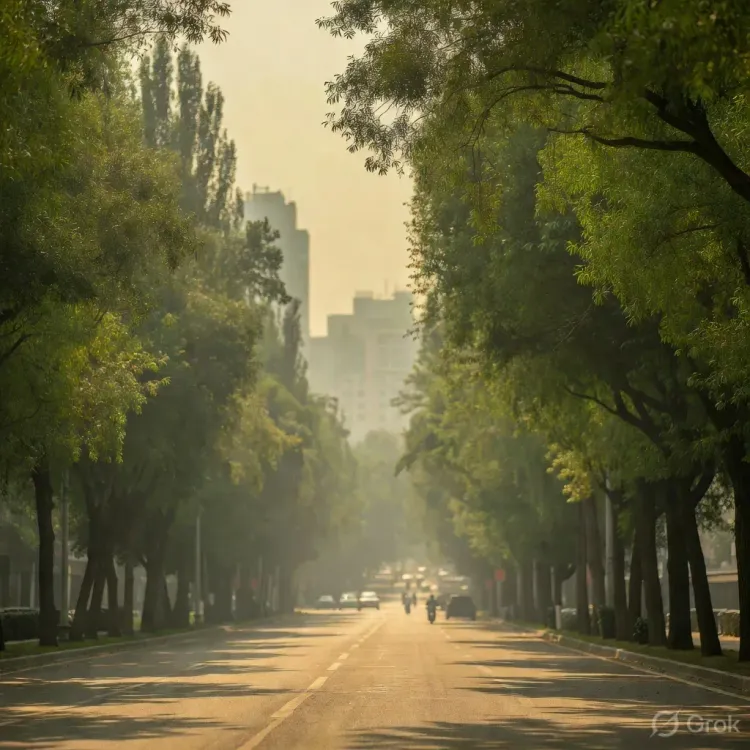
The trees — predominantly weeping willows and white poplars, planted in large numbers over more than four decades — produce unusually high concentrations of isoprene, a volatile organic compound (VOC). When isoprene reacts with nitrogen oxide emitted by vehicles or factories, it generates ground-level ozone, a key component of smog. Scientists warned the greenery may be effectively "choking" residents by elevating ozone concentrations across the city.
Why it matters
Ground-level ozone smog has been recognised as a serious public health threat since the 1940s, with severe episodes historically linked to hundreds of deaths. The findings carry particular weight in Beijing, where policymakers have invested heavily in electrifying the city's vehicle fleet. Despite a significant shift to electric cars — which produce no direct exhaust emissions — ozone levels had continued to puzzle researchers. The new study identifies biogenic VOC emissions from trees as the most likely missing variable.
The research behind the finding
The Jinan University-led international team originally set out to quantify how human activities drive ozone pollution in Beijing. Their measurements, however, revealed that the city's trees were generating far more smog-forming compounds than anticipated, redirecting the study's conclusions. The findings were published in Science Advances, a peer-reviewed journal of the American Association for the Advancement of Science.
Competitive backdrop: urban greening vs. air quality
Cities across Asia have aggressively expanded urban tree cover as a climate adaptation strategy, often without accounting for species-specific VOC profiles. Beijing's decades-long reliance on willows and poplars — chosen for their fast growth and shade — now appears to carry an unintended atmospheric cost. The research adds a new layer of complexity to urban planning decisions in megacities balancing heat mitigation with pollution control.
What's next
The findings are likely to prompt a reassessment of urban forestry policy in Beijing and potentially other Chinese cities with similar tree compositions, including the planned city of Xiongan New Area. Researchers and city planners may need to weigh species selection more carefully against air-quality modelling. Whether municipal authorities move to replace existing trees or simply diversify future planting will be the key policy question to watch.
Point of View
It is a particularly awkward finding — the city has spent years and enormous capital reducing tailpipe emissions, only to discover that its own boulevard trees may be partially undoing those gains. The broader implication is that biogenic VOC emissions deserve the same policy scrutiny as industrial and transport sources, especially as Asian megacities scale up green-infrastructure investment. Mainstream coverage tends to frame urban trees as an unambiguous climate good; this research is a reminder that ecological interventions in dense urban environments carry complex, sometimes counterproductive, second-order effects.
NationPress
27 Aug 2026
Frequently Asked Questions
How are Beijing's trees causing ozone smog?
Beijing's weeping willows and white poplars emit high levels of isoprene, a volatile organic compound. When isoprene reacts with nitrogen oxide from vehicles or factories, it produces ground-level ozone — a major component of smog.
Who conducted the research on Beijing tree pollution?
An international team led by scientists from Jinan University in Guangzhou conducted the research. Their findings were published in the peer-reviewed journal Science Advances.
Why does this matter if Beijing has more electric vehicles?
Even as Beijing has electrified much of its vehicle fleet, ozone levels remained puzzlingly high. The study suggests that biogenic isoprene from trees — not just exhaust — is a significant driver, meaning EV adoption alone cannot fully resolve the city's ozone problem.
How serious is ground-level ozone as a health risk?
Ground-level ozone has been recognised as a public health hazard since the 1940s. Severe smog episodes have historically been linked to the deaths of hundreds of people, and chronic exposure is associated with respiratory and cardiovascular disease.
What could Beijing do in response to this finding?
City planners may need to reassess which tree species are planted in urban areas, prioritising low-isoprene varieties. A broader review of urban forestry policy — in Beijing and other Chinese cities like Xiongan New Area — is likely to follow.