Chinese-led team confirms glueball, a particle made purely of force
Synopsis
After 50 years of theoretical prediction and 15 years of targeted experimentation, a Chinese-led team of 700 scientists has confirmed the glueball — a particle made entirely of force-carrying gluons — using the Beijing Electron Positron Collider II. It is among the most consequential particle physics discoveries since the Higgs boson.
Key Takeaways
A Chinese-led team of ~700 scientists from 15 countries confirmed the existence of the glueball on 8 August 2026 at the International Conference on High Energy Physics in Natal, Brazil .
The glueball is a subatomic particle composed entirely of gluons , the carriers of the strong nuclear force , with no quark content — a configuration predicted but never proven for roughly 50 years .
Evidence was gathered over 15 years using the Beijing Electron Positron Collider II (BEPCII) , operated under the Chinese Academy of Sciences .
The experimental method involved colliding electrons and positrons to generate J/psi particles , whose decay environment enabled glueball detection.
The discovery is the most significant validation of quantum chromodynamics (QCD) theory since the Higgs boson confirmation in 2012 and is expected to intensify global debate over funding next-generation colliders.
A Chinese-led international team of roughly 700 scientists from 15 countries has confirmed the existence of the glueball — a rare subatomic particle composed entirely of force-carrying particles — marking one of the most significant breakthroughs in particle physics in decades. The finding was formally presented on Thursday, 8 August 2026, at the International Conference on High Energy Physics in Natal, Brazil, a biennial gathering that showcases the field's most consequential advances.
What is a glueball?
Glueballs are exotic particles made entirely of gluons — the force-carriers that bind quarks together into composite particles such as protons and neutrons, which in turn form the atoms underpinning all matter in the universe. Unlike photons, which carry the electromagnetic force and do not interact with each other, gluons carry the strong nuclear force and attract one another, making it theoretically possible for them to clump into a self-bound state with no quark content. Physicists have predicted this possibility for roughly 50 years, but definitive experimental evidence remained elusive until now.
The breakthrough: 15 years in the making
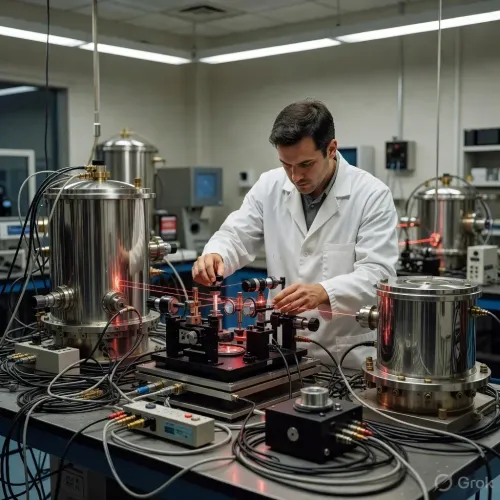
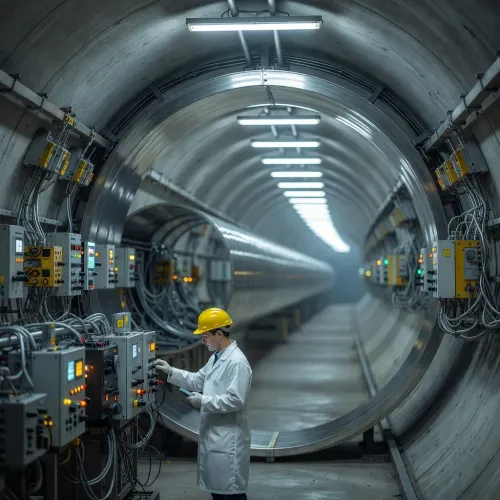
The team achieved the confirmation after 15 years of research using the Beijing Electron Positron Collider II (BEPCII), according to Guangming Daily. Scientists accelerated electrons and their antiparticles to near light speed and smashed them together to produce short-lived J/psi particles. The decay products of these J/psi particles provided an ideal, low-background environment in which glueball signatures could be isolated and studied with sufficient statistical confidence.
Why it matters
The confirmation fills a long-standing gap in the Standard Model of particle physics, the theoretical framework that describes the fundamental constituents of matter and the forces governing them. Glueballs had been the one predicted particle class that lacked direct experimental verification, making their discovery comparable in conceptual weight to the detection of the Higgs boson in 2012. The result validates decades of quantum chromodynamics (QCD) theory and opens a new experimental window into the behaviour of the strong force at the most fundamental level.
The competitive backdrop
The BEPCII, operated under the Chinese Academy of Sciences, has steadily positioned China as a serious contender in high-energy physics research, a domain historically dominated by CERN in Europe and Fermilab in the United States. The glueball confirmation is the collider's highest-profile result to date and strengthens the case for China's planned next-generation circular electron-positron collider, which would operate at energies far exceeding the current machine.
What's next
Independent verification by other experimental collaborations will be the immediate next step, as is standard practice for landmark claims in particle physics. Broader implications for nuclear theory, including how the strong force confines quarks permanently inside hadrons — a phenomenon known as confinement — may take years to fully work out. The result is expected to energise funding discussions for next-generation colliders in both China and Europe, where the proposed Future Circular Collider (FCC) at CERN remains under review.
Point of View
Long-horizon investment in basic research infrastructure — exemplified by the BEPCII — can now produce results that rival or surpass those from Western-led facilities on the most fundamental questions in physics. Mainstream coverage tends to frame this as a pure science story, but the timing matters: the announcement lands as China lobbies internationally for support of its next-generation collider project, and a landmark discovery is the most persuasive funding argument imaginable. The result also quietly challenges the assumption that breakthrough particle physics requires the multi-billion-dollar scale of CERN — BEPCII operates at a fraction of that budget. Independent replication will be the real test, but if the result holds, it reshapes the global map of high-energy physics leadership.
NationPress
23 Sept 2026
Frequently Asked Questions
What is a glueball and why is it significant?
A glueball is a subatomic particle made entirely of gluons — the force-carrying particles of the strong nuclear force — with no quarks involved. Its significance lies in the fact that its existence was predicted roughly 50 years ago by quantum chromodynamics theory but had never been experimentally confirmed until now, making this one of the most important particle physics discoveries in decades.
Who discovered the glueball and when?
A Chinese-led international collaboration of approximately 700 scientists from 15 countries announced the confirmation on 8 August 2026 at the International Conference on High Energy Physics in Natal, Brazil. The team conducted 15 years of research using the Beijing Electron Positron Collider II.
How was the glueball detected?
Scientists used the Beijing Electron Positron Collider II to collide electrons and positrons at near light speed, producing short-lived J/psi particles. The decay of these J/psi particles created an ideal low-background environment where glueball signatures could be identified with sufficient statistical confidence, according to Guangming Daily.
What does the glueball discovery mean for physics?
The discovery fills the last major experimental gap in the Standard Model's description of the strong force and validates decades of quantum chromodynamics theory. It is expected to deepen understanding of quark confinement — why quarks are permanently bound inside protons and neutrons — and will likely accelerate funding discussions for next-generation particle colliders globally.
What happens next after the glueball announcement?
Independent experimental verification by other collaborations is the immediate priority, as is standard for landmark claims in particle physics. The result is also expected to strengthen China's case for building a next-generation circular electron-positron collider, while adding pressure on CERN's proposed Future Circular Collider to secure approval and funding.