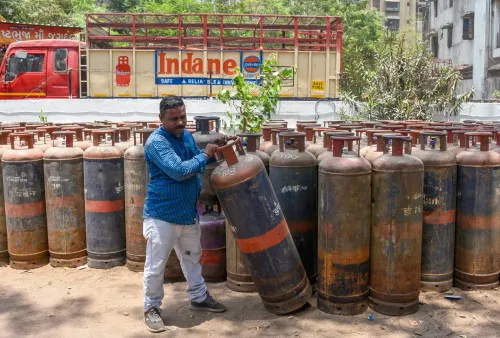
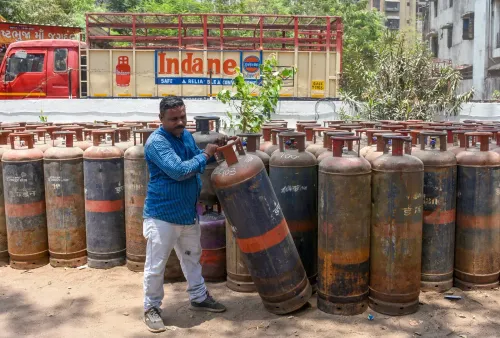
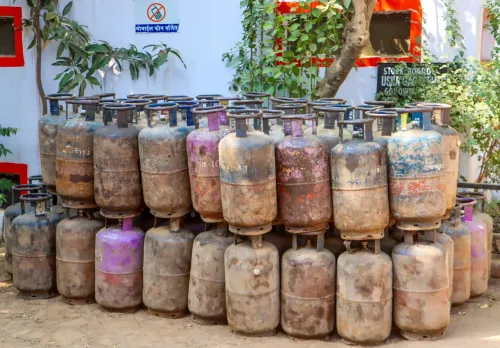
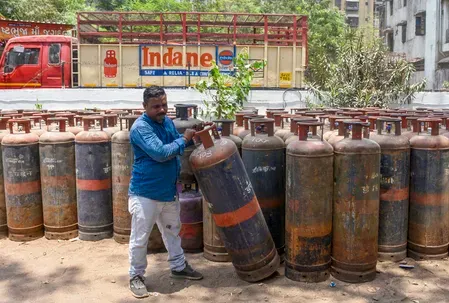
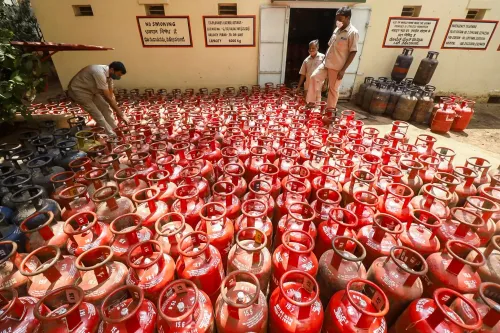
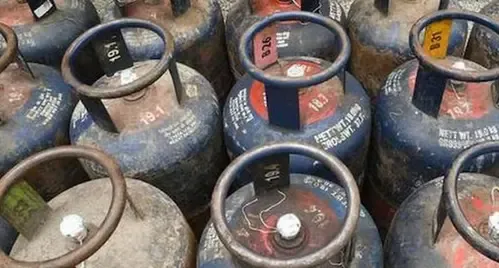
Commercial LPG cylinder rates surge ₹993 to ₹3,071.5; household gas unchanged

Synopsis
Commercial LPG just jumped ₹993 per cylinder — the third spike since the US-Israel-Iran conflict began — but 33 crore household gas users felt nothing. The government and state oil firms are absorbing global crude shocks to shield consumers. The real story: how long can they hold the line if West Asia tensions persist?
Key Takeaways
19-kg commercial LPG cylinders hiked by ₹993 to ₹3,071.5 in Delhi on 1 May 2026 .
Third price increase since 28 February 2026 West Asia conflict began (prior hikes: ₹115 in March, ₹200 on 1 April).
33 crore household LPG consumers saw no rate change.
Petrol, diesel, ATF prices for consumers remained frozen.
Export duties on diesel set at ₹23/litre , ATF at ₹33/litre from 1 May 2026 ; revised fortnightly based on global crude averages.
Commercial LPG cylinder prices jumped sharply on May 1, 2026, with 19-kg cylinders rising by ₹993 to reach ₹3,071.5 in Delhi, while 33 crore domestic consumers saw no change in household gas tariffs, according to Indian Oil Corporation (IOC).
The hike marks the third upward revision since the US-Israel-Iran conflict began on 28 February, following increases of roughly ₹115 in early March and nearly ₹200 on 1 April. Notably, petrol and diesel prices for consumers remained unchanged, and aviation turbine fuel (ATF) rates for domestic carriers were also held steady.
Why commercial LPG rose while household rates held
The divergence reflects government and state-owned oil companies' strategy to shield ordinary citizens from global energy volatility. While commercial LPG — used by hotels, restaurants, and small industries — tracks international crude movements more directly, household LPG pricing is administratively managed to protect low-income households. IOC stated that state-owned oil firms absorbed global cost increases to protect carriers and passengers on ATF.
Export duties tightened to secure domestic supply
The government introduced export levies — Special Additional Excise Duty (SAED) and Road and Infrastructure Cess (RIC) — on 27 March 2026 to curb petroleum product exports and ensure domestic availability amid West Asia tensions. From 1 May 2026, the Finance Ministry revised these fortnightly: diesel exports now attract ₹23 per litre duty (SAED only), ATF exports face ₹33 per litre (SAED), while petrol export duty remains nil. The previous revision occurred on 11 April 2026.
Domestic fuel prices insulated from global shocks
Despite elevated international crude prices, petrol and diesel for domestic consumption saw no excise duty changes, and consumer pump prices remained frozen. This reflects a deliberate policy choice: absorb global cost pressures at the state-owned oil company and government level rather than pass them to motorists and householders. The IOC statement emphasised that
Point of View
Household gas frozen, petrol-diesel-ATF held — reveals the government's political calculus: absorb global shocks at the pump and state-owned oil company level, not at the consumer gate. It works short-term, but if West Asia tensions extend beyond six months, the fiscal cost becomes unsustainable. The real test: whether export levies can genuinely dampen outflows or merely shift the burden downstream.
NationPress
16 Sept 2026
Frequently Asked Questions
Why did commercial LPG prices rise while household gas stayed the same?
Commercial LPG tracks global crude prices more directly and is market-linked, while household LPG pricing is administratively managed to protect 33 crore low-income consumers. State-owned oil companies absorbed the global cost increase for household users but passed it on to commercial buyers.
How much has commercial LPG risen since the West Asia crisis began?
Commercial 19-kg cylinders have risen ₹1,308 in total since 28 February 2026: ₹115 in early March, ₹200 on 1 April, and ₹993 on 1 May 2026. A single cylinder now costs ₹3,071.5 in Delhi.
What are the new export duties on petroleum products?
From 1 May 2026, diesel exports face ₹23 per litre duty (SAED only), ATF exports face ₹33 per litre (SAED), and petrol export duty remains nil. These are revised fortnightly based on average international crude prices.
Why did the government introduce export duties on fuel?
Export levies were introduced on 27 March 2026 to curb petroleum product exports and ensure domestic availability amid West Asia tensions. By disincentivising exports, the government aims to keep more fuel in the domestic market.
Are petrol and diesel prices changing for consumers?
No. Despite elevated global crude prices, petrol and diesel rates for domestic consumers remain unchanged, and excise duty rates on domestically consumed fuel have not been revised. State-owned oil firms are absorbing global cost increases.