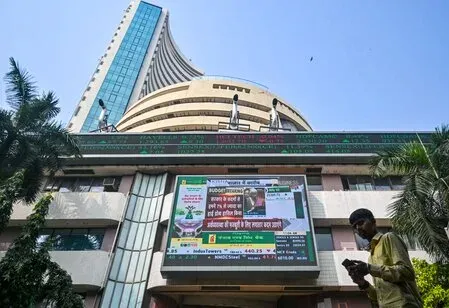
Sensex, Nifty slip 0.75% in volatile week as oil surge, geopolitical strain dent appetite
Synopsis
Indian equities took their worst week in a month as crude oil soared to $126 per barrel on Strait of Hormuz tensions, triggering FII outflows and currency pressure. While defensive sectors held up and smallcaps defied gravity, banking stocks crumbled and the Sensex-Nifty face a narrow 1,000-point range until geopolitical clarity returns.
Key Takeaways
Sensex closed down 582 points (0.75%) at 76,913 ; Nifty 50 fell 0.73% to 23,997 for the week.
Crude oil surged to $126 per barrel — the highest in four years — on Strait of Hormuz blockade tensions.
FII selling and inflationary pressure from oil weighed on sentiment; Bank Nifty tumbled 2.56% to 54,863 .
Nifty IT and Pharma remained resilient; Nifty Smallcap100 gained 1.62% despite headline weakness.
Nifty 50 expected to remain range-bound between 23,500–24,500 until geopolitical clarity emerges.
Indian equity benchmarks closed in the red this week, with the Sensex shedding 582 points or 0.75% to finish at 76,913, while the Nifty 50 declined 0.73% to 23,997. Persistent selling by foreign institutional investors (FIIs) and a sharp surge in crude oil prices to $126 per barrel — the highest level in four years — weighed heavily on investor sentiment throughout the week.
Geopolitical tensions and oil shock
The Strait of Hormuz blockade remained a key drag on global markets, with negotiations showing little progress. The spike in crude prices, driven by geopolitical risk, intensified inflationary concerns and raised the spectre of domestic fuel price hikes. Analysts noted that India's heavy reliance on oil imports amplifies currency pressure, reviving fears of capital outflows and widening current account deficits.
Sectoral divergence and defensive strength
Most sectors traded lower, with Nifty Metal, PSU Banks, Realty, and FMCG as major laggards. Conversely, Nifty IT and Pharma remained resilient. Defensive and demand-led sectors — pharmaceuticals, healthcare, telecom, and energy — outperformed amid volatility, buoyed partly by early Q4 FY26 corporate earnings that prompted selective buying.
Midcap and smallcap divergence
Broader indices painted a different picture: Nifty Midcap100 dipped just 0.28%, while Nifty Smallcap100 gained 1.62%, signalling a flight to perceived safety in smaller-cap stocks despite headline weakness.
Banking sector under pressure
Bank Nifty underperformed sharply, closing at 54,863 and down 2.56% for the week. Analysts expect the banking index to consolidate in the 54,000–57,500 range as Q4 earnings reports drive stock-specific action in the coming weeks.
Outlook and rate expectations
Geopolitical risks and persistent inflationary pressures are expected to keep global central banks, including the US Federal Reserve, hawkish through 2026, adding uncertainty to the interest rate trajectory. Analysts project Nifty 50 to remain range-bound between 23,500 and 24,500 in the near term, with consolidation likely to persist until clarity emerges on crude prices and global monetary policy.
Point of View
FIIs heading for the exits, and the rupee under pressure. What's notable is the bifurcation — smallcaps and defensive plays held while banking cratered. This suggests the market is not uniformly spooked but rather repricing sectors exposed to rate hikes and import inflation. Until the Hormuz blockade resolves or crude retreats below $115, expect range-bound chop and sector rotation, not capitulation.
NationPress
27 Sept 2026
Frequently Asked Questions
Why did the Sensex and Nifty fall this week?
The Sensex fell 582 points (0.75%) to 76,913 and Nifty dropped 0.73% to 23,997 due to persistent FII selling, a surge in crude oil to $126 per barrel (four-year high) on Strait of Hormuz blockade tensions, and inflationary concerns from higher fuel costs. The rupee came under pressure as import costs rose.
What is the Strait of Hormuz blockade and why does it matter for India?
The Strait of Hormuz is a critical global shipping chokepoint through which a large share of world oil passes. A blockade there drives oil prices higher, which directly impacts India — a net oil importer — by raising fuel costs, triggering inflation, widening the current account deficit, and putting pressure on the rupee and capital flows.
Which sectors performed worst and which held up?
Nifty Metal, PSU Banks, Realty, and FMCG were major laggards. In contrast, Nifty IT and Pharma remained resilient, while defensive sectors such as healthcare, telecom, and energy outperformed, buoyed by early Q4 earnings and lower sensitivity to rate hikes.
Where is the Nifty 50 expected to trade in the near term?
Analysts expect Nifty 50 to remain range-bound between 23,500 and 24,500 in the near term, with consolidation likely to persist until geopolitical clarity emerges on the Hormuz blockade or crude prices retreat.
Why did Bank Nifty underperform more sharply than the broader market?
Bank Nifty fell 2.56% for the week to 54,863, underperforming because banking stocks are sensitive to rising interest rates (expected to remain elevated amid geopolitical inflation) and slowing credit growth. The index is expected to consolidate in the 54,000–57,500 range as Q4 earnings reports drive stock-specific action.