Hong Kong bids to host 2030 International Congress of Mathematicians
Synopsis
Hong Kong, backed by 1982 Fields Medallist Shing-Tung Yau, is bidding to host the 2030 International Congress of Mathematicians — a move its proponents frame as marking China's emergence as a rival to America's long-held dominance in mathematical sciences.
Key Takeaways
Hong Kong is competing with Glasgow and Tokyo to host the 2030 International Congress of Mathematicians (ICM) .
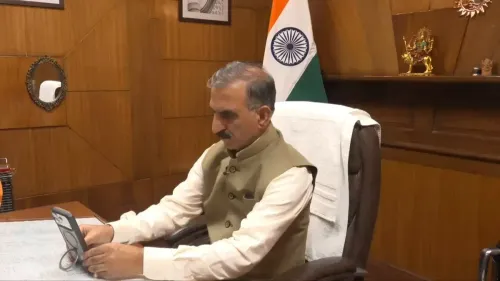
The bid is led by Shing-Tung Yau , a 1982 Fields Medallist and Tsinghua University professor, alongside academic Wong Wing-hung .
The International Mathematical Union (IMU) inspection team visited all three candidate cities in February 2026 and was reportedly impressed by Hong Kong 's immigration policy.
The winning host city will be announced at the IMU general assembly in New York on July 21, 2026 .
The bid was formally launched under the Hong Kong Mathematical Society with backing from the Chinese Mathematical Society .
Yau and Wong Wing-hung describe the bid as timed to a 'tipping point' in which China is closing the mathematics gap with the United States .
Hong Kong is competing against Glasgow and Tokyo to host the 2030 International Congress of Mathematicians (ICM), the most prestigious gathering in global mathematics, with the winning city to be announced at the International Mathematical Union (IMU) general assembly in New York on July 21. The bid is being championed by Shing-Tung Yau, a 1982 Fields Medallist and professor at Tsinghua University, who describes the moment as a historic inflection point for mathematics in Asia.
The bid and who is behind it
According to Yau, the Hong Kong bid was formally launched last year under the auspices of the Hong Kong Mathematical Society, with strong backing from the Chinese Mathematical Society. Fellow academic Wong Wing-hung has co-championed the effort, framing it as strategically timed. An IMU inspection delegation completed site visits to all three candidate cities in February, and Yau noted the team left visibly impressed by Hong Kong's immigration policy in particular.
Why it matters: a shifting mathematical order
Yau and Wong Wing-hung described the bid as coinciding with a 'tipping point' — a moment when America's long-standing dominance in the mathematical sciences is beginning to cede ground to a rapidly rising China. Hosting the ICM in Hong Kong would mark the first time the congress convenes in Chinese territory, and would signal the region's growing institutional weight in pure mathematics. The ICM, held every four years, is also the occasion at which the Fields Medal — often called the Nobel Prize of mathematics — is awarded.
The competitive backdrop
Glasgow and Tokyo present formidable competition. Both cities have established academic infrastructure and strong ties to the IMU. Tokyo in particular has deep roots in mathematical research, while Glasgow offers proximity to Europe's dense network of research universities. Hong Kong's pitch leans on its role as a gateway between mainland China's surging mathematical output and the international academic community, as well as its flexible immigration framework for visiting scholars.
The broader context: China's mathematical ascent
Even as the world's top mathematicians prepare to convene in Philadelphia in late July 2026 for the current ICM, the contest for 2030 reflects a broader geopolitical shift in science. China has invested heavily in mathematical talent pipelines, and institutions such as Tsinghua University and the Chinese Mathematical Society have steadily elevated their global standing. The Greater Bay Area, of which Hong Kong is a part, has been positioned by Beijing as a hub for world-class research.
What's next
The IMU general assembly convenes in New York on July 21, 2026, when member nations will vote to select the host city for the 2030 International Congress of Mathematicians. A Hong Kong win would represent a landmark moment for mathematics in the Asia-Pacific region and could accelerate the flow of international research talent into the Greater Bay Area. All eyes will be on how the IMU's member delegations weigh academic merit against geopolitical considerations.
Point of View
On the surface, a logistical question about conference venues — but it is also a proxy battle over whose mathematical tradition commands global prestige. What mainstream coverage often underweights is the institutional machinery behind Hong Kong's bid: the alignment of the Hong Kong Mathematical Society, the Chinese Mathematical Society, and a Fields Medallist of Yau's stature signals coordinated state-adjacent soft-power ambition, not merely academic enthusiasm. The IMU's reported admiration for Hong Kong's immigration policy is telling — at a time when US visa friction is pushing Chinese and other Asian researchers to reconsider their base of operations, Hong Kong is positioning itself as the frictionless alternative hub. A 2030 ICM in Hong Kong would not just celebrate mathematics; it would validate the Greater Bay Area's pitch as the new centre of gravity for global science.
NationPress
30 Sept 2026
Frequently Asked Questions
What is the International Congress of Mathematicians and why does hosting it matter?
The International Congress of Mathematicians (ICM) is the world's largest and most prestigious mathematics conference, held every four years under the auspices of the International Mathematical Union (IMU) . It is also the occasion on which the Fields Medal — widely regarded as the highest honour in mathematics — is awarded. Hosting the ICM confers significant academic prestige and draws thousands of the world's leading researchers to the host city.
Which cities are competing to host the 2030 ICM?
Hong Kong , Glasgow , and Tokyo are the three candidate cities bidding to host the 2030 International Congress of Mathematicians . An IMU inspection delegation visited all three cities in February 2026 . The final decision will be announced at the IMU general assembly in New York on July 21, 2026 .
Who is leading Hong Kong's bid for the 2030 ICM?
Shing-Tung Yau , a 1982 Fields Medallist and professor at Tsinghua University , is spearheading Hong Kong 's bid alongside fellow academic Wong Wing-hung . The bid was formally launched under the Hong Kong Mathematical Society with strong support from the Chinese Mathematical Society .
What does China's rise in mathematics have to do with Hong Kong's ICM bid?
Yau and Wong Wing-hung have framed the bid as coinciding with a 'tipping point' at which America 's long-standing dominance in mathematical sciences is beginning to give ground to a rapidly rising China . Hosting the ICM in Hong Kong would symbolise this shift and reinforce the city's role as a bridge between mainland China 's growing research output and the global academic community.
When and where is the current International Congress of Mathematicians being held?
The current International Congress of Mathematicians is scheduled to take place in Philadelphia in late July 2026 . It is at this congress that the host city for the 2030 edition will also be formally confirmed, following the IMU general assembly vote in New York on July 21, 2026 .