Will MP Introduce Education on Vedas, Yoga, and Cows in New Gurukul Schools?
Click to start listening
Synopsis
The Madhya Pradesh government is embarking on a unique educational initiative that will incorporate cow education into its school system. This program aims to revitalize ancient Indian wisdom while promoting holistic development among students. Learn more about this innovative approach to education.
Key Takeaways
- Madhya Pradesh to introduce cow education in schools.
- Focus on Sanskrit, Vedas, and Yoga.
- Initiative aims for holistic student development.
- Plans for agricultural education in 3367 higher secondary schools.
- Revitalizing ancient Indian knowledge is a priority.
Bhopal, Dec 22 (NationPress) The Madhya Pradesh government is preparing to introduce a comprehensive curriculum focused on cows, highlighting their cultural, health, and scientific importance.
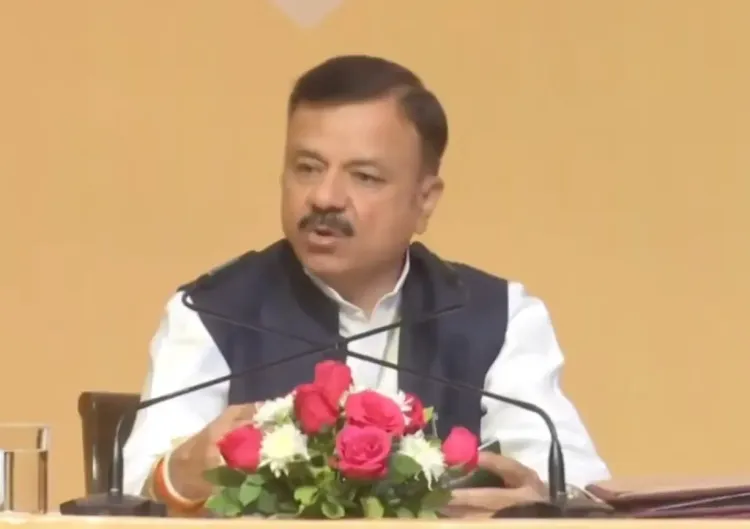
On Monday, School Education Minister Uday Pratap Singh revealed that specialized institutions are being established in Rajgarh and Narsinghpur districts, where students will start their education with Sanskrit, Vedas, and Yoga.
“As we move ahead, we will incorporate education about cows,” the minister stated, noting the scientific evidence that suggests cows provide energy and inspiration for maintaining health.
“These schools will serve as a source of motivation and a research hub,” he added.
The initiative seeks to merge ancient Indian wisdom with contemporary education, fostering overall development.
“Advocates believe that engaging with cows offers both physical and mental benefits, rooted in traditional beliefs about their role in enhancing well-being,” he explained.
The minister mentioned that this initiative aligns with the goal of revitalizing Vedic education and promoting cow conservation in the state.
However, specific details regarding the cow-focused curriculum remain to be disclosed.
“Just as we have Central government-owned Sandipani schools for Sanskrit in Indore and Ujjain, we will establish these institutions as Gurukuls, named after Adi Shankaracharya. If successful, we aim to replicate this model across the state,” he said.
Additionally, the Education Minister announced plans to introduce 3367 new programs in higher secondary schools (grades 9-12) to address dropout rates from the eighth grade.
“We have launched 17 trades and 42 job-role training programs in these institutions. Agriculture has been introduced in 690 schools, with the Chief Minister expressing a desire to further integrate it as a trade in various schools,” he noted.
The Education Minister acknowledged that while it is currently available in 690 schools, expanding the agriculture curriculum poses a significant challenge, but the government is committed to increasing the number of schools offering this subject.
“We have included professional education in an additional 984 schools for the 2025-26 academic year, raising the total number of enrolled schools from 4 lakh to 5.90 lakh,” the minister stated, adding, “Next year, we aim for 100% enrollment in all such schools.”
These new institutions will operate as modern Gurukuls, focusing on traditional subjects in conjunction with vocational training to minimize dropout rates and improve employability.
While the mainstream scientific community supports the nutritional benefits of cow milk and its products, rich in proteins, calcium, and vitamins contributing to health and energy, there are no peer-reviewed studies that specifically confirm cows as a source of "energy" or "inspiration" beyond these aspects.
“Nevertheless, traditional Ayurvedic texts and cultural practices emphasize the revered position of cows for purity and vitality,” he concluded.
Point of View
It is essential to recognize the significance of blending traditional and modern education. The Madhya Pradesh government's initiative reflects a broader movement to revive ancient Indian knowledge while addressing contemporary educational challenges, such as dropout rates. By focusing on holistic development, this program could enhance students' employability and cultural understanding. However, it is crucial to ensure a balanced approach that incorporates scientific rigor alongside traditional beliefs.
NationPress
22/12/2025
Frequently Asked Questions
What subjects will be taught in the new Gurukul schools?
The new Gurukul schools will initially focus on Sanskrit, Vedas, and Yoga, with plans to incorporate education about cows in the future.
Where will these Gurukul schools be located?
The first Gurukul schools are being established in Rajgarh and Narsinghpur districts of Madhya Pradesh.
What is the goal of this educational initiative?
The initiative aims to blend ancient Indian knowledge with modern education to promote holistic development and reduce dropout rates.
How many schools are planned for agricultural education?
The Madhya Pradesh government plans to introduce agricultural education in 3367 higher secondary schools to address dropout issues.
What benefits are associated with cow education?
Proponents argue that interaction with cows can provide physical and mental benefits, based on traditional beliefs.