How are Mumbai University and VES collaborating to enhance Sindhi language and culture?
Click to start listening
Synopsis
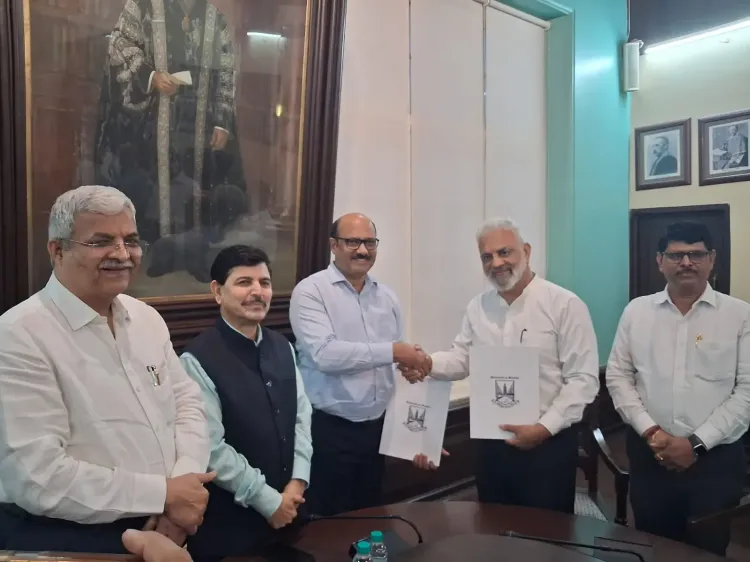
In a groundbreaking partnership, Vivekanand Education Society and Mumbai University have signed a MoU to establish a Centre of Excellence dedicated to the Sindhi language and culture. This initiative is set to be a significant step in preserving and promoting the rich heritage of the Sindhi community while fostering academic collaboration.
Key Takeaways
- Establishment of a Centre of Excellence for Sindhi studies.
- Collaboration between Vivekanand Education Society and Mumbai University.
- Focus on preserving and promoting Sindhi language and culture.
- 12,000 sq. ft. facility to house the Centre.
- Opportunities for academic programs, research, and community engagement.
New Delhi, Dec 12 (NationPress) The Vivekanand Education Society (VES) has officially revealed a partnership with the University of Mumbai through a signed Memorandum of Understanding (MoU) to create a Centre of Excellence (CoE) focusing on Sindhi language, heritage, and cultural studies.
Additionally, this CoE will feature the dedicated Vivekanand Education Society Sindhi Research and Development Centre (SRDC).
The primary goal of this initiative is to preserve and promote the Sindhi language, as well as its rich culture and heritage, while enhancing the collaboration between VES and the University of Mumbai.
The proposed Centre will occupy a space of 12,000 sq. ft. within a new facility at the University of Mumbai and aligns with the Government of India’s mission to enhance the status of Sindhi languages.
Through various academic programs, research initiatives, and community outreach, the Centre aims to broaden access to education and scholarship related to heritage languages.
“This represents a historic achievement for the Sindhi community and a long-overdue chance to take significant steps towards preserving their language and literature,” stated Advocate Rajesh Gehani, Secretary of Vivekanand Education Society.
Gehani emphasized that the centre will facilitate linguistic analysis and research, digitization of manuscripts, conversion and transliteration of Sindhi texts into digital formats in Arabic and Devanagari, audio rendering of Sindhi books into audiobooks, and the creation of audio-visual educational and research materials, in addition to the documentation and preservation of oral traditions.
“The Centre will also support the documentation of Sindhi culture, traditions, and heritage; archival and preservation efforts; academic conferences, seminars, and workshops; alongside educational and training programs. This model has the potential to be replicated in other states, considering the widespread presence of Sindhis across India,” he added.
Professor Ravindra Kulkarni, Vice-Chancellor of Mumbai University, remarked that “the Sindhi language embodies a rich cultural legacy that must be transmitted to future generations with appropriate academic and research backing.”
“This initiative signifies not merely an expansion of infrastructure but a decisive step towards the conservation of linguistic heritage,” he expressed, with confidence that the Department will emerge as a national and international hub for research and cultural outreach,” Kulkarni noted.
This landmark collaboration signifies a pivotal advancement in the preservation and promotion of the Sindhi language and its extensive cultural legacy.
Point of View
The establishment of the Centre of Excellence in Sindhi language and culture is a commendable initiative that reflects the commitment to preserving India's linguistic diversity. This collaboration between VES and Mumbai University not only strengthens academic ties but also empowers the Sindhi community to celebrate and maintain their rich heritage. Such efforts are essential to foster cultural understanding in a diverse nation like India.
NationPress
14/12/2025
Frequently Asked Questions
What is the purpose of the Centre of Excellence?
The Centre of Excellence aims to preserve and promote the Sindhi language, heritage, and culture while enhancing collaboration between VES and the University of Mumbai.
What facilities will the Centre include?
The Centre will include a dedicated research and development centre focused on Sindhi studies, along with educational programs and community engagement initiatives.
How will the Centre benefit the Sindhi community?
The Centre will facilitate linguistic analysis, digitization of manuscripts, and the creation of educational resources, thereby helping to preserve the Sindhi language and culture.