Nvidia Joins AI Security Community at Black Hat USA
Synopsis
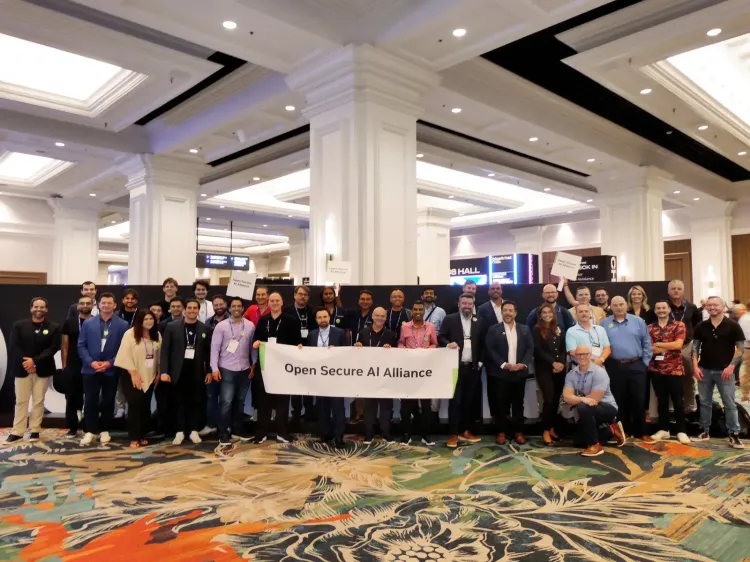
Nvidia and Akamai joined Open Secure AI Alliance members at Black Hat USA on 6 August 2026, marking an in-person milestone for a cross-industry coalition working to advance AI security standards and collaboration.
Key Takeaways
Nvidia and Akamai participated in an in-person Open Secure AI Alliance community meeting at Black Hat USA on 6 August 2026 .
The gathering was held under the #BHUSA track at Black Hat, one of the cybersecurity industry's most prominent annual conferences.
Members met to connect, share ideas, and advance AI security — described by Nvidia as 'a great moment for a growing community'.
Nvidia's involvement reflects its role as the foundational GPU and AI-infrastructure supplier with a direct stake in securing the AI stack.
Cross-industry coalitions on AI security are growing as adoption of AI systems expands the potential attack surface.
At one of the cybersecurity world's most-watched annual gatherings, chip giant Nvidia stepped into a room full of peers — and the conversation was about keeping artificial intelligence secure. On 6 August 2026, Nvidia shared that members of the Open Secure AI Alliance met in person at Black Hat USA, a landmark moment for a coalition working to push AI security standards forward.
Responding to a post by cloud and cybersecurity firm Akamai, Nvidia's account described the gathering as 'a great moment for a growing community' — members connecting face-to-face to share ideas and sustain momentum on AI security. The event, part of the #BHUSA track at Black Hat, brought together professionals whose shared concern is the expanding attack surface that AI systems introduce.
Why Black Hat Is the Right Room for This Conversation
Black Hat USA has long been the industry's premier venue for surfacing hard security problems before they become headlines. Bringing an AI security alliance into that environment signals that the community is treating AI threats with the same seriousness as traditional network or application vulnerabilities — not as a future concern, but a present one.
Technology firms across the stack — from hardware makers like Nvidia to CDN and security providers like Akamai — have increasingly formed cross-industry coalitions to address risks that no single vendor can solve alone. The Open Secure AI Alliance appears to be one such effort, built on the premise that AI infrastructure security requires shared standards and shared accountability.
Nvidia's Stake in Securing the AI Stack
As the dominant supplier of GPUs that power large-scale AI training and inference, Nvidia sits at the foundation of the AI infrastructure chain. Any vulnerability at the hardware or platform layer can cascade upward through models and applications — which gives Nvidia both a direct stake in AI security and a platform to convene the industry around it.
In-person gatherings like this one matter precisely because standards bodies and alliances move faster when people are in the same room. Whether this meeting produces published frameworks, shared tooling, or simply tighter working relationships, the direction of travel is clear: AI security is becoming a formal discipline, not an afterthought.
Point of View
Security can no longer be siloed within individual vendors. Nvidia's presence is strategically significant — a hardware leader co-owning the security narrative signals that responsibility is being pushed down to the infrastructure layer, not left to application developers alone. This mirrors how cloud security evolved a decade ago, when hyperscalers had to step in and define shared responsibility models. The formation of cross-vendor AI security alliances at venues like Black Hat suggests the industry is entering a phase of standardisation, which typically precedes regulatory frameworks.
NationPress
6 Aug 2026
Frequently Asked Questions
What is the Open Secure AI Alliance?
The Open Secure AI Alliance is a cross-industry community focused on advancing AI security standards and collaboration. It includes technology firms such as Nvidia and Akamai, and held an in-person meeting at Black Hat USA in August 2026.
What is Black Hat USA?
Black Hat USA is one of the cybersecurity industry's most prominent annual conferences, known for bringing together security researchers, vendors, and professionals to address emerging threats and vulnerabilities.
Why is Nvidia involved in AI security?
As the leading supplier of GPUs used in AI training and inference, Nvidia sits at the base of the AI infrastructure stack. Vulnerabilities at the hardware or platform layer can affect all AI systems built on top, giving Nvidia a direct stake in AI security.
What did Nvidia and Akamai do at Black Hat USA 2026?
Nvidia and Akamai joined other Open Secure AI Alliance members for an in-person meeting at Black Hat USA on 6 August 2026, sharing ideas and working to advance AI security collaboration.
Why do tech companies form AI security alliances?
No single vendor can address the full range of AI security risks alone. Cross-industry alliances allow hardware makers, cloud providers, and cybersecurity firms to develop shared standards, tools, and accountability frameworks that protect the broader AI ecosystem.