Nvidia Backs Both Open and Closed AI Models, Welcomes Jensen Huang

Synopsis
Nvidia's corporate X account on 24 July 2026 welcomed CEO Jensen Huang and declared that the future of AI leadership depends on both frontier closed and open models — a platform-neutral stance with wide implications for AI researchers, cloud providers, and policymakers globally.
Key Takeaways
Nvidia posted on 24 July 2026 that 'the future of AI leadership needs both frontier closed models and frontier open models.' The statement comes from Nvidia's official corporate account, not a personal post by Jensen Huang .
Nvidia's CUDA platform, launched in 2006 , underpins the AI training workloads of both open and closed model developers.
The company's platform-neutral stance maximises its hardware market across competing AI development philosophies.
The open-versus-closed AI debate is central to ongoing regulatory consultations in the US , EU , and India .
Upcoming Nvidia developer events will be watched for hardware roadmap details that reflect this dual-track commitment.
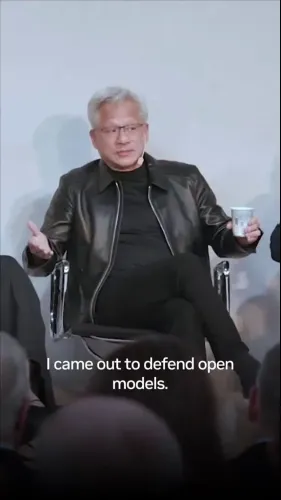
Chip giant Nvidia Corporation on Friday, 24 July 2026 posted on X welcoming its chief executive Jensen Huang while staking out a clear position on the future of artificial intelligence: both frontier closed models and frontier open models are essential to AI leadership.
The post, published from Nvidia's official corporate account, read: 'Welcome @jensenhuang. The future of AI leadership needs both frontier closed models and frontier open models.' The message signals that the world's dominant AI-chip maker sees no contradiction between proprietary and open-weight approaches to large-scale AI development.
Context
Nvidia has been the central hardware enabler of the modern AI era. Its graphics processing units power the training and inference workloads of virtually every major AI lab, from those building tightly controlled proprietary systems to those releasing open-weight models for public use. The company's CUDA parallel-computing platform, launched in 2006, laid the groundwork for the deep-learning revolution that followed.
By publicly endorsing both paradigms, Nvidia is reinforcing its platform-neutral stance — a posture that maximises its addressable market regardless of which AI development philosophy wins broader adoption.
Policy Backdrop
The debate between open and closed AI models has intensified globally. Advocates of open-weight models argue they democratise access, enable independent safety research, and reduce dependence on a handful of large corporations. Proponents of closed models counter that proprietary guardrails are necessary to prevent misuse of the most capable systems.
Governments and regulatory bodies across the United States, the European Union, and India are actively examining how to govern frontier AI, with the open-versus-closed question sitting at the heart of several ongoing policy consultations. Nvidia's explicit endorsement of both tracks carries weight in these conversations given the company's infrastructural role in the AI supply chain.
Stakeholders and Impact
AI researchers and cloud providers are the most immediately affected constituencies. For researchers, Nvidia's neutrality means continued hardware support for open-weight model development — a lifeline for academic labs and smaller startups that cannot afford to build closed, proprietary infrastructure from scratch.
For cloud providers — including hyperscalers that resell Nvidia GPU capacity — the statement reinforces that Nvidia will optimise its chips for diverse workloads rather than favouring any single customer's architecture. This has direct implications for competitive dynamics in the AI-as-a-service market, including in India, where cloud AI adoption is accelerating rapidly across sectors such as fintech, healthcare, and government services.
What's Next
Attention will now turn to upcoming Nvidia developer conferences and product announcements for concrete signals of how the company plans to deliver hardware optimisations for both open-weight and closed-source frontier models. Specific roadmap details — such as memory bandwidth improvements relevant to large open models or security features suited to closed deployments — will reveal how the stated philosophy translates into silicon.
As frontier AI models grow larger and more capable, the infrastructure choices made by companies like Nvidia will increasingly shape which development paradigms are technically and economically viable at scale — making the company's platform stance a de facto policy position in the global AI race.
Point of View
Nvidia avoids being drawn into the increasingly politicised open-versus-closed debate while remaining indispensable to all sides. For policymakers in India and elsewhere who are still drafting AI governance frameworks, Nvidia's stance signals that the world's most critical AI hardware supplier will not resolve the open-closed question for them. The burden of choosing — and regulating — remains firmly with governments and the labs they oversee.
NationPress
23 Oct 2026
Frequently Asked Questions
What did Nvidia say about open and closed AI models?
Nvidia's official X account stated on 24 July 2026 that 'the future of AI leadership needs both frontier closed models and frontier open models,' endorsing a dual-track approach to AI development.
Who is Jensen Huang and why did Nvidia welcome him on X?
Jensen Huang is the chief executive of Nvidia Corporation , a position he has held since 1993 . The corporate post welcomed his handle, @jensenhuang, in what appears to be a coordinated message associating his leadership with Nvidia's AI strategy statement.
What is the difference between open and closed AI models?
Closed AI models are proprietary systems whose weights and training details are kept private by the developing organisation, while open models — often called open-weight models — release their parameters publicly, allowing researchers and developers to study, fine-tune, and deploy them independently.
Why does Nvidia's position on AI models matter for India?
India is a fast-growing market for cloud AI services, and Nvidia GPUs power much of that infrastructure. Nvidia's neutrality between open and closed AI paradigms means Indian startups, researchers, and cloud providers can expect continued hardware support regardless of which development model they adopt.
What is Nvidia's CUDA platform?
CUDA is a parallel-computing platform launched by Nvidia in 2006 that allows developers to harness GPU power for general computing tasks. It became the foundational software layer enabling modern deep-learning and AI training workloads.