Nvidia unveils Vera CPU, claims 80% edge over x86 for AI agents

Synopsis
Chip giant Nvidia has introduced Vera, a new CPU it says delivers 80% faster agentic task completion than x86 processors. Pitched as the processor for AI factories and agent workloads, the launch extends Nvidia's push beyond GPUs into a full systems stack and intensifies competition with Intel and AMD in the data-center market.
Key Takeaways
Chip giant Nvidia announced a new CPU named Vera via its official corporate channel on 2 June 2026 .
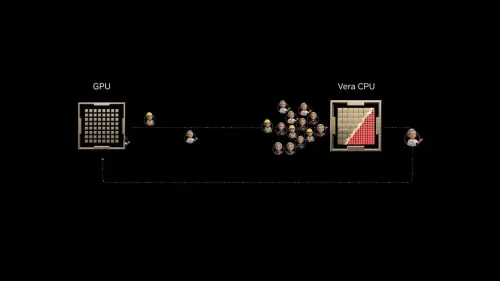
The company claims 80% faster agentic task completion than x86 server processors.
Vera is positioned as the processor for AI factories and autonomous-agent workloads.
The launch extends Nvidia's CPU lineage that began with the Grace Arm-based chip in 2021 .
It sharpens competition with Intel and AMD in the long-dominant x86 server market.
Independent benchmarks and early AI-factory deployments will test the headline performance claim.
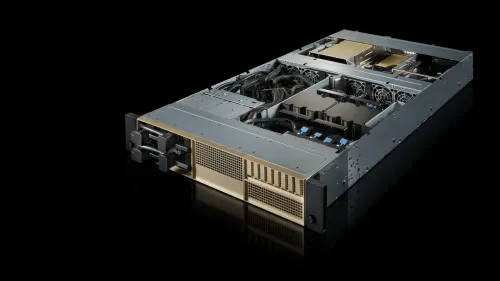
Chip giant Nvidia has unveiled a new central processing unit named Vera, positioning it as a purpose-built processor for the agentic-AI era and claiming an 80% improvement in agentic task completion over incumbent x86 server chips. The announcement was made through the company's official corporate channel on 2 June 2026, framed as a milestone in Nvidia's expansion from accelerator supplier to full-stack AI-infrastructure provider.
In its post, Nvidia declared that 'the AI era needs a new CPU', describing Vera as 'built for AI factories' and 'built for what's next', and asserting that 'the CPU for agents has arrived'. The corporate voice — not chief executive Jensen Huang personally — pitched the launch as a generational reset of the data-center processor stack.
Context
Nvidia, founded in 1993 and led by Mr Huang, has spent the past several years extending its dominance in graphics processing units into a broader systems play. Its product cadence through Hopper and Blackwell generations emphasised tightly integrated silicon, networking and software rather than standalone accelerators.
The Vera launch builds directly on that arc. Nvidia first signalled a CPU ambition in 2021 with the Grace Arm-based processor, designed to sit alongside its GPUs in AI and high-performance-computing systems. Vera, as presented in the post, extends that lineage with an explicit pitch to workloads driven by autonomous software agents.
Policy backdrop
For two decades, server-grade computing has been anchored by the x86 instruction set, shared between Intel and AMD. That duopoly is now being tested by Arm-based designs from cloud operators and silicon vendors, many of whom argue that AI inference and agentic workloads do not map cleanly to legacy x86 assumptions about general-purpose throughput.
Nvidia's framing of Vera as 'the CPU for agents' lands squarely inside that debate. By citing an 80% lead in agentic task completion, the company is staking a claim that the host processor — not just the accelerator — is becoming a competitive battleground as enterprises move from training-heavy pipelines to always-on inference and tool-using AI agents.
Stakeholders and impact
The most immediate audience is hyperscale cloud operators and large enterprise data-center teams, who are evaluating custom silicon to manage rising power draw and per-token inference costs. A credible Nvidia CPU paired with Nvidia GPUs offers a single-vendor stack, which can simplify procurement but also intensifies concerns about platform lock-in.
For Indian buyers — including domestic cloud providers, sovereign AI initiatives and the growing cohort of GPU-as-a-service start-ups — the announcement matters because it signals where future reference architectures for 'AI factories' will be benchmarked. Government-backed compute missions that procure Nvidia systems will inherit the Vera roadmap as it rolls forward.
Competing vendors are likely to respond. Intel and AMD have both been investing in AI-tuned x86 variants, while several Arm-based server programs from cloud majors target similar inference workloads. Independent benchmarks will determine how durable Nvidia's 80% claim proves outside curated tests.
What's next
Attention now shifts to deployment timelines, the specific systems that will ship with Vera, and how the new CPU integrates with Nvidia's networking and software layers. Industry observers will watch upcoming conferences and customer disclosures for third-party benchmarks and pricing signals.
If Vera lives up to its billing, it could accelerate the shift of agentic AI workloads onto vertically integrated stacks, reshaping procurement conversations from Bengaluru to Santa Clara. If the performance lead narrows under independent testing, the x86 incumbents retain room to defend their installed base — making the next two product cycles a defining contest for the architecture of the AI data center.
Point of View
The company is reframing the competitive question — from 'whose GPU' to 'whose stack'. That pressures the x86 incumbents and complicates choices for sovereign AI programmes that prize architectural diversity. The real test will be whether independent benchmarks and total-cost-of-ownership math sustain the 80% headline outside Nvidia's own AI-factory blueprints.
NationPress
20 Oct 2026
Frequently Asked Questions
What is Nvidia Vera?
Nvidia Vera is a new central processing unit announced by chip giant Nvidia, pitched as a CPU purpose-built for AI factories and agentic-AI workloads. The company says it delivers 80% faster agentic task completion than x86 server chips.
How is Vera different from x86 CPUs from Intel and AMD?
Nvidia positions Vera as optimised for AI agents and inference inside integrated AI-factory systems, while x86 chips from Intel and AMD are general-purpose server processors. Nvidia claims an 80% lead in agentic task completion, though independent benchmarks are awaited.
When was the Nvidia Vera CPU announced?
The Vera CPU was announced through Nvidia's official corporate channel on 2 June 2026, framed as a milestone for processors designed around agentic AI workloads.
What does 'CPU for agents' mean?
It refers to a processor tuned for software agents — AI systems that autonomously plan, call tools and complete multi-step tasks. Nvidia argues such workloads need a CPU designed around agentic execution rather than legacy server patterns.
How does Vera affect Indian data centers and AI projects?
It influences future reference designs for AI factories that Indian cloud providers, GPU-as-a-service firms and sovereign AI programmes may procure. The choice between Nvidia's integrated stack and x86-based alternatives will shape cost, power and vendor-lock-in considerations.