Nvidia Vera CPU beats x86 by 1.5x in AI benchmarks
Synopsis
Nvidia's Vera CPU, designed for agentic AI, has outperformed leading x86 processors by 1.5x overall, with 2x faster Linux kernel compilation and 4x greater memory bandwidth, according to independent benchmarks from Phoronix published on 26 May 2026.
Key Takeaways
Nvidia announced its Vera CPU benchmark results on 26 May 2026 , citing independent testing by Phoronix .
Vera delivers 1.5x overall performance compared to leading x86 processors.
Linux kernel compilation on Vera is 2x faster than on competing x86 chips.
Vera achieves 4x greater STREAM TRIAD memory bandwidth , a critical metric for AI workloads.
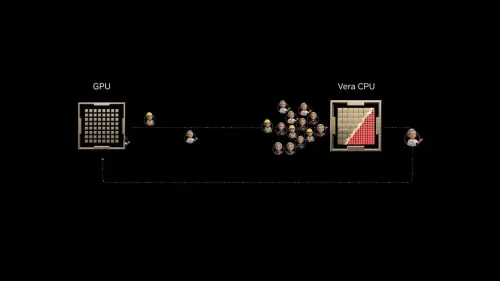
The Vera CPU is built specifically for agentic AI — autonomous, multi-step AI reasoning tasks.
Vera follows Nvidia's earlier Grace CPU (announced 2021) as part of its ARM-based, vertically integrated AI platform strategy.
Chip giant Nvidia announced on Tuesday, 26 May 2026 that its newly built Vera CPU, designed specifically for agentic AI workloads, has cleared independent performance benchmarks — with results confirming substantial leads over leading x86 processors across multiple metrics.
In a post on X, Nvidia cited benchmark results published by independent hardware testing site Phoronix, stating the Vera CPU delivers 1.5x overall performance versus leading x86 processors, 2x faster Linux kernel compilation, and 4x greater STREAM TRIAD memory bandwidth. The company described these figures as validation that Vera 'achieves the performance that AI' demands — a phrase that appears truncated in the original post due to platform character limits.
Context
The Vera CPU is Nvidia's latest custom ARM-based processor, positioned as the successor in a lineage that began with the Grace CPU, first detailed in 2021. Grace was designed to pair with Nvidia's Hopper GPUs in integrated CPU-GPU platforms targeting AI and high-performance computing workloads. Vera represents the next step in that roadmap, now explicitly aimed at the emerging category of agentic AI — systems where AI models autonomously plan, reason, and act across extended tasks.
Phoronix, the benchmarking site cited in Nvidia's post, has published independent Linux hardware performance tests since 2004 and is widely regarded within the open-source and HPC communities as a credible third-party evaluator. Its involvement lends the benchmark figures a degree of independence from Nvidia's own internal claims.
Policy Backdrop
Nvidia's push into custom CPU design reflects a deliberate vertical integration strategy that has accelerated since the early 2020s. The company's 2020 bid to acquire ARM Holdings — abandoned in 2022 following regulatory opposition globally — underscored its ambition to control CPU intellectual property for AI infrastructure. Having failed to acquire ARM outright, Nvidia has instead deepened its ARM architectural licensing to develop proprietary CPU cores.
This approach mirrors moves by hyperscale cloud providers and rivals including Intel and AMD, all of whom have pursued tighter integration between compute, memory, and networking layers to capture a larger share of AI infrastructure spending. For India, where government-backed AI compute initiatives and data centre investments are accelerating, the availability of competitive non-x86 platforms has direct implications for procurement decisions by public and private cloud operators.
Stakeholders and Impact
The primary beneficiaries of a high-performing Vera CPU are AI developers, hyperscale data centre operators, and HPC facilities that run Linux-native workloads at scale. The 4x STREAM TRIAD memory bandwidth advantage is particularly significant for large language model inference and training, where memory throughput is frequently the binding constraint on performance per watt.
For Indian enterprises and government institutions investing in sovereign AI infrastructure — including projects under the IndiaAI Mission — benchmark-validated CPU performance at this margin could influence future hardware procurement. Faster Linux kernel compilation times also matter for cloud-native development pipelines widely used by Indian IT services firms and startups.
What's Next
Nvidia has previously indicated that Vera-based systems will be deployed in next-generation supercomputers. Independent follow-on benchmarks at future GTC events and real-world deployment data from early adopters will be the next credibility tests for the platform. Analysts will also watch whether x86 incumbents — particularly Intel and AMD — respond with competing benchmark disclosures or accelerated roadmap announcements in the months ahead.
Point of View
Overall throughput, Linux compilation speed, and memory bandwidth, map precisely onto the bottlenecks that matter most for agentic AI deployments, suggesting Nvidia is positioning Vera as an enterprise-grade alternative to x86 in data centre procurement cycles. For India, where sovereign AI compute policy is actively shaping hardware investment decisions, a benchmark-validated non-x86 platform from a dominant AI vendor could meaningfully shift the conversation around domestic supercomputer and cloud infrastructure tenders. The broader pattern is one of accelerating vertical integration in AI silicon, and Nvidia is using Vera to argue that owning the full stack — CPU, GPU, and networking — is no longer optional for frontier AI performance.
NationPress
10 Oct 2026
Frequently Asked Questions
What is the Nvidia Vera CPU?
The Nvidia Vera CPU is a custom ARM-based processor designed by Nvidia specifically for agentic AI workloads, succeeding the earlier Grace CPU announced in 2021. It is built to pair with Nvidia GPUs in integrated AI infrastructure platforms.
How does the Nvidia Vera CPU compare to x86 processors?
According to independent benchmarks published by Phoronix on 26 May 2026, the Vera CPU delivers 1.5x overall performance versus leading x86 processors, 2x faster Linux kernel compilation, and 4x greater STREAM TRIAD memory bandwidth.
What is Phoronix and why does it matter for these benchmarks?
Phoronix is an independent hardware benchmarking site that has published Linux and open-source performance tests since 2004. Its independence from Nvidia makes its benchmark results more credible to the broader hardware and HPC community than vendor-run tests.
What is agentic AI and why does it need a specialised CPU?
Agentic AI refers to AI systems that autonomously plan, reason, and execute multi-step tasks without constant human input. These workloads demand high memory bandwidth and efficient CPU-GPU communication, which is why Nvidia designed Vera specifically for this use case.
How does the Nvidia Vera CPU affect India's AI infrastructure plans?
India's government-backed AI compute initiatives require high-performance, cost-efficient hardware. A benchmark-validated ARM-based CPU like Vera could influence procurement decisions for domestic supercomputers and cloud data centres under programmes such as the IndiaAI Mission.