Anand Mahindra hails Nanhi Kali's reach, Toofaan Cup
Synopsis
Mahindra Group chairman Anand Mahindra marked nearly three decades of Project Nanhi Kali on 11 July 2026, highlighting the programme's reach to close to a million girls and its Toofaan Cup football tournament featuring over 2,350 teams mirroring the FIFA World Cup format.
Key Takeaways
Project Nanhi Kali was founded by Anand Mahindra in 1996 to provide educational support to underprivileged girls across India.
The initiative has, by Mahindra's account, impacted close to a million girls over nearly three decades.
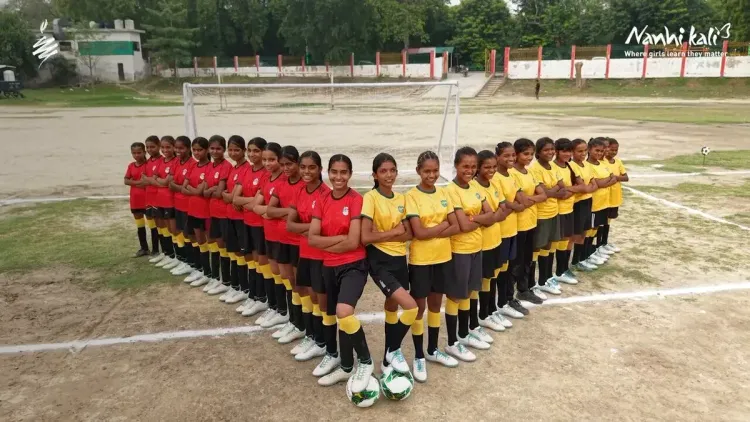
The Toofaan Cup , Nanhi Kali's girls' football tournament, this year features more than 2,350 teams structured around the 32-nation FIFA World Cup format.
The programme employs 'thousand-odd Skill Associates' and an all-women corps of Game Changers and coaches as its operational backbone.
Mahindra credited eight named individuals — including Sheetal Mehta , Rohini Mukherjee , and Manoj Kumar — for shaping the initiative's journey.
The football module is positioned as a life-skills vehicle, teaching confidence, teamwork, and leadership alongside the sport itself.
Mahindra Group chairman Anand Mahindra on Saturday, 11 July 2026, marked nearly three decades of Project Nanhi Kali, saying the girl-child education initiative has grown into a movement that has impacted close to a million underprivileged girls and now uses football to build confidence and leadership skills.
Context
In his post on X, Anand Mahindra recalled founding Project Nanhi Kali roughly thirty years ago with no expectation of the scale it would eventually reach. 'When I started Project Nanhi Kali nearly three decades ago, I never imagined it would become a movement of this scale,' he wrote, crediting an ecosystem of communities, corporates, and individuals for the initiative's growth. The project, launched in 1996, was conceived to provide educational sponsorship and support to girls from low-income families across multiple Indian states.
Mahindra singled out the programme's latest innovation: using football as a vehicle for life-skills development. The Toofaan Cup, an annual girls' football tournament run under the Nanhi Kali umbrella, this year mirrors the structure of the FIFA World Cup, with teams representing all 32 participating nations. Mahindra noted that more than 2,350 girls' teams are competing, and that participants are 'learning far more than football — they're discovering the world.'
Policy Backdrop
Project Nanhi Kali's three-decade arc runs parallel to India's evolving policy landscape on female literacy and gender equity. The initiative gained early momentum in the years following the 1990s economic reforms, which spurred Indian corporations to formalise social responsibility commitments. Over time, national priorities around girl-child education — reflected in successive government schemes targeting school enrolment and retention — created a complementary environment for private-sector programmes to operate at scale.
Indian companies have progressively broadened CSR education efforts beyond basic schooling to include life-skills and sports components. The Toofaan Cup's football-linked curriculum fits squarely within this trend, drawing on research that links structured sports participation among adolescent girls to improved self-esteem, school retention, and community standing. Formal public-private partnerships with bodies such as the Ministry of Youth Affairs and Sports or national sports federations remain a space to watch for further integration.
Stakeholders and Impact
Mahindra offered a specific salute to the human infrastructure behind the programme: 'the thousand-odd Skill Associates and the all-women Game Changers and coaches.' He named several individuals who have shaped the journey — Sheetal Mehta, Swati, Rohini Mukherjee, Lisa Murawsky, Radha Varadarajan, Seema, Devu, and Manoj Kumar — underscoring that the initiative's reach rests on a large, largely women-led operational workforce.
The primary beneficiaries are girls from underprivileged and rural communities who might otherwise lack access to both formal schooling and structured extracurricular activity. By structuring the Toofaan Cup around a globally recognised tournament format, the programme also gives participants a frame of international awareness, exposing them to geography, teamwork dynamics, and a sense of belonging to a wider world.
What's Next
Mahindra's post closes with an aspirational note — 'May this tribe continue to Rise' — signalling an intent to sustain and expand the initiative rather than treat the milestone as a conclusion. The Toofaan Cup's football module, if scaled, could serve as a template for sports-linked life-skills curricula in other state-level girls' education programmes. Observers will watch whether Mahindra Group's CSR apparatus formalises partnerships with national sports bodies or state governments to extend the model beyond its current footprint, potentially deepening its impact on female participation in both education and sport across India.
Point of View
Reportable institution. The Toofaan Cup's FIFA World Cup framing is a deliberate narrative choice: it positions a domestic CSR programme within a global sporting idiom, raising its aspirational ceiling and its media visibility simultaneously. At a moment when India's corporate CSR mandates under the Companies Act are under renewed scrutiny for impact measurement, Mahindra's emphasis on qualitative outcomes — confidence, leadership, 'discovering the world' — reflects a broader industry pivot from input metrics to life-skills claims. The initiative's longevity also sets a benchmark that implicitly challenges peers in Indian industry to move beyond short-cycle, compliance-driven giving.
NationPress
10 Oct 2026
Frequently Asked Questions
What is Project Nanhi Kali?
Project Nanhi Kali is a Mahindra Group CSR initiative launched in 1996 by Anand Mahindra to provide educational sponsorship and support to underprivileged girls from low-income families across multiple Indian states.
What is the Toofaan Cup?
The Toofaan Cup is an annual girls' football tournament organised under Project Nanhi Kali. This year it features over 2,350 teams structured to mirror the 32-nation FIFA World Cup format, using football to teach confidence, teamwork, and leadership.
How many girls has Project Nanhi Kali helped?
Anand Mahindra stated in his 11 July 2026 post that the initiative has impacted close to a million girls, though this figure comes from the programme's own account.
Who are the Game Changers in Project Nanhi Kali?
Game Changers is the name given to the all-women corps of coaches and community workers who form the operational backbone of Project Nanhi Kali's on-ground activities, working alongside 'thousand-odd Skill Associates'.
Why did Anand Mahindra start Project Nanhi Kali?
Anand Mahindra founded Project Nanhi Kali in 1996 to address the educational needs of underprivileged girls in India, aiming to create an ecosystem involving communities, corporates, and individuals committed to changing what it means to be a girl in India.