Nvidia Bets on AI Agents to Rewire Retail Commerce
Synopsis
Nvidia has unveiled its agentic commerce framework, using AI agents to manage retail workflows from product discovery to secure checkout — while letting retailers retain control over pricing and payments. The move targets a major new enterprise vertical for the chip giant.
Key Takeaways
Nvidia announced on August 3, 2026 that it is helping retailers deploy AI agents for end-to-end commerce workflows.
The company calls this model agentic commerce — AI handles discovery, comparison, and checkout autonomously.
Retailers retain control over pricing, payments, and inventory within the Nvidia-powered framework.
Nvidia positions AI as the new primary interface for product discovery , replacing traditional search and browse navigation.
The announcement signals Nvidia's push into retail as a major enterprise AI vertical , beyond its established data-centre and auto segments.
The checkout counter is getting a brain. Nvidia announced on Monday, August 3, 2026 that it is actively helping retailers build AI-powered commerce pipelines — from the moment a shopper discovers a product to the final tap at a secure checkout — positioning artificial intelligence as the new storefront for the modern consumer.
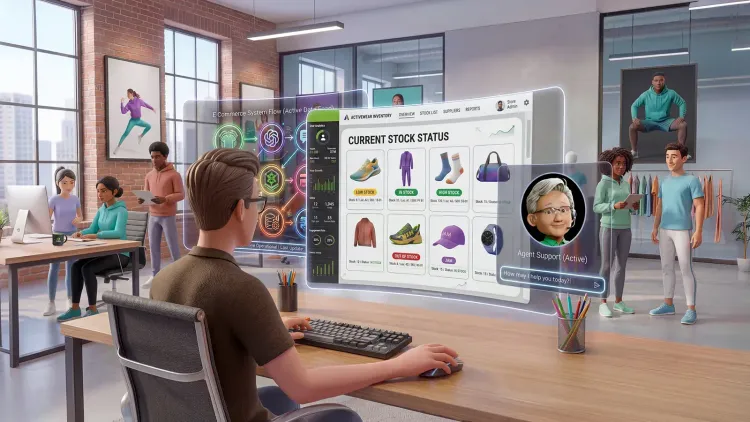
In its post, Nvidia stated: 'AI is becoming a primary interface for product discovery, opening new revenue opportunities for retailers.' The company outlined a framework it calls agentic commerce — a model where AI agents handle end-to-end shopping workflows autonomously, while retailers retain control over pricing, payments, and inventory.
What 'Agentic Commerce' Actually Means for Retailers
Traditional e-commerce puts the burden of navigation on the shopper. Agentic commerce flips that: an AI agent understands intent, searches catalogues, compares options, and initiates transactions — all without the user clicking through multiple pages. Nvidia's pitch is that its GPU infrastructure and AI tooling can power these agents at scale, giving retailers a plug-in path to the next generation of shopping.
Critically, Nvidia frames retailer sovereignty as a selling point. Merchants are not handing over their business logic to a black box — they keep authority over what gets priced, how payments are processed, and what stock levels the agent can see. That guardrail matters enormously in a sector where margin control is existential.
Why This Move Lands Now
Retail has been under pressure from platform giants who own the discovery layer — search, social feeds, marketplace algorithms. An AI agent that a retailer deploys on its own infrastructure changes that power dynamic. Nvidia is essentially offering the picks-and-shovels play: it does not sell products, it sells the AI engine that sells products.
For Indian retailers — from large omnichannel chains to D2C brands racing to reduce dependence on marketplace fees — the promise of owning an AI-native discovery channel is particularly compelling. India's e-commerce market is projected to keep expanding rapidly, and whoever controls the discovery interface controls the conversion funnel.
Nvidia's move signals that the GPU giant sees retail as a major vertical for its enterprise AI push, extending well beyond data centres and autonomous vehicles. The battle for the AI commerce stack has begun — and Nvidia just announced it is in the room.
Point of View
It is now packaging that stack into sector-specific solutions where the ROI story is immediate and measurable. Retail is a smart beachhead — high transaction volume, clear conversion metrics, and a sector desperate to reduce dependence on third-party marketplaces. The retailer-sovereignty angle (control over pricing and payments) is strategically sharp, directly countering the fear that AI platforms become new gatekeepers. If Nvidia can lock in retail clients at the infrastructure layer, it captures recurring compute spend every time an AI agent processes a shopper query — a compounding revenue moat that has nothing to do with selling GPUs directly.
NationPress
18 Sept 2026
Frequently Asked Questions
What is agentic commerce and how does Nvidia fit in?
Agentic commerce refers to AI agents that autonomously handle shopping tasks — from finding products to completing checkout — on behalf of users. Nvidia is providing the AI infrastructure and tooling that powers these agents for retail businesses.
Will retailers lose control of their pricing if they use Nvidia AI?
No. Nvidia has specifically stated that its framework allows retailers to maintain control over pricing, payments, and inventory even as AI agents manage the customer-facing shopping experience.
How does AI change product discovery for shoppers?
Instead of browsing pages manually, shoppers interact with an AI agent that understands their intent, searches the retailer's catalogue, and surfaces relevant products — making discovery faster and more personalised.
Is Nvidia's retail AI relevant for Indian e-commerce?
Yes. Indian retailers and D2C brands looking to reduce marketplace dependency could benefit from owning an AI-native discovery channel, which Nvidia's agentic commerce framework is designed to enable.
What does Nvidia gain from entering the retail AI space?
Every AI agent query a retailer processes runs on compute infrastructure — likely Nvidia GPUs and software. This creates a recurring revenue stream tied to retail transaction volume, expanding Nvidia's enterprise footprint well beyond data centres.