Nvidia Spotlights CUDA-X, Its GPU Software Powerhouse

Synopsis
Nvidia spotlighted CUDA-X, its collection of GPU-accelerated SDKs including cuDNN, TensorRT, and cuBLAS, built on the CUDA platform first launched in 2007. The move underscores how Nvidia's software ecosystem — not just its chips — anchors global AI development.
Key Takeaways
Nvidia posted a direct callout to explore CUDA-X on August 24, 2026 .
CUDA-X is a collection of GPU-accelerated libraries — including cuDNN , TensorRT , and cuBLAS — built on Nvidia's CUDA platform.
Nvidia introduced the CUDA programming model in 2006-2007 , originally to enable general-purpose GPU computing beyond graphics.
The CUDA-X ecosystem serves AI developers , HPC researchers , and data scientists worldwide.
Nvidia's software stack is considered a key competitive moat alongside its data-centre hardware dominance.
Major CUDA-X updates are typically announced at Nvidia's annual GTC conference .
The software stack that quietly powers the world's AI ambitions just got a fresh spotlight. Chip giant Nvidia on Monday, August 24, 2026, directed developers and researchers to explore CUDA-X — its suite of GPU-accelerated libraries that sits at the heart of modern artificial intelligence and high-performance computing.
The post is brief, but the subject it points to is anything but. CUDA-X is Nvidia's curated collection of domain-specific SDKs and libraries — including cuDNN, TensorRT, and cuBLAS — all built on top of the company's foundational CUDA parallel-computing platform. Think of CUDA as the foundation, and CUDA-X as the specialised toolkit floors built on top of it: one for deep learning, one for linear algebra, one for inference optimisation, and so on.
From 2007 Side Project to AI's Backbone
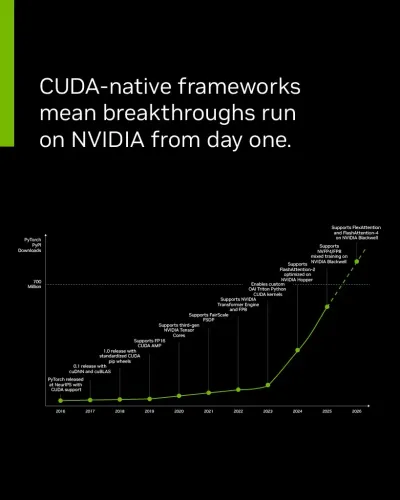
Nvidia first introduced the CUDA programming model in 2006-2007, a move that transformed its graphics processors into general-purpose computing engines. What began as a niche tool for researchers slowly became the default language of AI training. Today, virtually every major large-language model, computer-vision system, and scientific simulation runs on infrastructure that speaks CUDA. CUDA-X extends that dominance deeper into the software layer. By offering pre-optimised, GPU-native libraries for specific workloads — rather than forcing every AI developer to write low-level GPU code from scratch — Nvidia dramatically lowers the barrier to entry while simultaneously raising the switching cost. An AI team that builds its training pipeline around cuDNN and TensorRT is, in practice, deeply anchored to Nvidia's hardware ecosystem.Why This Software Moat Matters as Much as the Chips
Nvidia's hardware lead in data-centre accelerators is well-documented, but the company's real strategic fortress is this software layer. Competitors can design faster chips; replicating a two-decade developer ecosystem is a different order of challenge entirely. AI developers, HPC researchers, and data scientists globally have built workflows, toolchains, and institutional knowledge around CUDA-X — and that inertia compounds with every new model trained and every new SDK released. With major CUDA and CUDA-X library updates typically unveiled at Nvidia's annual GTC conference, the company's cadence of software releases has become as closely watched by the developer community as its chip roadmap. For India's rapidly expanding AI developer base — from IIT labs to Bengaluru-based AI startups — CUDA-X is not a distant American platform. It is the daily toolkit. Every time Nvidia nudges its developer community toward a deeper look at CUDA-X, it is reinforcing the gravitational pull of an ecosystem that has no obvious substitute on the horizon.Point of View
Not just silicon. By continuously surfacing its library ecosystem, Nvidia reinforces developer dependency that compounds over time — every trained model and optimised inference pipeline deepens the moat. For rivals trying to close the hardware gap, the CUDA ecosystem represents a two-decade head start that no single chip announcement can erase. India's AI developer community, growing fast, is increasingly part of this global dependency chain.
NationPress
9 Oct 2026
Frequently Asked Questions
What is Nvidia CUDA-X?
CUDA-X is Nvidia's branded collection of GPU-accelerated libraries and SDKs — such as cuDNN, TensorRT, and cuBLAS — built on top of the CUDA parallel-computing platform. It gives AI developers and researchers pre-optimised tools for deep learning, inference, linear algebra, and other compute-heavy workloads.
What is the difference between CUDA and CUDA-X?
CUDA is Nvidia's foundational parallel-computing platform and programming model, first released in 2007. CUDA-X is the layer above it — a suite of domain-specific libraries and SDKs that use CUDA to accelerate specific tasks like AI training (cuDNN), inference (TensorRT), and matrix operations (cuBLAS).
Why is CUDA important for AI development?
CUDA allows software to run directly on Nvidia GPUs, which are far faster than CPUs for the parallel calculations that power AI model training and inference. Virtually all major AI frameworks, including widely used deep-learning platforms, are optimised for CUDA.
How does CUDA-X benefit Indian AI developers and startups?
Indian AI developers and startups using Nvidia GPUs — whether in cloud environments or on-premise — can use CUDA-X libraries to accelerate their models without writing low-level GPU code. This significantly speeds up development cycles for computer vision, natural language processing, and scientific computing projects.
Where are major Nvidia CUDA-X updates announced?
Nvidia typically unveils significant CUDA and CUDA-X library updates at its annual GTC (GPU Technology Conference), which is closely watched by the global AI and high-performance computing community.