Nvidia showcases CUDA-X simulations at GTC Berlin

Synopsis
Nvidia used its GTC Berlin conference to spotlight CUDA-X, the GPU-accelerated software stack that lets scientists and engineers run high-fidelity computer graphics and simulation workloads — turning decades of parallel computing investment into a live demo for the world.
Key Takeaways
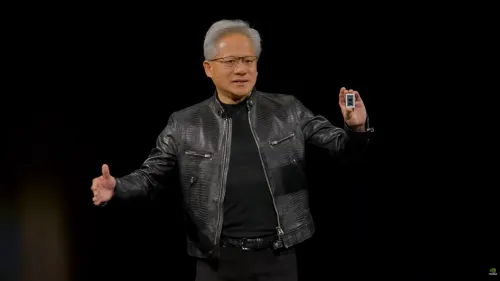
Nvidia posted a simulation and computer-graphics video from NVIDIA GTC Berlin , showcasing real-time GPU-powered scientific visualisation.
CUDA-X is Nvidia's domain-specific software stack extending the base CUDA parallel computing platform, first launched in 2007 .
The stack provides ready-made libraries for scientists and engineers, removing the need to write low-level GPU code for complex simulations.
GTC events serve as Nvidia's primary developer and researcher engagement platform, blending hardware showcases with software ecosystem building.
As cloud GPU instances become more accessible, CUDA-X-based simulation is increasingly available to researchers and startups globally, including in India.
Science meeting spectacle — that is the pitch Nvidia made at NVIDIA GTC Berlin, inviting the world to watch computer graphics and simulation roar to life on hardware most people associate only with video games. The chip giant posted a video from the conference floor, urging viewers to 'sit back and enjoy the show' as CUDA-X rendered the kind of physics-accurate virtual worlds that scientists and engineers use to test ideas before a single prototype is built.
What CUDA-X actually does on a scientist's workstation
CUDA-X is Nvidia's layered software stack built on top of the CUDA parallel computing platform, which the company first introduced in 2007. Where the base CUDA architecture gave developers a way to run general-purpose code on GPUs, CUDA-X adds domain-specific libraries — covering areas like linear algebra, signal processing, deep learning inference, and fluid dynamics simulation — so that a materials scientist or an aerospace engineer does not have to write low-level GPU code from scratch.
The result is that the same chip powering a gamer's frame rate can simultaneously solve partial differential equations for a climate modeller or render a crash-test simulation for an automotive team. That dual identity — consumer and scientific workhorse — has been central to Nvidia's value proposition for nearly two decades.
Why GTC Berlin matters beyond the demo reel
GPU Technology Conference events are Nvidia's primary stage for developer and researcher engagement. The Berlin edition follows the company's established pattern of using GTC to demonstrate tight hardware-software integration, letting the visuals do the persuading before the technical sessions begin. A compelling simulation clip is, in effect, a recruiting poster for the CUDA-X ecosystem — every scientist who watches it is a potential new workload migrating onto Nvidia silicon.
For engineers in India and globally, CUDA-X represents access to a mature, well-documented stack that can compress months of physical prototyping into days of GPU-accelerated virtual testing. As compute costs fall and cloud-based GPU instances proliferate, the barrier to entry for high-fidelity simulation keeps dropping.
The show Nvidia is putting on in Berlin is not just a demo — it is a statement about where the next decade of scientific computing lives.
Point of View
Nvidia ensures that workloads follow the platform even as rival accelerators enter the market. The simulation demo is less a product announcement and more a loyalty signal to the developer community. In a world where every hyperscaler is building custom AI silicon, Nvidia's deepest moat may well be its two-decade head start in software, not transistors.
NationPress
31 Oct 2026
Frequently Asked Questions
What is Nvidia CUDA-X?
CUDA-X is Nvidia's collection of GPU-accelerated software libraries built on top of the CUDA parallel computing platform, designed to speed up scientific simulation, deep learning, signal processing, and other high-performance computing tasks for scientists and engineers.
When did Nvidia launch the CUDA platform?
Nvidia introduced the CUDA parallel computing platform in 2007 , enabling developers to run general-purpose workloads on GPUs beyond traditional graphics rendering.
What is NVIDIA GTC Berlin?
NVIDIA GTC Berlin is an edition of Nvidia's GPU Technology Conference held in Berlin, serving as a venue for the company to showcase hardware and software advances to developers, researchers, and engineers worldwide.
How does CUDA-X help scientists and engineers?
CUDA-X provides domain-specific libraries that let scientists and engineers run high-fidelity simulations and graphics workloads on Nvidia GPUs without writing low-level code, dramatically accelerating research and prototyping timelines.
Can Indian researchers use Nvidia CUDA-X?
Yes. CUDA-X is freely accessible through Nvidia's developer platform and runs on cloud-based GPU instances, making it available to researchers, startups, and academic institutions in India and globally.